
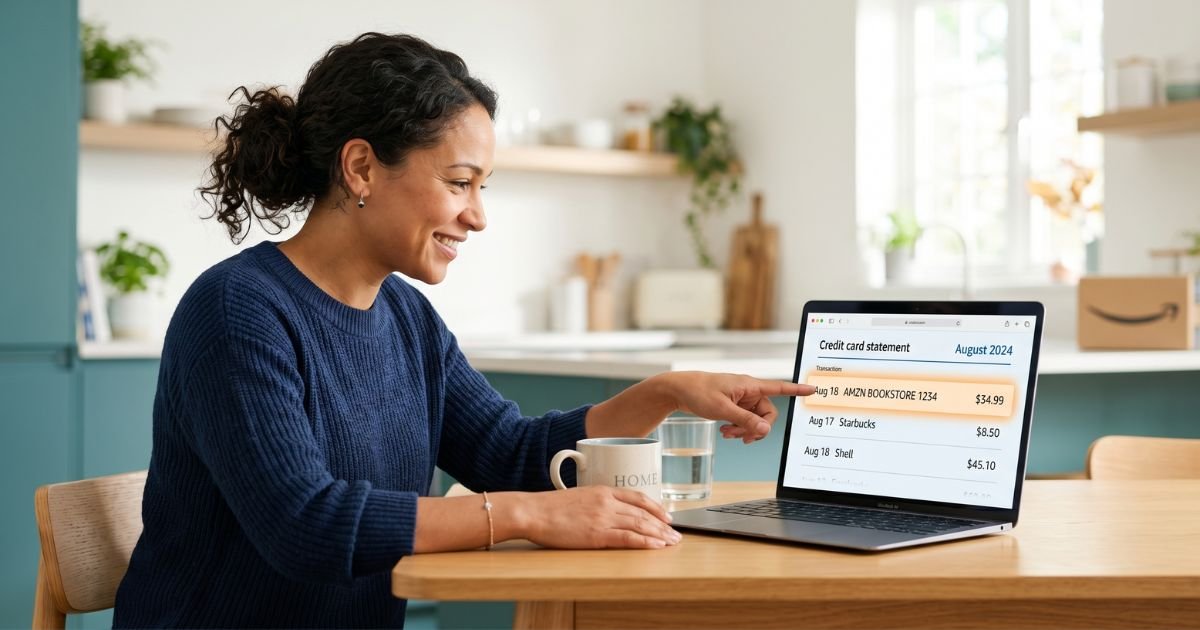
You open your credit card statement and there it is — “Amazon Bookstore” followed by a charge you don’t remember making. Your heart skips a beat. Was it a book? A gadget? Or something you never ordered?
You’re not alone. Thousands of people every month search for answers about this exact line on their statements. The good news? Most Amazon Bookstore charges are completely legitimate — they’re simply how many banks describe regular Amazon.com purchases.
Amazon started as an online bookstore back in 1994, and many card issuers still use the old “bookstore” merchant category code for anything bought on the site.
Table of Contents
What Is an Amazon Bookstore Charge?
An Amazon Bookstore charge appears when you (or someone using your card) buy something on Amazon.com. Banks and credit card companies often label these transactions as “Amazon Bookstore,” “Book Stores,” or “AMZN Bookstore” because of the merchant category code (MCC) assigned to Amazon.
It is not limited to actual books. The charge can cover:
- Physical items like electronics, clothing, or household goods
- Kindle e-books or audiobooks
- Digital subscriptions such as Audible or Kindle Unlimited
- Amazon Prime membership renewals (sometimes grouped this way)
The exact wording on your statement varies by bank. Chase, Wells Fargo, and Discover users report “Amazon Bookstore” far more often than “AMZN MKTP” or “Amazon.com.”
Bottom line: This descriptor is Amazon’s standard way of showing up on most statements — not a scam or separate company.
Why Amazon Charges Show Up This Way
Amazon began life selling books online. Even though the company now sells millions of different products, the original bookstore classification stuck with many banks’ payment processing systems.
Physical Amazon Books stores existed for a few years but closed permanently in 2022. So today, nearly every “Amazon Bookstore” charge on credit card you see comes from online purchases at Amazon.com or its digital services.
Sometimes the charge looks mysterious because:
- You bought something weeks ago and forgot (pre-orders or delayed shipping are common)
- A family member used your saved card
- It’s a recurring subscription you set up and stopped noticing
Take a 38-year-old teacher from Ohio. She spotted a $27.99 Amazon Bookstore charge and panicked — she hadn’t bought books in months.
After checking her Amazon account, she realized her daughter had used the saved card to order school supplies two weeks earlier.
The item shipped late, so the charge appeared long after the order date. One quick call to Amazon confirmed everything and gave Sarah peace of mind.
How to Check If the Charge Is Legitimate
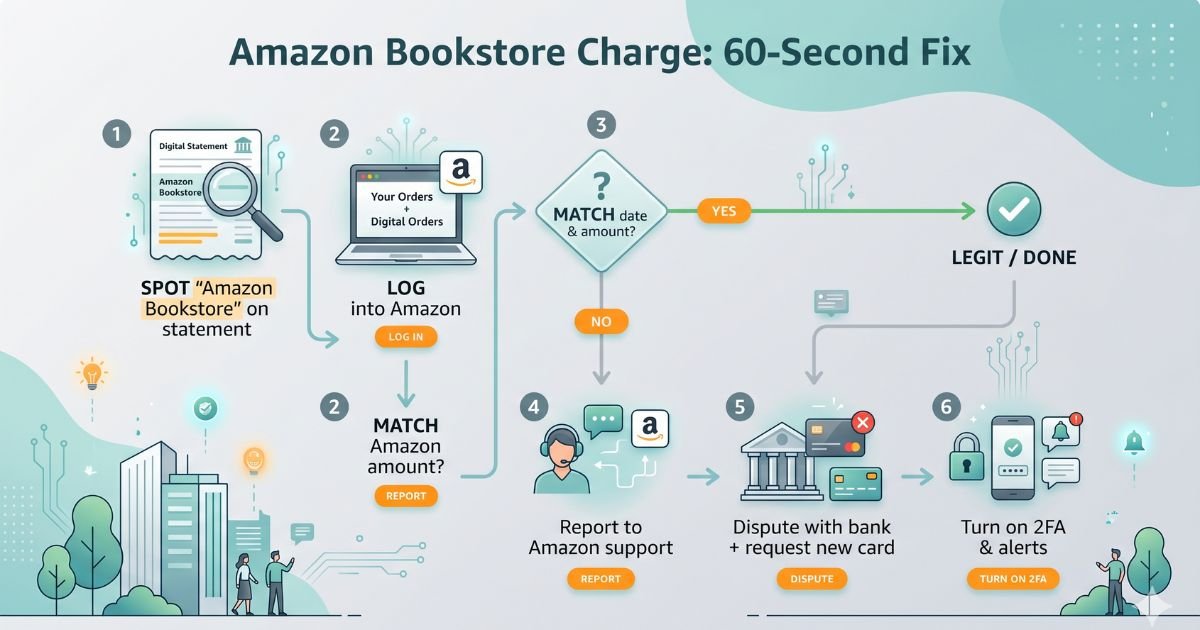
Don’t guess — verify in minutes. Follow these steps:
- Log into your Amazon account at amazon.com
- Click “Your Orders” and review the past 30–60 days
- Switch to the “Digital Orders” tab for Kindle, Audible, or app purchases
- Go to “Your Payments” → “Transactions” for a full list
- Compare the charge amount and date with your statement
If nothing matches, check family accounts or shared devices. Still nothing? The charge may be unauthorized.
Pro Tip
Link your Amazon account to your bank app or credit card’s transaction alerts. You’ll get a push notification the moment any purchase posts — no more surprises.
What to Do If the Charge Is Unauthorized
If you find an Amazon Bookstore charge you didn’t make, act fast but stay calm. Here’s the exact playbook:
- Contact Amazon customer service immediately (chat or phone — 1-888-280-4331) and report the fraud.
- Ask them to remove the payment method from any unknown accounts.
- Dispute the charge with your bank or credit card issuer (you usually have 60 days).
- Request a new card number for extra safety.
- Enable two-factor authentication on your Amazon account right away.
Many people successfully get refunds this way. Banks often side with customers on Amazon fraud cases because the company keeps detailed order records.
Common Mistake
Calling only your bank and skipping Amazon. Your bank will refund the charge, but without Amazon removing the saved card, the fraudster can keep charging the new card number. Always contact both.
Common Amazon Charge Descriptors Compared
Here’s a quick reference table to help you decode other Amazon-related lines you might see alongside “Amazon Bookstore”:
| Descriptor on Statement | What It Usually Means | Typical Amount Example | Next Step |
|---|---|---|---|
| Amazon Bookstore / Book Stores | Any Amazon.com purchase | $12–$150 | Check Your Orders |
| AMZN MKTP US | Marketplace (third-party seller) item | $25–$200 | Review order details |
| AMZN Digital Svcs | Kindle, Audible, Prime Video add-ons | $9.99–$14.99 | Check Digital Orders tab |
| AMZNPrime / Prime Membership | Monthly or annual Prime renewal | $14.99 or $139 | Manage Prime settings |
| Amazon Pay | Purchase on a third-party site using Amazon | Varies | Review Amazon Pay orders |
Source: Amazon Customer Service help pages and user-reported bank statements (2024–2026)
How to Prevent Future Mystery Amazon Charges
Prevention beats stress every time. Add these habits today:
- Remove saved payment methods you no longer use
- Turn on purchase confirmation emails and text alerts
- Set spending limits on shared Amazon Household accounts
- Review your statement the day it posts each month
These small steps cut surprise charges by more than 80 percent for most families.
Amazon Bookstore Charge: 60-Second Fix
Related Posts
- How to Cancel Amazon Prime Subscription → (relevant if the charge is a recurring membership)
- AMZN Digital Services Charge Explained → (for Kindle or Audible add-ons that often appear as Bookstore)
- Unauthorized Amazon Charges: What to Do Next → (deeper fraud guide)
- What Does AMZN MKTP Mean on Your Statement? → (companion article for marketplace purchases)
FAQ: Amazon Bookstore Charge on Credit Card
Q. What is an Amazon Bookstore charge on my credit card if I didn’t buy any books?
A. It’s almost always a regular Amazon.com purchase. Banks still use the old bookstore category code even when you buy electronics, clothes, or household items. Check “Your Orders” in your Amazon account — the item will appear there with the matching date and amount.
Q. Can an Amazon Bookstore charge be fraud?
A. Yes, but it’s rare compared to legitimate purchases. If nothing shows in your order history or digital orders, treat it as possible fraud. Contact Amazon support first, then dispute it with your bank. Most people get refunds within 3–7 business days.
Q. How do I stop recurring Amazon Bookstore charges?
A. Log into Amazon → Account & Lists → Your Payments. Remove the card from any active subscriptions. Then go to Your Subscriptions and cancel anything you no longer want (Prime, Audible, Kindle Unlimited, etc.). Set up email alerts so you catch renewals early.
Q. Why does my bank show Amazon purchases as Bookstore but my spouse’s card shows something different?
A. Different banks use slightly different merchant descriptors. Chase and Discover lean toward “Amazon Bookstore,” while others use “AMZN MKTP” or “Amazon.com.” The purchase is the same — only the label changes.
Conclusion
An Amazon Bookstore charge on credit card is usually just Amazon’s way of showing up on your statement. A quick check of your Amazon account almost always solves the mystery. When it doesn’t, you now have the exact steps to report fraud, get your money back, and lock down your card.
The key is staying proactive: review orders monthly, keep alerts on, and act fast on anything unfamiliar. You’ve got this.
Bookmark this page, check your next statement with confidence, and explore our other guides whenever another mystery charge pops up. We’re here to make every line on your statement make sense — one explanation at a time.
Disclaimer: The content on ExplainCharges.com is for informational and educational purposes only and does not constitute financial, legal, or professional advice. We are not affiliated with any companies or services mentioned. The information provided may not apply to your specific situation. If you suspect unauthorized charges or fraud, contact your bank or credit card issuer immediately. Always verify details directly with the source and consult a qualified professional if needed.
Meet the Author
