
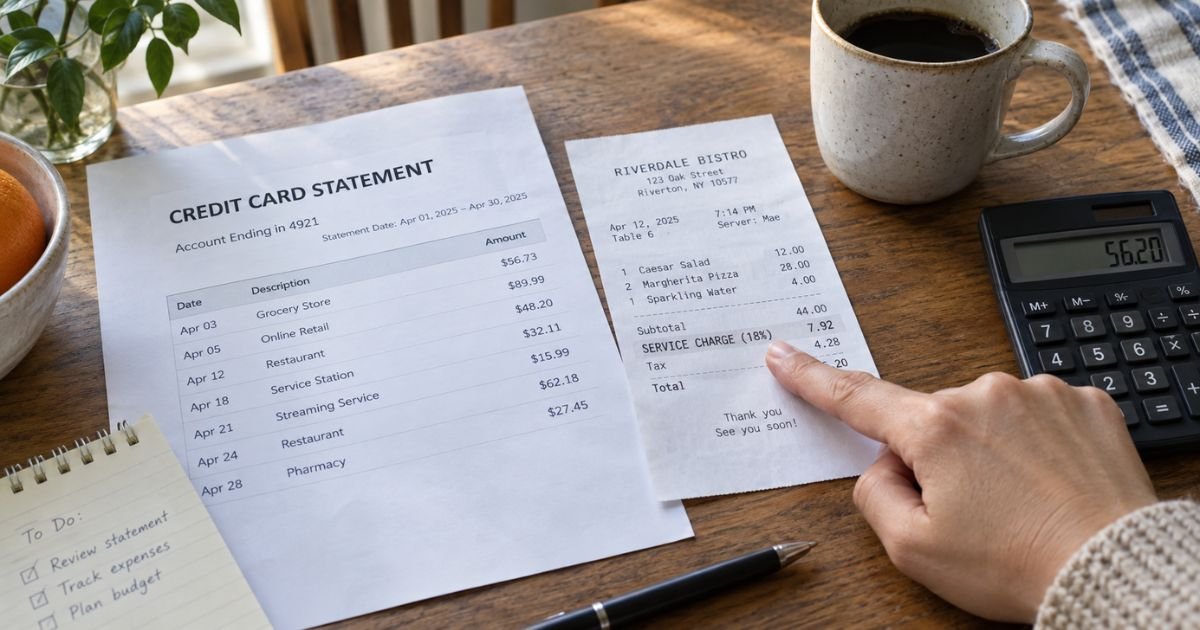
A service charge definition can feel confusing if you see the same words on a dinner bill, a bank statement, and a credit card.
The phrase is not one single fee. It is a label businesses use for extra money they add on top of a purchase or account.
This guide explains the common meanings, how official rules treat them, and what to do when the line shows up on a card.
Table of Contents
What Is the Service Charge Definition?
A service charge is generally a fee a business, bank, or card issuer adds for handling an account, a payment, or a service.
The words do not have one locked meaning in everyday billing. A restaurant may add an automatic percentage for a large table. A bank may bill a monthly checking fee. A merchant may add a card-processing extra. Your issuer may list a periodic account fee. All of those lines can say “service charge.”
Official rules treat those extras differently. The IRS treats a required restaurant add-on as wages-style income, not a tip.
Regulation Z treats some creditor “service, transaction, activity, and carrying charges” as part of the finance charge. The OCC says banks may charge deposit-account service fees when they disclose them.
Read the rest of the line. The merchant name, city, and amount usually tell you which definition applies.
| Where you see it | What it typically is | Who usually sets it |
|---|---|---|
| Restaurant or hotel bill | Auto-gratuity, banquet fee, room service add-on | The business |
| Bank or credit union statement | Monthly maintenance or account activity fee | The bank |
| Credit card statement | Issuer fee, merchant add-on, or a labeled restaurant extra | Issuer or merchant |
| Utility, school, or government pay portal | Convenience or service fee for paying by card | The biller or processor |
| Nightclub or bottle service | Required add-on on the check | The venue |
Pro Tip: Match the date and amount to a receipt first. “Service charge” on a card is often the restaurant or hotel add-on, not a new mystery company.
Restaurant service charge vs. tip
The IRS draws a bright line. A tip is a voluntary extra you choose. A service charge is an amount the business requires.
Official IRS guidance says a payment is a tip only if all of these are true:
- You pay it free from compulsion.
- You set the amount.
- The employer does not dictate the amount.
- You generally decide who receives it.
If any factor is missing, the payment may be a service charge. The IRS also says the label on the receipt does not control. Calling an 18% auto-add a “gratuity” does not make it a tip.
Official IRS examples of service charges include a large-party automatic gratuity, a banquet event fee, a cruise package fee, a hotel room service charge, and bottle service.
When the restaurant later pays that money to staff, the IRS generally treats the distributed amount as non-tip wages. The service charge is income to the employer first, even if some of it later goes to servers.
That matters at the table. You can usually still add a voluntary tip on top. Only the extra amount you choose is a tip under the IRS test.
Bank service charge definition
On a checking or savings statement, a service charge is typically an account fee. Banks also call it a monthly service fee, maintenance fee, or activity fee.
The OCC’s HelpWithMyBank site says federal law allows banks to charge non-interest fees, including deposit account service charges. It also says banks must disclose certain fees when you open the account. Read the account agreement for the amount and any waiver rules.
Many banks waive a monthly fee if you keep a minimum balance or set up direct deposit. Those waiver rules vary by bank. They are not a federal price cap.
A bank service charge is not the same as an overdraft fee or an ATM surcharge. Those have their own names. If the statement only says “service charge,” open the transaction detail or the fee schedule.
Credit card and Regulation Z meaning
On a credit card, “service charge” can mean several different things.
Regulation Z, at 12 CFR 1026.4, defines the finance charge as the dollar cost of consumer credit. That definition includes “service, transaction, activity, and carrying charges” in many cases, except where the rule excludes them.
Interest is the most common finance charge on a card. A service-style fee tied to the credit plan can sit in that same bucket.
The same rule generally excludes charges of a type you would pay in a comparable cash deal.
It also excludes certain application fees charged to all applicants, and charges for actual late payment, going over a limit, or similar default events.
So a late fee is usually a penalty fee, not the same thing as the finance charge, even if a statement uses loose wording.
Your card agreement lists the issuer’s own fees. Those may include an annual fee, a balance transfer fee, a cash advance fee, or a foreign transaction fee. Some issuers still use “service charge” as a catchall. The agreement, not the three-word label, controls.
A merchant can also send a restaurant or hotel service charge through as part of the sale. That posts as a purchase, often under the restaurant name, with the extra baked into the total or shown as a second line.
Surcharge, convenience fee, and service fee
Merchants sometimes add a fee when you pay by card. People call all of them a service charge. Card networks and states treat them as different tools.
A surcharge is an extra percentage for paying with credit. Network rules generally bar a surcharge on debit or prepaid cards. Some states restrict or ban credit surcharges. Where allowed, the merchant generally must disclose it and keep it within network caps tied to the cost of acceptance.
A convenience fee is typically for a nonstandard payment channel, such as paying by phone when the usual method is mail or a counter. A service fee, in card-network language, is often used by eligible government, education, or utility billers.
These extras should appear before you finish the sale. If a checkout only revealed the fee after the card was charged, that can be a billing issue to raise with the merchant and, if needed, your issuer.
How a service charge shows up on a statement
Banks shorten text. You may see SERVICE CHARGE, SVC CHG, SERV CHARGE, or SC next to a merchant or bank name.
A restaurant extra may not say “service charge” on the card at all. It may sit inside one larger TIPS or restaurant total. Ask for the itemized receipt.
A bank fee often posts on the statement cycle date, not the day you used the card. An issuer fee may appear as a separate transaction from purchases.
Pending lines can change. A restaurant authorization may start as the food total, then post higher after the service charge and any voluntary tip.
What to do if you do not recognize the charge
- Copy the exact wording, date, amount, and last four card digits.
- Match the amount to a dinner check, hotel folio, utility confirmation, or bank fee schedule.
- Ask household members who used the card that day.
- Open the issuer app for the fuller merchant name and category.
- Call the merchant or bank on the receipt if you recognize the visit but not the extra.
If the extra is a restaurant service charge you agreed to by dining under posted house rules, it is generally part of the sale. If nobody authorized the underlying purchase, treat the whole line as unauthorized.
For a U.S. credit card billing error, send written notice so it arrives within 60 days after the issuer sent the first statement that shows the problem. Use the billing-inquiry address on the statement.
The issuer generally must acknowledge a timely written notice within 30 days unless it already finished the case, and resolve it within two billing cycles, not later than 90 days.
Federal rules generally cap unauthorized credit card use at $50. Many issuers advertise $0 liability when you report promptly. Pay the undisputed rest of the bill.
Common Mistakes: Assuming every “service charge” is a tip you can remove. Paying a random “refund fee” to clear a bank line. Missing the 60-day written dispute window while waiting on a restaurant manager.
FAQs: Service Charge Definition
Q. Is a service charge the same as a tip?
A. No. Official IRS guidance treats a required add-on as a service charge, not a tip. A tip is voluntary, and you set the amount. An automatic 18% for a large party is generally a service charge even if the check says gratuity.
Q. Is a service charge the same as a finance charge on a credit card?
A. Not always. Regulation Z defines the finance charge as the dollar cost of credit and includes some service and carrying charges. Interest is the usual finance charge. A restaurant add-on on the same statement is usually a purchase, not interest.
Q. Can my bank legally charge a service charge?
A. Often yes, if the fee is in your account agreement. The OCC says federal law allows deposit-account service charges and that banks must disclose certain fees. Compare the posted amount with the fee schedule. Shop another account if the fee is too high.
Q. How long do I have to dispute a service charge on a credit card?
A. For many billing errors, send written notice so the issuer receives it within 60 days after it sent the statement that first listed the charge. The issuer generally has 30 days to acknowledge and 90 days to finish. Report debit problems faster.
Conclusion
The service charge definition depends on who billed you. It can be a bank account fee, a credit-plan cost under Regulation Z, a merchant card extra, or a restaurant auto-add that the IRS does not treat as a tip.
Read the merchant name and the receipt, not just the three words. If the line still does not match anything you authorized, use the issuer’s written dispute path.
Disclaimer: This article is for general information only. It is not financial, legal, or tax advice. Card agreements, merchant descriptors, and refund rules vary by issuer and company. Confirm account-specific questions with the biller on your receipt or with the phone number on the back of your card.
Meet the Author
