
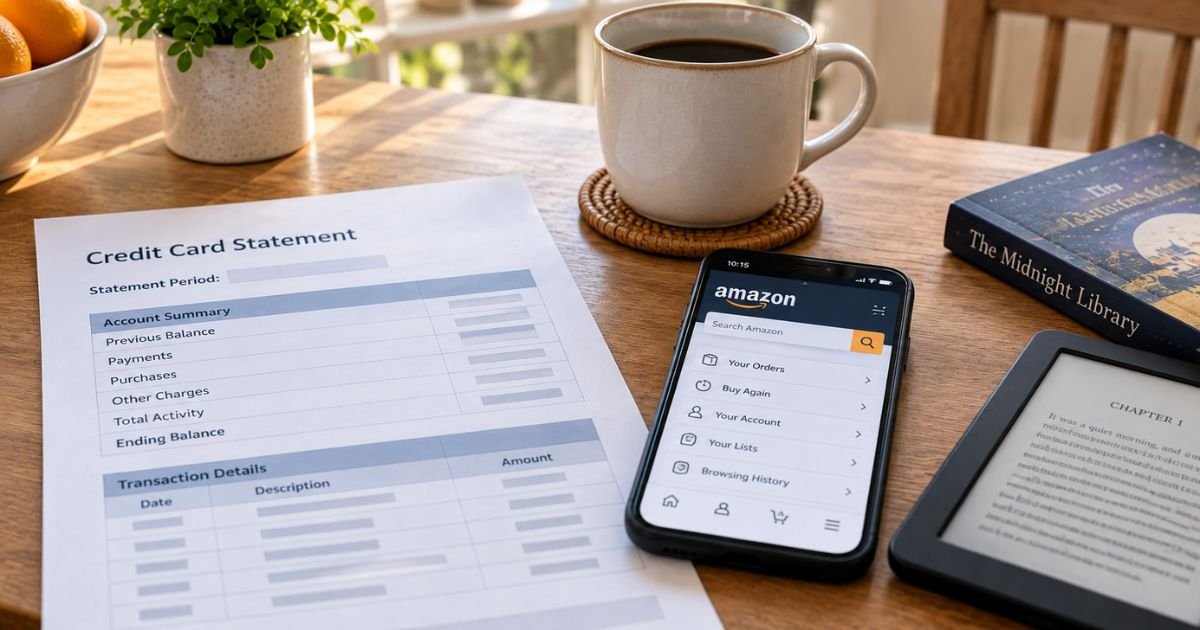
A Kindle Unlimited charge on bank statement can feel confusing if you don’t recall signing up for anything. In many cases it is a real Amazon reading membership, not a random store.
This guide shows what the line usually means, how to match it in your Amazon account, and how to cancel or pause it.
Table of Contents
What Is a Kindle Unlimited Charge on Credit Card Statement?
A Kindle Unlimited charge on bank statement is typically Amazon’s paid reading membership.
Official Amazon help describes Kindle Unlimited as a plan that lets you read from a large catalog of titles, plus thousands of audiobooks and magazine subscriptions.
Amazon’s current U.S. help page lists the price as $11.99 USD per month plus any applicable taxes, until you cancel.
You do not need a Kindle e-reader for this bill to appear. The Kindle app on a phone, tablet, or computer can start the same membership.
Amazon also says digital services such as Kindle Unlimited are billed monthly. You can review those charges in Your Digital Orders and Your Transactions.
The statement text is often short. Banks trim merchant names to fit one line. That is why you may see “KINDLE UNLTD” instead of the full plan name.
How a Kindle Unlimited charge shows up on a bank statement
Issuers format Amazon text in different ways. You may see a Washington state tag, a phone-looking number, or a short code after an asterisk.
That code is generally Amazon’s reference, not a support number you should call from a search ad.
| Statement wording you may see | What it often means |
|---|---|
| KINDLE UNLIMITED or KINDLE UNLTD* plus a code | Typically the monthly Kindle Unlimited membership |
| KINDLE UNLIMITE or similar cut-off text | Same plan, with the bank shortening the name |
| AMAZON DIGITAL SVCS or AMZN DIGITAL | Broader Amazon digital billing, which can include Kindle |
| KINDLE SVCS or KINDLE SVCS* plus a code | More often a Kindle book, magazine, or other Kindle service, not always Unlimited |
| AMZN.COM/BILL or Amazon Digital Svcs with WA | Amazon digital billing routed through Amazon’s usual statement labels |
Amazon’s official “Identify an Amazon Charge” table lists “Amazon Digital Svcs” and “amzn.com/bill” for digital items such as Kindle books.
The same official page says Kindle Unlimited is a digital service billed monthly. Consumer reports also show lines like KINDLE UNLTD* followed by letters and numbers.
The dollar amount may not be a clean $11.99. Sales tax can raise the posted total. A promo month, a trial conversion, or an older $9.99 rate can also change what you see.
Match the date and amount in Amazon before you assume the line is wrong.
Why you might see this charge
The most common reason is auto-renew. Kindle Unlimited Terms of Use say the membership continues unless you cancel before the next charge. Amazon then collects the current fee and any taxes on a payment method on file.
Other typical reasons include:
- A free trial or device bundle that converted to a paid month
- A “Read for Free with Kindle Unlimited” click that started a trial
- A family member using a saved card on a shared Amazon account
- Amazon Family payment sharing, which can put digital bills on a household card
- A prepaid, gift, or bundle plan that later posts as one membership charge
- A card authorization while Amazon confirms the payment method
Amazon help notes that an authorization can appear on your statement and is not always a final charge. If a small hold drops off and a later charge posts, that pattern is common with stored-card billing.
Prime Reading is a different product. It is generally a reading benefit inside Amazon Prime. Kindle Unlimited is a separate membership and can bill even if you already pay for Prime.
How to confirm the charge in your Amazon account
Start inside Amazon, not with a random phone number on the statement.
- Sign in at Amazon.com with the account tied to the card.
- Open Your Transactions and match the date and amount.
- Open Your Orders and switch to Digital orders.
- Open Memberships & Subscriptions and look for Kindle Unlimited.
- Open Kindle Unlimited Central (amazon.com/kucentral) to see membership status.
- Search email for “Kindle Unlimited,” “Welcome,” or “ordered from Amazon.com” near that date.
- Ask anyone who shares the Amazon login, Amazon Family, or the saved card.
If the membership is on a different Amazon login, the charge can still hit a card saved on that other account. That happens in households more often than people expect.
Pro Tip: Compare the statement date with Amazon’s renewal date, not only the posted bank date. Banks can take an extra day or two to show the charge.
How to cancel or pause Kindle Unlimited
Amazon’s official cancel page says you manage the plan from Kindle Unlimited Central.
- Go to amazon.com/kucentral and sign in.
- Under Your Membership, select Cancel membership.
- Follow the on-screen steps until Amazon confirms the cancel.
You can also start from Account & Lists, then Memberships & Subscriptions, then Kindle Unlimited settings. Official help says the membership stays active until the next billing date. After that date, you lose access to titles you have checked out.
Amazon also offers a pause option on monthly plans. Official help says you can pause for one month instead of canceling.
The pause starts at the end of the current billing cycle. The plan then resumes on its own unless you resume it sooner. You generally cannot pause during a free trial or promotional period.
If you signed up through a third party, Amazon’s terms say you may need to cancel with that third party. Gift and bundle plans follow the prepaid rules on Amazon’s cancel page.
After you cancel, watch one more statement cycle. Auto-renew should stop if you canceled before the renewal date. If another charge posts, save the Amazon confirmation and contact Amazon from amazon.com/contact-us.
Refunds, trials, and what Amazon’s terms actually say
Kindle Unlimited Terms of Use say membership fees may include tax and are non-refundable except as those terms allow. If you cancel, Amazon says you will not receive a refund of fees already paid.
You keep access until the end of the paid period. If you cancel before renewal, Amazon says you will not be charged for the next period.
Amazon’s cancel help also says you will not get a partial refund for unused months on a prepaid gift or bundle membership. That is different from a regular month-to-month plan.
Customer service sometimes issues a courtesy credit. That is not a promised right in the public terms. Do not count on a full refund after several paid months.
A Kindle book you bought outright is not the same as Kindle Unlimited. Amazon’s Kindle book return help generally allows an accidental book return within seven days, with limits if the book was partly read or if the account has many returns.
Returning a borrowed Unlimited title only frees a loan slot. It does not cancel the membership.
If you do not recognize the charge
Work the account first. Then decide whether you need Amazon support or your bank.
- Confirm no other Amazon login uses the same card.
- Check Amazon Family and household profiles.
- Look for a Kindle device bundle that included months of Unlimited.
- Compare KINDLE SVCS lines with Digital Orders. Those are often single books.
- If nothing matches, contact Amazon through amazon.com/contact-us and give the statement date, amount, and any reference code.
- If the charge is unauthorized, tell your card issuer promptly. Federal billing-error rules generally give you 60 days from the statement date to send a written dispute.
A lookalike line is not always Unlimited. KINDLE SVCS often points to a book or magazine. Amazon Digital Svcs can cover apps, downloads, or other digital items.
Audible and Prime have their own membership labels. Match the record before you cancel the wrong plan.
Common Mistakes: Calling a number printed beside the charge without checking Amazon first. Disputing the card before you search Digital Orders. Canceling Prime when the line is Kindle Unlimited. Assuming one refund covers every past month. Forgetting that a paused plan can start billing again.
FAQs: Kindle Unlimited Charge on Bank Statement
Q. Is a Kindle Unlimited charge on credit card always $11.99?
A. Not always. Amazon’s U.S. help lists $11.99 per month plus tax until you cancel. Tax, a promo price, an older rate, or a prepaid bundle can change the amount on your statement. Match the posted total to Your Transactions.
Q. Why does my statement say KINDLE UNLTD or KINDLE SVCS instead of Kindle Unlimited?
A. Banks shorten merchant text. KINDLE UNLTD plus a code usually points to the membership. KINDLE SVCS more often points to a Kindle book or another Kindle service. Open Digital Orders and Memberships & Subscriptions to see which one you have.
Q. Do I get my money back if I cancel after the charge posts?
A. Official terms generally say you do not get a refund of fees already paid. You typically keep access until the period ends, and future renewals should stop. Prepaid gift or bundle months generally do not get a partial unused-month refund. Ask Amazon about your own account if the charge looks wrong.
Q. Can a family member cause a Kindle Unlimited charge on my card?
A. Yes. Anyone with the Amazon password, a saved card, or Amazon Family payment sharing may start or keep the plan. Only the primary Kindle Unlimited account holder can start borrows to share, per Amazon’s family-sharing help. Check every login that can use the card.
Conclusion
A Kindle Unlimited charge on credit card statement is usually Amazon collecting the monthly reading membership, often shown as KINDLE UNLIMITED, KINDLE UNLTD, or a related digital label.
Confirm it in Your Transactions, Digital Orders, and Kindle Unlimited Central. Cancel at amazon.com/kucentral before the next billing date if you do not want another month.
If the line still does not match any Amazon record, contact Amazon and then your bank.
Disclaimer: This article is for general information only. It is not financial, legal, or tax advice. Amazon policies, statement wording, prices, taxes, and issuer dispute rules can change and may vary by account. Verify membership status, refunds, and unauthorized charges with Amazon or your bank.
Meet the Author
