
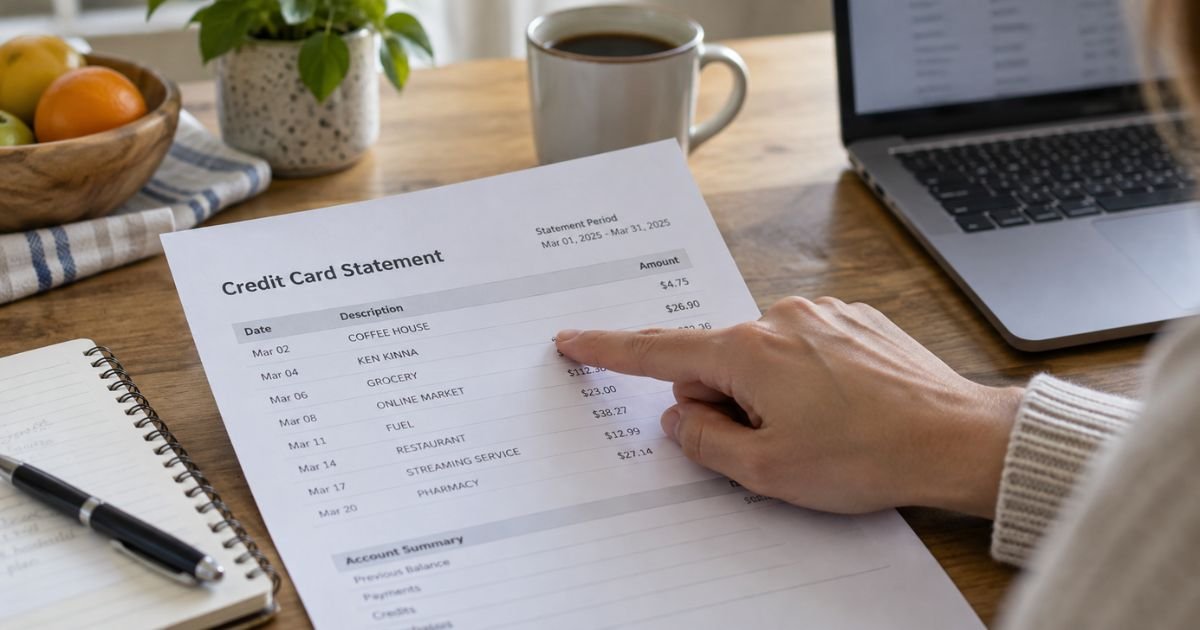
A Ken Kinna credit card charge can feel confusing if you don’t recall signing up for anything. An unfamiliar name is often a shortened billing label, not instant proof of fraud.
This guide explains what that line usually is, which lookalikes people mix it up with, and how to match, stop, or dispute it.
Table of Contents
What Is a Ken Kinna Credit Card Charge?
A Ken Kinna credit card charge is a statement line that uses some form of “Ken Kinna,” “KEN KINNA,” or “KENKINNA.”
No major U.S. retailer, bank, or card network publishes an official glossary that maps that exact phrase to one consumer brand.
Public company pages, BBB profiles, and consumer complaint boards do not show a confirmed national merchant that bills only under that name.
Banks also shorten merchant text. Card networks generally give merchants a short descriptor field, often around 22 characters.
A legal name, DBA, processor tag, or city can get cut off. That is why a line can look like a person’s name even when it is a store, a website, or a billing company.
Treat “Ken Kinna” as a label to decode, not as a proven company. Match the date, amount, and extra text first. Then compare that package to receipts, emails, and household card use.
| Statement clue | What it may tell you |
|---|---|
| KEN KINNA, Ken Kinna, or KENKINNA | The short name the processor sent. Not a confirmed brand by itself. |
| KEEN, KEEN INC, or KEEN plus a city | Often discussed as KEEN footwear, not “Kinna.” |
| INGENIO KEEN.COM or KEEN.COM | Official Keen.com help lists Ingenio Keen.com for cards. |
| KINUM or a Virginia Beach VA tag | Often discussed as Kinum collections, a different company. |
| City, state, or a 10-digit string | Usually the merchant’s registered billing location or a reference, not a support number from a search ad. |
| PENDING or PRE-AUTH | Typically a hold that may drop or post later. |
Pro Tip: Copy the line exactly as your issuer shows it, including spaces and any city. Search that full string in your email and in the card app before you call a number from a random web result.
How a Ken Kinna charge may show up
Issuers format the same sale in different ways. You may see a pending hold first, then a posted purchase a few days later.
The line may also include POS, CHECKCARD, PURCHASE, or a state abbreviation. Those words generally describe how the payment ran. They do not prove who sold you something.
A small first amount can be a card check. Hotels, gas pumps, and some websites place a short authorization to confirm the card works. That hold typically falls off if no sale posts. Timing varies by issuer.
A posted amount that repeats on a cycle can be a subscription or a stored-card renewal. One standalone amount is more often a one-time sale, a tip catch-up, or a test charge. Look at your last two or three statements before you decide.
Common lookalikes, not confirmed matches
These names look close. None of them is an official match for “Ken Kinna” unless your own receipt or issuer confirms it.
KEEN footwear
KEEN, Inc. sells outdoor shoes and related gear at keenfootwear.com. Charge-lookup pages often map a plain “KEEN” or “KEEN INC” line, sometimes with a California tag, to that brand.
KEEN’s public help describes orders, returns, and a 30-day try-on offer on its own site. It does not publish “Ken Kinna” as its billing name.
Keen.com advice sessions
Keen.com is a live-advice marketplace powered by Ingenio. Official Keen help says credit card charges appear as billed by “INGENIO KEEN.COM.” PayPal charges appear as billed by “Keen.”
Official help also lists 1-800-ASK-KEEN (1-800-275-5336) to check a balance or add funds. That wording is close to “Ken,” not a verified “Kinna” descriptor.
Kinum, Inc
Kinum is a Virginia Beach, Virginia collections firm at kinum.com. Public materials list 888-471-0280 for client services. People more often see Kinum on a credit report or a collection letter than as “Ken Kinna” on a card. Do not pay a collector from a cold call until you confirm the debt in writing.
A local person or small shop
Public records also show individuals named Ken Kinna or Kenneth Kinna, including a Massachusetts filmmaker. A tiny local sale can bill under an owner name. That is possible. It is not a documented national pattern.
A truncated longer name
“Ken Kinna” may be the first words of a longer DBA that your bank cut off. Ask your issuer for the full merchant name, city, and merchant category before you assume fraud.
Evidence for every lookalike above is limited for this exact spelling. Your date, dollar amount, and extra statement text matter more than a web guess.
What to do first if you see the charge
Start with your own records. You are looking for a match, not a viral story.
- Write down the exact descriptor, date, amount, last four card digits, and whether the line is pending or posted.
- Check the same day in email, texts, app stores, PayPal, Venmo, Amazon, and any wallet you use.
- Ask household members or authorized users if they bought shoes, left a restaurant tip, added website funds, or paid a small local invoice.
- Open the transaction in your issuer’s app. Many apps show a fuller merchant name, city, or category than the printed statement.
- Search the amount plus the date in quotes. A receipt subject line often survives even when the brand name does not.
If you recognize a KEEN shoe order, start a return through that order email or keenfootwear.com. If you recognize a Keen.com balance add, sign in at keen.com and review Payment Information.
If you recognize a collection payment, use the written account details from the original creditor, not a number from an unexpected text.
If nothing matches and the card was lost, stolen, or skimmed, call the number on the back of the card the same day. Ask the issuer to freeze or replace the card while you keep researching.
How to stop a related charge
You cannot cancel a name. You cancel the account or merchant that created the sale.
If the match is KEEN footwear, use the order lookup and return tools on the official KEEN site. Public return help describes warehouse processing after the pair is received. Shipping rules and timing can vary by order.
If the match is Keen.com, sign in and review saved cards and any stored balance. Official help explains how to add funds online or by phone. Look for a separate official refund article in that same help center before you assume unused funds come back automatically.
If the match is a subscription you opened after a social ad or a pop-up trial, cancel inside that account first. Closing the credit card does not stop a merchant that still has the number on file.
If you never created an account, do not “log in” on a site you found only by searching the charge. Use your issuer’s dispute path instead.
Common Mistakes: Calling the first phone number that appears next to “Ken Kinna” in a search ad. Paying a refund “fee” to get the charge removed. Ignoring a pending $1 test while waiting to see if a larger sale posts.
How to dispute a Ken Kinna credit card charge
If the sale is still pending, ask the merchant to void it when you have a real merchant. Your issuer generally cannot force a live authorization to disappear on demand. Many holds drop in a few days. Hotel, gas, and rental holds can last longer.
If the sale has posted and you recognize the seller, ask that seller for a refund first. Keep the chat or email. Then watch the statement for a credit. A refund and a dispute for the same amount can collide.
If you do not recognize the charge, or the merchant will not help, use your card issuer.
For a U.S. credit card, the Fair Credit Billing Act covers many billing errors. That includes unauthorized use, a wrong amount, a charge you want explained, and a charge for goods you never received.
Send a written billing-error notice so it arrives within 60 days after the issuer sent the first statement that shows the problem. Use the billing-inquiry address on the statement, not the payment stub address. A phone call may start a case, but writing generally preserves the federal timeline.
After a timely written notice, the issuer generally must acknowledge it within 30 days unless it has already finished the case. It generally must resolve the case within two billing cycles, and not later than 90 days after it received the notice.
Federal rules also cap most unauthorized credit card use at $50. Many large issuers advertise $0 liability when you report the problem promptly.
If only the number was stolen, CFPB guidance generally describes $0 liability for that unauthorized use. Your card agreement still controls the details.
Pay the rest of the bill that you do not dispute. You can usually withhold the disputed amount during a proper billing-error case. Interest and fees on undisputed balances can still apply.
If the payment ran on a debit card or as an ACH debit, different Electronic Fund Transfer rules may apply. Report a debit problem quickly. Loss limits and investigation clocks differ from credit cards.
You can also file a complaint with the CFPB at consumerfinance.gov/complaint and report fraud at reportfraud.ftc.gov. Those reports do not replace the issuer dispute.
FAQs: Ken Kinna Charge on Credit Card
Q. Is a Ken Kinna credit card charge always a scam?
A. No. Unfamiliar wording is common when a bank shortens a merchant name. It can also be a lookalike such as KEEN footwear or Ingenio Keen.com. Treat it as unconfirmed until you match the date and amount. If nobody in your household authorized it, report it.
Q. Why would the statement use a person’s name?
A. Small businesses sometimes bill under an owner or legal name. Processors also cut long names. “Ken Kinna” may be a DBA fragment, a lookalike for KEEN or Keen.com, or text your issuer displayed poorly. Ask the issuer for the full merchant record.
Q. Can I get a refund for a Ken Kinna credit card charge?
A. Only the seller or your issuer can credit the card. No public page lists a refund amount or phone just for “Ken Kinna.” If you identify KEEN or Keen.com, use that company’s official help. If you cannot identify anyone, dispute in writing with the issuer.
Q. How long do I have to dispute it?
A. For many credit card billing errors, send written notice so the issuer receives it within 60 days after it sent the statement that first listed the charge. The issuer generally has 30 days to acknowledge and 90 days to finish. Debit and ACH clocks can be shorter, so report those faster.
Conclusion
A Ken Kinna credit card charge is a short statement label, not a well-documented national storefront. No official consumer help page claims that exact name as its only billing descriptor.
Match the date, amount, and extra text to your receipts first. Check close lookalikes such as KEEN footwear, Ingenio Keen.com, and Kinum only when those details fit. If the line still makes no sense, freeze the card if needed and send a timely written dispute to your issuer.
Disclaimer: This article is for general information only. It is not financial, legal, or tax advice. Card agreements, merchant descriptors, and refund rules vary by issuer and company. Confirm account-specific questions with the merchant you can verify or with the phone number on the back of your card.
Meet the Author
