
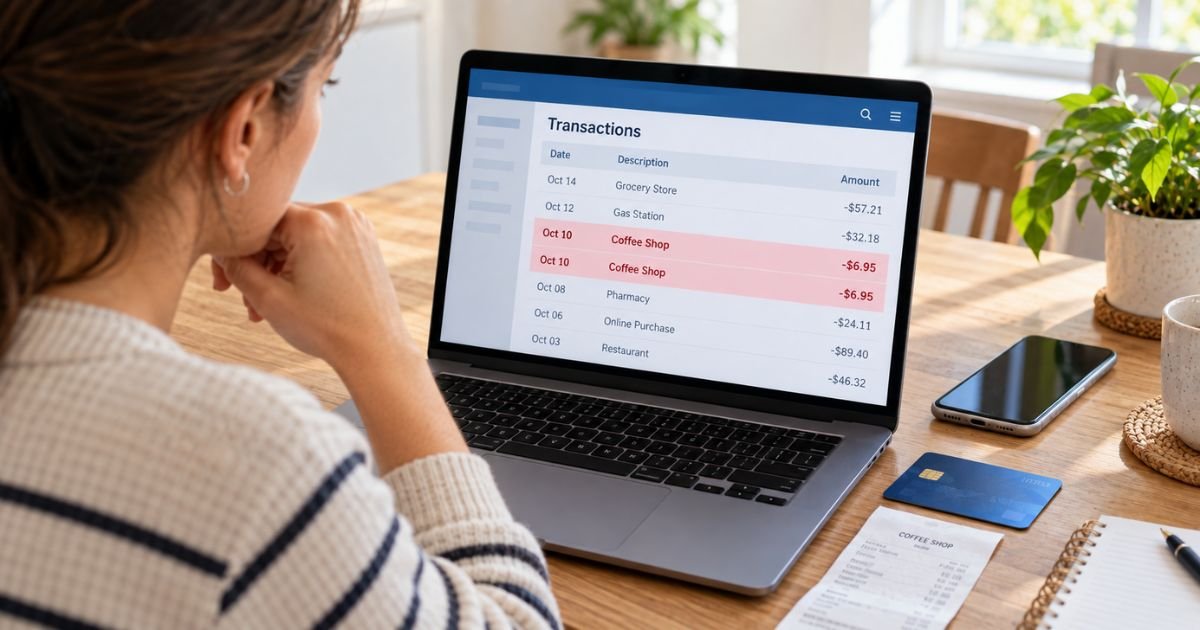
Seeing the same purchase twice on your bank statement can be stressful, especially when both charges reduce your available balance. A double charge is often a processing error, temporary authorization, or merchant mistake rather than fraud.
You should first check whether both transactions have actually posted. If they have, you can usually ask the merchant or your bank to investigate and correct the duplicate.
Table of Contents
What Is a Double Charge from the Bank?
A double charge happens when the same purchase appears more than once on your credit card, debit card, or bank account. You may see two transactions with the same merchant, amount, and date.
A duplicate does not always mean you were charged twice permanently. One entry may still be a pending authorization while the other is the final posted transaction.
A true duplicate usually means two completed transactions were processed for one purchase. The FTC identifies being charged more than once for the same purchase as a billing problem you can dispute.
Check Whether Both Charges Are Posted
Open the transaction details in your banking app. Look for labels such as pending, processing, completed, or posted.
A pending card transaction is generally an authorization that has not finished processing. Pending amounts can change or disappear before they post.
| What you see | What it generally means |
|---|---|
| One pending and one posted charge | May be a temporary authorization |
| Two pending charges | May still change or disappear |
| Two identical posted charges | More likely to be a real duplicate |
| Different amounts from one merchant | Could be separate purchases or an adjusted total |
| Unknown duplicate charges | Could require a fraud review |
Some issuers do not allow ordinary disputes on pending credit card transactions. If the duplicate remains after both charges post, you have stronger evidence of a billing error.
Pro Tip: Take screenshots while the transactions are visible. If one charge later disappears, you will still have a record of what happened.
Compare the Charges Carefully
Compare the amount, transaction date, posting date, location, and any reference numbers your bank provides.
Two similar charges may be legitimate if you made separate purchases close together. Restaurants, gas stations, hotels, and car rental companies can also show authorization amounts that differ from the final total.
Check your receipts and email confirmations. If you bought only one item but have two matching posted transactions, you may have a valid duplicate-charge dispute.
Contact the Merchant First
A merchant can sometimes correct a genuine duplicate faster than a bank investigation. Contact the company using its official website, receipt, or transaction details.
Explain that you made one purchase but see two completed charges. Give the date, amount, and only the last few digits of your card if needed.
Ask whether the merchant sees two payments and whether it can reverse the extra one. Keep records of the date, representative name, emails, chats, receipts, and refund confirmation.
Never send your full card number, PIN, CVV, password, or one-time security code.
Dispute the Double Charge With Your Bank
If the merchant does not correct the problem, contact your bank or card issuer. Most issuers let you dispute a posted transaction online, in an app, by phone, or by mail.
Choose the duplicate or double-charge reason if available. Do not report fraud if you recognize the merchant and authorized one of the payments.
You may need:
- The transaction date and amount.
- The merchant name.
- A receipt showing one purchase.
- Screenshots of both charges.
- Proof that you contacted the merchant.
Your bank may request records from the merchant before deciding the claim.
Credit Card Double Charges and the 60-Day Rule
A duplicate credit card charge can qualify as a billing error under the Fair Credit Billing Act. To preserve federal billing-error protections, you generally should send written notice within 60 calendar days after the issuer sent the first statement containing the error.
Send the notice to the billing-dispute address provided by your issuer. This may differ from the address used for payments.
Include your name, account information, disputed amount, transaction date, and a short explanation. Keep a copy.
The issuer generally must acknowledge a qualifying written dispute within 30 days unless it has already resolved the matter. It generally must finish the investigation within two billing cycles, but no more than 90 days.
Do You Have to Pay the Duplicate Credit Card Charge?
During a qualifying credit card billing-error investigation, you generally do not have to pay the disputed amount or related finance charges.
You still need to pay the undisputed portion of the bill on time. Missing the rest of your payment could cause fees or other account problems.
If the issuer agrees that the duplicate was an error, it should correct the account. If it decides both transactions were valid, it should explain the decision.
How Debit Card Double-Charge Disputes Work
A debit card duplicate can be more disruptive because the money may leave your checking account immediately.
Debit card purchases generally fall under Regulation E. An incorrect electronic fund transfer can qualify as an error, so your bank may have formal investigation duties after you report it properly.
In many situations, you should notify the bank no later than 60 days after it sends the statement showing the error. Report it sooner whenever possible.
The bank generally has 10 business days to investigate many Regulation E errors. Different timelines can apply, and temporary credit may be available if the investigation takes longer.
Is a Double Charge the Same as Fraud?
Usually not if you recognize the purchase and authorized one payment.
If you bought a $45 item and the merchant accidentally processed $45 twice, the extra transaction is generally a duplicate-charge dispute. If you recognize neither transaction, tell your bank that you may be dealing with unauthorized activity.
Common Mistakes: Do not choose “fraud” only because a merchant charged you twice. The wrong dispute category may slow the claim or cause an unnecessary card replacement.
What if the Merchant Says It Refunded the Duplicate?
Ask for the refund date and confirmation number. A merchant refund may take time to appear.
Do not consider the issue finished until the credit reaches your account. If the promised refund never posts, give the bank the merchant’s written confirmation.
What if Your Bank Denies the Dispute?
Read the bank’s explanation. It may have received records suggesting the charges were for separate purchases.
Compare those records with your receipt and order history. If you still disagree, ask whether the bank offers reconsideration and whether you can obtain documents used in the decision.
If you believe the bank did not follow applicable consumer rules, you can also consider filing a complaint with the Consumer Financial Protection Bureau.
FAQs: How to Dispute a Double Charge from the Bank
Q. How long should I wait before disputing a double charge?
A. If one transaction is pending, check whether it disappears when the final charge posts. If both charges are posted, contact the merchant and your bank promptly.
Q. Can my bank refund a duplicate charge?
A. Your bank may reverse or credit the duplicate after reviewing the dispute. The outcome depends on the transaction records and supporting evidence.
Q. Should I dispute both duplicate charges?
A. Usually, you should dispute only the extra transaction because one charge represents the purchase you actually made. Follow your issuer’s instructions.
Q. What proof do I need for a double-charge dispute?
A. A receipt, order confirmation, screenshots of both transactions, and records of your merchant contact can help. Your bank may request more information.
Conclusion
Knowing how to dispute a double charge from the bank starts with confirming that both transactions are posted. A pending authorization beside a completed payment may disappear without a formal dispute.
If two completed charges remain for one purchase, contact the merchant and then your bank if needed. Keep your proof, choose the correct dispute reason, and act within the applicable deadlines.
Disclaimer: This article is for informational purposes only and is not financial or legal advice. Dispute procedures, investigation timelines, and account protections may vary by issuer and transaction type, so verify account-specific questions with the merchant or your bank.
Meet the Author
