
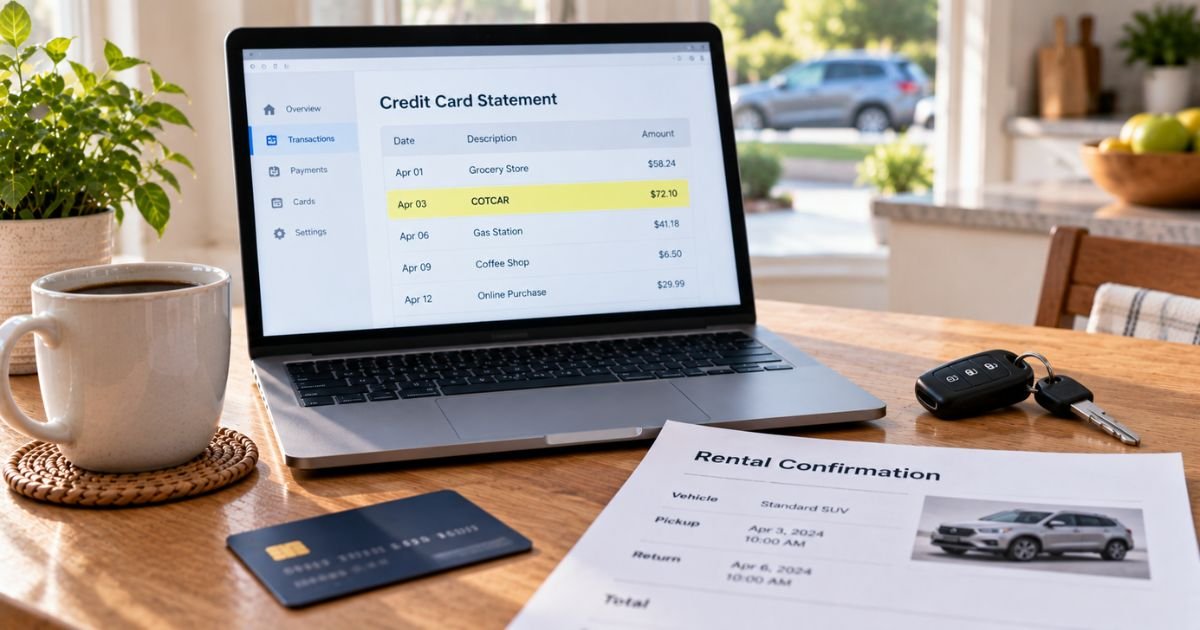
Seeing a Cotcar charge on credit card can feel confusing if you don’t recall signing up for anything. In many cases the line is a travel booking, not a random store.
This guide explains what the charge typically means, how it may print on a statement, and the steps most people take to verify or stop it.
Table of Contents
What Is a Cotcar Charge on Credit Card?
A Cotcar charge on credit card is typically a shortened merchant name. Banks cut long labels to fit a statement line. That is why COTCAR can look like a brand you never heard of.
The most consistent match for U.S. cardholders is Capital One Travel car rental. Capital One Travel is the issuer’s booking site and app for flights, hotels, cars, and activities.
A related flight label, COTFLT or COT*FLT, is widely reported as Capital One Travel airfare. COT plus CAR follows the same short pattern: Capital One Travel, then car.
Capital One has not published a public glossary that lists every exact code. Treat COTCAR as an educated match unless your dates, emails, and My Trips history say otherwise.
A second, less common match is Grupo Cotocar. That is a real auto-parts distributor in southern Spain with a site at cotocar.com. That explanation generally fits only if you bought parts there or paid a shop in that area.
COTCAR is usually a one-time travel or parts purchase. It is not typically a monthly membership by itself.
How a Cotcar Charge Usually Appears
Issuers truncate names in different ways. Read the full line, including any city, phone fragment, or extra letters.
| Statement text | What it often points to |
|---|---|
| COTCAR or COT CAR | Often a Capital One Travel car booking |
| COTCAR or COTCAR RENTAL | Same idea, with a separator added by the processor |
| COTCAR plus a city or airport code | Portal billing tied to the pickup area |
| COTFLT or COT*FLT nearby on the same trip | Supports the Capital One Travel reading |
| COTOCAR or COTOCAR SL | More likely the Spanish parts company |
| HERTZ, AVIS, ENTERPRISE after pickup | The rental brand billing extras, not the portal prepaid rate |
The portal can be the merchant of record when you book through Capital One Travel. That is why the statement may say COTCAR instead of Hertz, Avis, Budget, or Enterprise.
You may still see a second charge from the rental company. That later line is often a deposit hold, fuel, tolls, extra days, or damage.
A hold is not always a final purchase. Capital One notes that rental companies commonly place authorization holds, then drop or replace them after you return the car.
Why You Might See This Charge
These are the usual legitimate reasons.
- You booked a rental car in Capital One Travel or the Capital One Travel app.
- You paid with miles plus a card, so only part of the total hit the statement.
- An authorized user booked the car on your account.
- You prepaid a refundable reservation, then changed dates.
- You bought auto parts from Cotocar in Spain or paid a related shop.
- The rental counter ran a hold that later posted or reversed.
Capital One Travel officially lets eligible cardholders book rental cars in one place. Some cards also earn extra miles or cash back on those portal car bookings. Rewards rates vary by card and can change, so check your own card terms.
If you never use Capital One Travel, look at the posted date against any recent trip. A family member may have used the card in the app while signed in on a shared phone.
How to Verify the Charge
Start with the date and amount. Then match them to a booking, not only to a brand name.
- Open the confirmation email from Capital One Travel or the rental company.
- Sign in to Capital One Travel and open My Trips.
- Compare the pickup date, city, and total with the statement line.
- Check whether you paid with card, miles, a travel credit, or a mix.
- Ask anyone who shares the card or the Capital One login.
- If the trip does not fit, search the same date for a parts order or a foreign purchase.
Capital One’s rental help page says you can view a car booking this way: sign in, open the menu, choose My Trips, then open the trip.
If you used miles, the cash amount on the card can be smaller than the car’s full price. That mismatch confuses people. It does not automatically mean fraud.
If nothing in My Trips or email matches, look at the city on the statement. A Málaga or Mijas tag points more toward Cotocar parts than toward a U.S. airport rental.
Pro Tip: Save the confirmation email and a screenshot of My Trips before you call. Those two items usually answer the “what is this” question in one minute.
How to Stop or Cancel a Cotcar Charge
You cannot cancel a finished rental the way you cancel a streaming app. You cancel the reservation, or you ask for a refund after a billing error.
If it is a Capital One Travel car
- Sign in to Capital One Travel.
- Open My Trips and select the trip.
- Choose Cancel Car Rental if that button appears.
- Read the cancellation rules in My Trips or in the Car Details section of your email.
- If you need a change instead of a cancel, Capital One generally says the easy path is to cancel and book again when the rate is refundable.
- For changes the portal will not make, contact the rental company named on the reservation.
Official Capital One Travel help lists 844-422-6922 for more booking help. Use the number on the back of your card for account or fraud questions.
Capital One says eligible car refunds go back to the original payment method. Refunds typically show within one or two billing cycles.
Card-only payments return to the card. Miles-only payments return as rewards. Mixed payments generally split in the same mix you used.
If you used an annual travel credit and cancel after that credit expires, Capital One says the credit may not come back.
If it looks like Cotocar parts
Check the order email or the shop receipt. Contact the seller through cotocar.com or the store on the slip. Do not send card numbers in email.
Removing the card from Capital One Travel or from a parts site stops new bookings on that card. It does not erase a charge that already posted.
What to Do If You Do Not Recognize It
Work in this order.
- Match the line to My Trips, a travel email, or a parts receipt.
- Ask authorized users.
- Call Capital One Travel if you have a booking number but the amount looks wrong.
- Call the number on the back of your card if you have no booking at all.
A true unauthorized charge is different from a rental you forgot. If someone used your card number, lock the card and ask for a replacement. Review recent travel logins on the Capital One app.
Your credit card has federal billing-error rights. Under the Fair Credit Billing Act, you generally have 60 days from the statement that first shows the charge to send a written billing-error notice.
Issuers typically acknowledge a written notice within 30 days and resolve it within two billing cycles, not more than 90 days. Ask your issuer for the current process and the disputes address.
Debit cards follow different electronic-transfer rules. Report those quickly. Policies vary by bank.
Do not assume a portal booking is a scam because the letters look odd. Do not ignore a COTCAR line that has no trip and no receipt either.
Common Mistakes: Skipping My Trips and jumping straight to a dispute. Mixing the prepaid portal charge with a later Hertz or Enterprise hold. Waiting past the 60-day written-notice window. Treating every foreign-looking car label as Cotocar parts when the dates match a U.S. rental.
FAQs: Cotcar Charge on Credit Card
Q. What does a Cotcar charge on credit card mean?
A. It typically means your bank shortened a merchant name to COTCAR. For many U.S. cardholders, that most closely matches a Capital One Travel rental car. A less common match is Cotocar, a Spanish auto-parts company. Confirm with My Trips, your email, and the charge date.
Q. Is a Cotcar charge a scam?
A. Not by default. Capital One Travel is a real booking platform, and Cotocar is a real parts business in Spain. A real descriptor can still hide an unauthorized use of your card. If you have no trip, no parts order, and no matching email, treat it as possible fraud and contact your issuer.
Q. Why doesn’t the charge say Hertz or Enterprise?
A. When you book through Capital One Travel, the portal often processes the prepaid rental. Your statement may show the portal label instead of the lot brand. The rental company can still bill separately for a deposit, fuel, tolls, or extra days.
Q. How do I dispute a Cotcar charge on my card?
A. First try to match it in Capital One Travel My Trips or with the seller receipt. Use Capital One Travel help if the booking exists but the amount is wrong. If you still do not recognize it, call the number on your card and ask about a billing error or unauthorized-use claim. Keep the statement text, date, and amount.
Conclusion
A Cotcar charge on credit card is usually a shortened billing name, not a hidden subscription. The strongest everyday match is a Capital One Travel car rental, especially if you also see COTFLT or have a trip in My Trips. A Spain-based parts company is a secondary explanation when the location and emails point there.
Check the date, the confirmation email, and My Trips before you panic. Cancel through the portal when the rate allows it. Use your issuer if the charge has no booking behind it.
Disclaimer: This article is for general information only. It is not financial, legal, or tax advice. Statement wording and refund rules vary by issuer, by Capital One Travel booking terms, and by the rental company. Confirm details in your own app, booking emails, and with your bank or card company.
Meet the Author
