
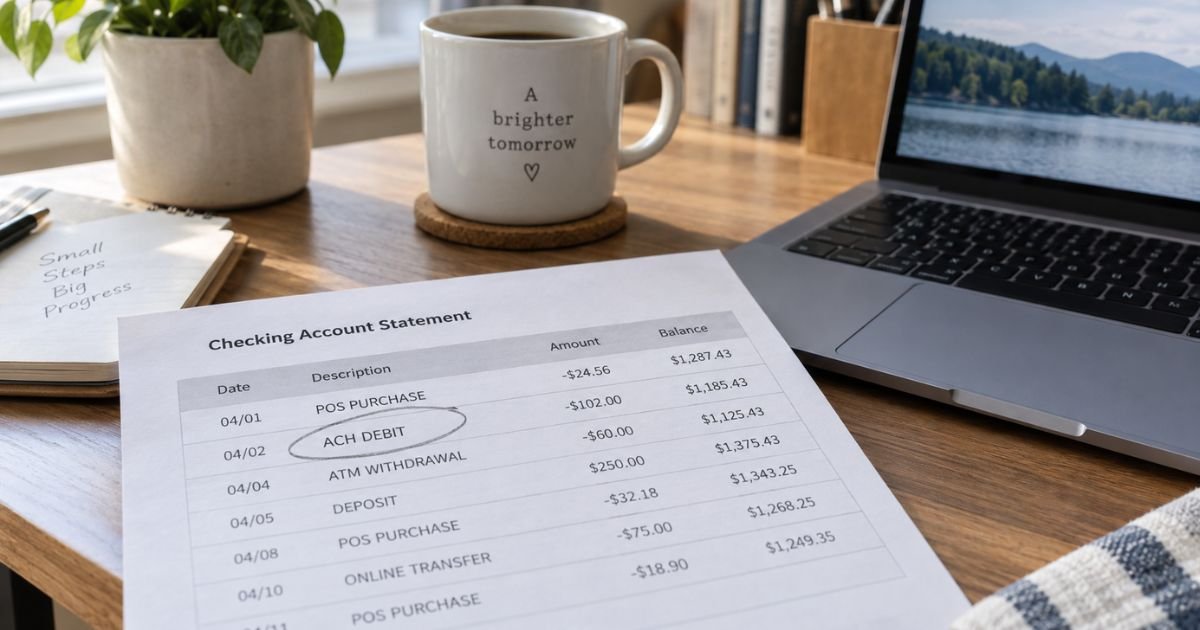
Seeing an ACH transaction on a statement can feel confusing if you don’t recall signing up for anything. The line may say ACH DEBIT, ACH CREDIT, or a company name with no card network logo. In many cases it is a normal electronic bank transfer, not a mystery store.
This guide explains what an ACH transaction is, how it differs from a card swipe, and what to do if one looks wrong.
Table of Contents
What is an ACH transaction?
An ACH transaction is an electronic money transfer between banks and credit unions on a network called the Automated Clearing House.
The Consumer Financial Protection Bureau uses that definition and notes ACH is used for direct deposit of paychecks and for monthly debits for routine bills.
You usually set one up by giving a routing number and account number. You do not swipe a card. The company or employer then “pushes” money in or “pulls” money out through its bank.
The Federal Reserve describes ACH as a nationwide batch network. Typical credits include payroll, Social Security, and tax refunds.
Typical debits include mortgages and utility bills. The network also handles many one-time internet and phone payments.
Nacha sets the operating rules for the ACH Network. It does not process your individual payment and cannot look up a single consumer transfer.
If a deposit is missing or a debit is wrong, Nacha’s consumer FAQ says to call your bank or the company that started the payment.
ACH credit vs ACH debit
Direction is the whole story.
An ACH credit pushes money into your account. Direct deposit is the common example. Your employer’s bank sends a file. Your bank later posts a deposit.
An ACH debit pulls money from your account. A utility, insurer, gym, or lender does this after you authorize it. The company is collecting a payment, not sending you cash.
| Type | What it does | Common examples | How it often prints |
|---|---|---|---|
| ACH credit | Money in | Paycheck, tax refund, benefits | ACH CREDIT, DIR DEP, DD |
| ACH debit | Money out | Rent, phone bill, streaming billed from checking | ACH DEBIT, ACH WITHDRAWAL, PPD, WEB |
Some statements add a short code such as PPD or WEB. Those are industry labels for how the payment was authorized. Banks may hide the code and show only the company name.
A returned or “bounced” ACH debit can also print. That happens when the account does not have enough money. The CFPB notes ACH transactions can bounce for nonpayment, and your bank may charge a fee.
How long an ACH transaction takes
ACH is a batch system. Banks gather many transfers and send them in groups, not one by one like a wire.
The CFPB says ACH payments can clear quickly, even on the same business day. That does not mean every transfer finishes the day you enter it. Reviews for fraud and the batch schedule can stretch the wait to days.
Nacha estimates that most ACH payments settle in one banking day or less when you include regular and Same Day ACH. Weekend and holiday calendars still apply. A Friday evening bill pay may not post until the next banking day.
Pending ACH lines can look like a hold. The money may be reserved before it posts. That is different from a card authorization at a gas pump, but it can reduce available balance in the same way.
Same Day ACH is faster when both banks support it and the file meets cutoff times. It is not a promise that every consumer transfer is instant.
How ACH compares with other payments
People mix ACH with anything electronic. The rails are not the same.
A debit-card purchase uses card networks and a PIN or signature. It often posts faster and shows a merchant descriptor. An ACH debit uses routing and account numbers.
A wire is usually a same-day, higher-cost bank-to-bank send. Wires are not processed as ACH batches.
A paper check can later be converted into an electronic debit. The statement may then say ACH even though you wrote a check.
Person-to-person apps may use ACH to move money to a bank account, or they may use another network. Do not assume every app send is ACH. Read the line. If it says ZELLE or the app name, treat it as that product first.
Your bank may limit how much you can send by ACH and may charge a fee on some outgoing transfers. Incoming direct deposit is often free. Check your deposit agreement for the exact fee, if any.
Pro Tip: If you need the money to land on a known date, ask whether the sender is using standard ACH or Same Day ACH. “I sent it Friday” does not always mean it posted Friday.
How to recognize ACH on your statement
Look for ACH, PPD, WEB, TEL, CCD, DIR DEP, or the words DEBIT and CREDIT next to a company or employer name. There is usually no Visa or Mastercard mark on a pure ACH line.
Match the amount and date to:
- Payroll or benefits calendars
- Autopay you set up with a utility or lender
- Bank bill pay
- A company that stored your routing and account numbers
- A returned payment and a later retry
One company can print several legal names. A fintech “pay from bank” button often shows the processor or the merchant, not the app icon you tapped.
If you never gave that company your account number, treat the debit as unauthorized. Routing numbers are public. Account numbers are not supposed to be.
How to stop or dispute an ACH debit
Stopping a future pull and disputing a posted pull are different jobs.
To stop a scheduled preauthorized debit, federal Regulation E says you may notify your bank orally or in writing at least three business days before the scheduled date.
The bank may require written confirmation within 14 days of a phone request. If you do not send that writing when asked, the oral stop can expire.
Also revoke authorization with the company in writing. A stop payment at the bank does not always delete your account number from the merchant’s file. The company could try again under a new description.
Banks often charge a stop-payment fee. Ask for the amount before you place the order.
If a debit already posted and you did not authorize it, report it to your bank as an unauthorized electronic fund transfer. Consumer ACH errors generally follow Regulation E.
Call the same day, then follow the bank’s written-notice instructions. The usual statement window for an error notice is 60 days after the bank sent the statement that first showed the problem.
Closing the account can stop old numbers from working. Update direct deposit and every remaining autopay first so paychecks do not bounce.
Nacha cannot reverse a consumer payment for you. Stay with your bank and the originator.
Common Mistakes: Sharing a photo of a voided check in an inbox you do not trust. Stopping the bank pull but never telling the merchant. Waiting on a “pending ACH” for weeks before calling payroll. Treating every app payment as ACH when the statement says something else.
FAQs: What is an ACH Transaction on a Bank Statement
Q. Is an ACH transaction the same as a debit-card charge?
A. No. An ACH transaction moves money between bank accounts using a routing number and account number. A debit-card charge uses the card network. Both can leave checking. The statement wording and the dispute path are not identical.
Q. Can an ACH transaction bounce?
A. Yes. The CFPB notes an ACH transfer can be returned if the account does not have enough money. Your bank may add a nonsufficient-funds or returned-item fee. A company may also retry the debit later if its rules allow it.
Q. How do I know if an ACH debit is legitimate?
A. Match the company name, amount, and date to an authorization you remember. Check payroll, utilities, lenders, and bank bill pay first. If you never gave that business your account number, call your bank the same day and ask to block further pulls.
Q. Who do I call about a missing ACH direct deposit?
A. Start with the employer, payroll provider, or agency that sent it. Nacha says the sender is usually in the best position to locate a misdirected deposit. Then call your bank with the expected amount and date if the sender says it already went out.
Conclusion
An ACH transaction is an electronic bank-to-bank transfer on the Automated Clearing House network. Credits push money in, such as a paycheck. Debits pull money out, such as a utility autopay.
Read the company name, not only the letters ACH. Stop future pulls at least three business days ahead, and report an unauthorized debit to your bank quickly. That combination solves most ACH surprises without guessing.
Disclaimer: This article is for general information only. It is not financial or legal advice. ACH timing, fees, stop-payment rules, and return rights vary by bank and by transfer type. Confirm account-specific questions with your bank or credit union or with official CFPB resources.
Meet the Author
