
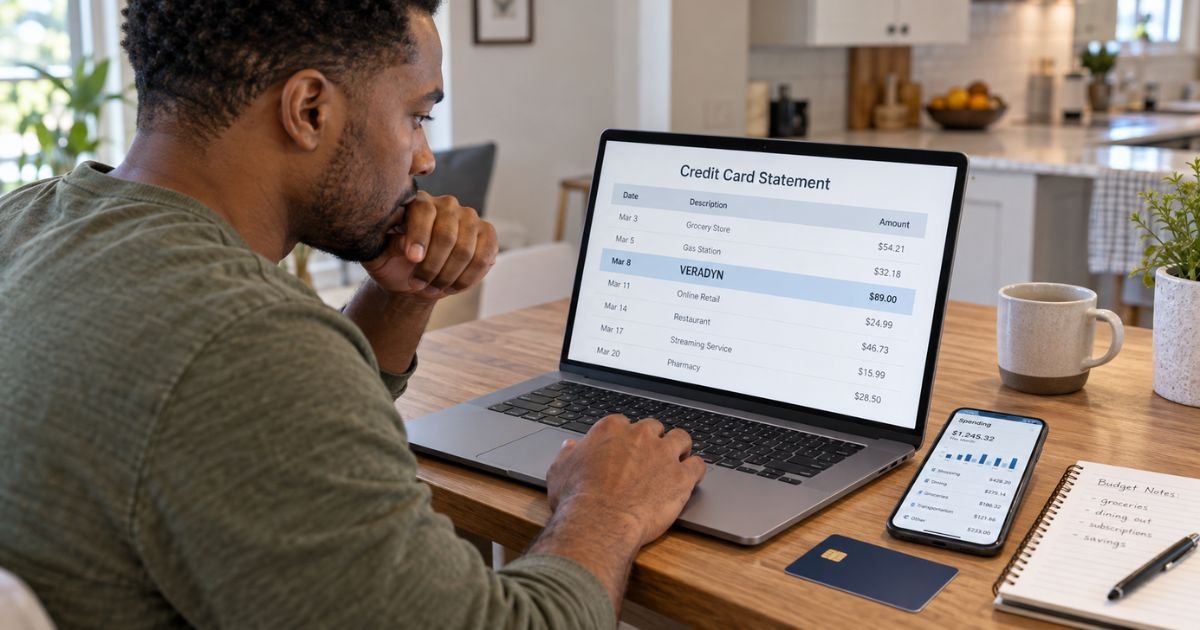
A Veradyn Charge on Credit Card can feel confusing if you don’t remember shopping with a company called Veradyn. The name may be a merchant descriptor, business name, or other billing label rather than the brand you remember using.
Public information about the exact merchant behind every Veradyn charge is limited. This guide shows you how to identify your transaction, check whether it is legitimate, and dispute it if nobody authorized it.
Table of Contents
What Is a Veradyn Charge on Credit Card?
A Veradyn Charge on Credit Card generally means a merchant submitted a transaction using Veradyn, or similar wording, as part of its billing descriptor. A billing descriptor is the name your card issuer receives with a transaction.
The problem is that Veradyn does not clearly identify one confirmed consumer merchant in every case. Several unrelated businesses use similar Veradyn or VeraDyne names.
You may see statement wording such as:
| Statement Description | What It May Indicate |
|---|---|
| VERADYN | Merchant or shortened billing name |
| VERADYN WEST BANGOR PA | Descriptor with a location field |
| VERADYN WEST BANGOR US | Similar location-based descriptor |
| VERADYNE | Possibly a different merchant |
| VERADYN plus numbers | Merchant reference or contact information |
Do not assume two similarly named businesses are connected. Your card issuer may have more complete merchant data than what appears on your statement.
What Does Veradyn West Bangor PA Mean?
Some cardholders search for a descriptor containing Veradyn West Bangor PA. The location may appear to point to West Bangor, Pennsylvania, but that alone does not reliably identify the merchant.
Credit card location fields can sometimes reflect a registered merchant address, billing office, processing location, or other information submitted with the transaction.
You should therefore avoid assuming that you physically made a purchase in Pennsylvania.
Open the transaction details in your card issuer’s app. Look for an extended merchant name, phone number, website, or merchant category.
Is Veradyn Connected to a Subscription?
It is possible, especially if the same amount appears repeatedly. However, there is not enough verified public information to state that every Veradyn transaction represents a particular subscription service.
Look at the pattern on your statement.
A charge that appears every week, month, or year may suggest recurring billing. A single transaction may instead represent a one-time purchase or service.
Check recent signups involving:
- Free trials
- Online memberships
- Software
- Digital services
- Professional services
- Online purchases
- Membership renewals
Search your email for the exact transaction amount as well as the word “Veradyn.” The amount may lead you to a receipt even when the merchant name does not.
Pro Tip: Search your email using the amount and transaction date instead of only searching for “Veradyn.” The receipt may use a completely different customer-facing business name.
Is Veradyn a People Search or Background Check Charge?
You may find websites online claiming that Veradyn charges are connected to people-search or background-check subscriptions. That connection should not be treated as confirmed for your transaction without supporting evidence from your bank, receipt, or merchant account.
If you recently used a people-search website, you can certainly review that account. However, you should not cancel unrelated accounts simply because another website says Veradyn belongs to a particular company.
Start with your own transaction data.
Your credit card issuer may be able to provide a longer merchant descriptor or contact information that gives you a much stronger identification.
Are There Real Businesses Called Veradyn?
Yes, but the existence of a business with the same name does not prove that it generated your credit card charge.
For example, there are currently businesses using the Veradyn name in areas such as business software, engineering, and dental technology. A similarly spelled VeraDyne company may also be unrelated.
This is why searching only for “Veradyn company” can produce misleading results.
Match several details before contacting a business:
- Exact merchant name
- Phone number
- Website
- Transaction location
- Merchant category
- Purchase amount
- Transaction date
If those details do not match, keep investigating.
How to Identify a Veradyn Credit Card Charge
Start with your card issuer’s website or mobile app. Tap the transaction and look beyond the short name shown on the main statement screen.
Your issuer may display extra information such as:
- Full merchant name
- Merchant phone number
- Merchant website
- Location
- Merchant category
- Whether it was recurring
- Whether the card was present
- Digital-wallet details
Next, check your email and text receipts.
Search around the transaction date for the amount charged. Also check PayPal, Apple Pay, Google Pay, or other payment services if your credit card is linked to them.
Ask other authorized cardholders as well. A family member may recognize the purchase even if you do not.
What If the Veradyn Charge Is Pending?
A pending charge generally means the transaction has been authorized but has not fully posted.
Some pending transactions disappear or change before they settle. The merchant information may also become clearer after posting.
If you recognize the amount but not the descriptor, waiting for the transaction to post may provide additional details.
However, contact your card issuer promptly if the transaction is completely unfamiliar, especially if you see several suspicious charges.
Your issuer can tell you whether it recommends locking the card while you wait.
Could a Small Veradyn Charge Be Card Testing?
Possibly, but you should not assume that is what happened.
Fraudsters sometimes make small purchases or authorization attempts to see whether stolen card information still works. A small unknown transaction followed by larger unfamiliar purchases can therefore deserve immediate attention.
Warning signs include:
- Several unknown charges appearing together
- Small charges from multiple unfamiliar merchants
- Transactions you cannot match to any receipt
- Purchase alerts you did not trigger
- Charges after your card was lost
- Purchases in places you have never used your card
Contact your credit card issuer if those patterns appear.
Common Mistakes: Don’t ignore a Veradyn charge because the amount is small. Also don’t report it as fraud before checking receipts, subscriptions, digital wallets, and other authorized cardholders when no immediate security warning exists.
How to Stop Recurring Veradyn Charges
You first need to identify the actual merchant. Without knowing which company is billing you, you may not know where the recurring payment originated.
Ask your issuer whether it can provide merchant contact information or confirm whether the payment is coded as recurring.
Once you identify the merchant:
- Sign in through its official website.
- Review your subscription or account.
- Cancel recurring billing if appropriate.
- Save the cancellation confirmation.
- Monitor your next statement.
Do not rely only on deleting an app or stopping use of a service. That may not cancel a paid subscription.
If you cannot identify the merchant at all, ask your issuer what options it provides for blocking additional transactions.
Can You Get a Refund for a Veradyn Charge?
That depends on the actual merchant and why you were charged.
If you recognize the purchase but believe the amount is incorrect, contact the merchant and request an explanation. Refund terms can vary widely.
You may have a stronger case if you can document:
- Duplicate billing
- Billing after cancellation
- An incorrect amount
- A purchase you never authorized
- A service you paid for but did not receive
Keep emails, screenshots, cancellation records, and receipts.
Never accept a promise of a refund that requires you to provide your online banking password or security code.
How to Dispute a Veradyn Charge on Your Credit Card
Contact your credit card issuer if you cannot identify the transaction and nobody authorized to use your account recognizes it.
Use the issuer’s official app or the phone number printed on the back of your card.
Explain exactly what happened. Tell the issuer whether the charge is completely unauthorized or whether you recognize the merchant but disagree with the billing.
Your issuer may:
- Open a billing dispute
- Open a fraud claim
- Block the card
- Replace your card number
- Request supporting documents
- Provide temporary credit where applicable
For certain U.S. credit card billing errors, your formal dispute rights can depend on acting within 60 days after the issuer sent the statement containing the error.
Contact your issuer sooner rather than waiting for that deadline.
Should You Replace Your Credit Card?
You generally do not need a replacement simply because a merchant descriptor looks unfamiliar.
If you eventually identify the Veradyn transaction as a legitimate purchase, your existing card may be fine.
Replacement becomes more relevant if you determine that someone used your card information without permission.
Your issuer may recommend issuing a new card number. Review all recent transactions because compromised card details may be used at more than one merchant.
What BBB, Trustpilot, and Reddit Show
Consumer-review evidence does not currently provide a reliable way to identify every Veradyn credit card charge.
There are businesses with Veradyn or similar names in public business listings, but you should not assume those businesses are responsible for your transaction without matching details.
Reddit and other consumer discussions may provide clues about unfamiliar descriptors. However, individual reports are not proof that your transaction came from the same merchant.
Trust your card issuer’s merchant data, your receipts, and your own account history first.
How to Prevent Future Mystery Charges
You cannot control how every merchant formats its statement descriptor. You can make unfamiliar transactions much easier to identify.
Consider these habits:
- Enable purchase alerts.
- Keep email receipts.
- Review statements regularly.
- Save subscription cancellation confirmations.
- Check annual renewals before they bill.
- Remove cards from services you no longer use.
- Use strong passwords.
- Enable two-factor authentication.
You should also avoid posting your full statement details publicly when asking for help identifying a charge.
Never share your full card number, security code, banking password, or one-time verification code.
FAQs: Veradyn Charge on Credit Card
Q. What is Veradyn on my credit card statement?
A. Veradyn appears to be a merchant or billing descriptor, but available public information does not reliably connect every Veradyn transaction to one specific business. Check your issuer’s expanded transaction details to identify your charge.
Q. What does Veradyn West Bangor PA mean?
A. It generally means West Bangor, Pennsylvania appears in the transaction’s merchant data. That may be a merchant or billing location, so it does not necessarily mean you personally made a purchase there.
Q. Is a Veradyn charge fraudulent?
A. Not necessarily. An unfamiliar descriptor can belong to a legitimate purchase, but you should investigate it if you cannot match the amount and date to anything you authorized.
Q. How do I stop a Veradyn charge?
A. First identify the merchant through your issuer, receipts, or payment accounts. Cancel directly with the merchant if it is recurring, or contact your card issuer promptly if the charge is unauthorized.
Conclusion
A Veradyn Charge on Credit Card should be treated as an unidentified merchant descriptor until you can match it to a specific business or purchase. Public information is too limited to reliably say that every Veradyn charge comes from one particular subscription, processor, or company.
Check the full transaction details, receipts, subscriptions, payment apps, and other authorized cardholders first. If you still cannot identify the charge, contact your credit card issuer promptly and ask whether you should dispute the transaction or replace your card.
Disclaimer: This article is for informational purposes only and isn’t financial or legal advice. Merchant descriptors, refund policies, fraud procedures, and credit card dispute rules may vary by issuer, so verify account-specific questions directly with the merchant or your card issuer.
Meet the Author
