
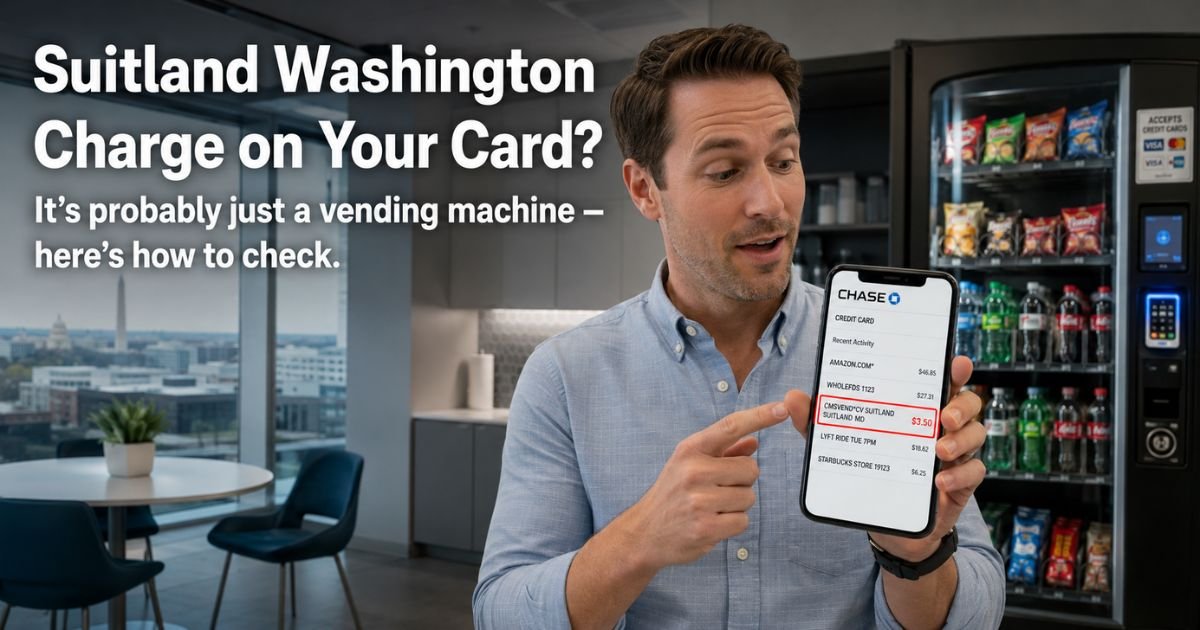
You glance at your credit card statement and spot it: “CMSVEND*CV SUITLAND SUITLAND MD” or something close to “Suitland Washington charge.”
Your stomach drops. You have never heard of any company in Suitland, and you definitely did not order anything from Washington.
You are not alone. Hundreds of people every month search for this exact line item wondering if it is fraud or a mistake.
The good news is that it is almost always a legitimate purchase from a vending machine. The confusing part comes from how the payment processor lists the transaction.
I will explain exactly what the Suitland Washington charge on credit card means, why it shows up that way, and the fastest ways to verify it, cancel any issues, or get your money back if something feels off.
Table of Contents
What Is the Suitland Washington Charge on Credit Card?
The Suitland Washington charge usually appears as CMSVEND*CV SUITLAND or a similar variation that includes “SUITLAND MD.” CMSVEND stands for Crane Merchandising Systems vending services (now part of a larger payment network).
These are the behind-the-scenes processors that let you tap your card at vending machines across the country.
When you buy a soda, chips, or candy from a credit-card-enabled vending machine in or near Suitland, Maryland, the transaction routes through their system.
The descriptor shows the machine’s location instead of a friendly name like “Office Vending Co.” That is why you see “Suitland” tied to Washington, the area sits just outside Washington DC in Prince George’s County.
These charges are small, typically $2 to $6, and they only happen when someone physically uses a card at the machine.
Why Does It Appear as Suitland Washington?
Vending operators use short codes to fit bank statement limits. The processor adds the city and state so the bank can route the payment correctly and you can recognize the general area.
Suitland itself is home to several large federal buildings, offices, and retail spots where these machines operate. Many people who live or work near Washington DC end up with this exact descriptor after a quick snack run.
Bottom line: The charge is real and tied to an actual vending purchase, but the name makes it look mysterious until you connect the dots.
How to Figure Out If the Charge Is Yours
Follow these four quick steps and you will usually solve the mystery in minutes.
- Check the exact date and amount on your statement.
- Think back, did you or anyone with card access grab a drink or snack that day?
- Look in your email or phone photos around that date for any vending receipt.
- Ask family members or coworkers who might have borrowed the card.
Take a 41-year-old federal employee who commutes to Suitland every week. He saw a $4.25 Suitland Washington charge and panicked until he remembered stopping at the break-room vending machine for an energy drink while waiting for a meeting. The machine had no screen name, just the card reader. One text to his wife confirmed she had not used the card, and he relaxed.
What to Do About the Charge: Step-by-Step
If the purchase matches your memory, you are all set. Mark it as “vending” in your budget app and move on.
If it does not match, act fast.
- Contact your card issuer right away and dispute the transaction as unrecognized.
- Provide the date, amount, and descriptor.
- Most banks will temporarily credit the amount while they investigate.
You can also reach the vending operator directly if you know the exact machine location. Many have a customer service number posted on the machine itself.
Pro Tip: Next time you tap a vending machine, snap a quick photo of the screen or receipt. It takes two seconds and saves you stress later when the charge shows up under a generic name like Suitland Washington.
Typical Amounts and Common Locations
Here is what people usually see with Suitland Washington charges:
| Amount Range | What You Likely Bought | Common Spots in the Area |
|---|---|---|
| $2.00–$3.50 | Soda, water, or energy drink | Office break rooms, government buildings |
| $3.50–$5.00 | Chips, candy, or snacks | Car dealerships, hospitals, metro areas |
| $5.00–$6.50 | Premium items or combo packs | Federal complexes near Suitland |
| $1.00–$2.00 | Small single items | Quick convenience machines |
These are real-world averages reported by cardholders. Your exact amount depends on the machine’s prices.
Common Mistake: Ignoring small charges because they seem harmless. Even $3 or $4 adds up fast if someone else is using your card or if a machine double-charges. Check every line on your statement each month.
How to Prevent Future Mystery Vending Charges
The simplest fix is to use cash or a prepaid card for vending machines when possible. Many banks now offer virtual card numbers you can create just for one-time use.
If you work or visit Suitland often, note the machines you use most and set a small monthly “snack” budget so surprises never catch you off guard.
FAQs: Suitland Washington Charge on Credit Card
Q. Why does my credit card show a Suitland Washington charge when I never went to Maryland?
A. The descriptor pulls the location of the vending machine or the processor’s local office. Even if you live far away, someone with access to your card could have used a machine in Suitland, or the charge routes through their Maryland hub. Check the exact date against your calendar.
Q. Is the CMSVEND*CV SUITLAND charge fraud or just a vending machine?
A. It is almost always legitimate and comes from a real vending purchase processed by Crane Merchandising Systems. Fraud is rare, but it can happen if your card details were compromised. Dispute it immediately if you have no memory of the snack or drink.
Q. Can I get a refund for a double charge or wrong amount from a Suitland vending machine?
A. Yes. Contact your bank first for the fastest reversal. You can also reach out to the vending operator using the phone number on the machine or the address in Suitland. Keep your transaction receipt or photo as proof.
Conclusion
The Suitland Washington charge on credit card is usually nothing more than a vending machine purchase that shows up with a location-based descriptor. Once you match the date and amount to a quick snack run, you can relax and move on.
If it does not match, your bank has your back with simple dispute steps. The key is checking statements regularly and using a photo or note for any vending taps.
Keep an eye on those small charges. They add up, but now you know exactly how to handle them. If another puzzling fee appears later, swing by ExplainCharges.com, we break down dozens more everyday mysteries just like this one.
Disclaimer: The content on ExplainCharges.com is for informational and educational purposes only and does not constitute financial, legal, or professional advice. We are not affiliated with any companies or services mentioned. The information provided may not apply to your specific situation. If you suspect unauthorized charges or fraud, contact your bank or credit card issuer immediately. Always verify details directly with the source and consult a qualified professional if needed.
Meet the Author
