
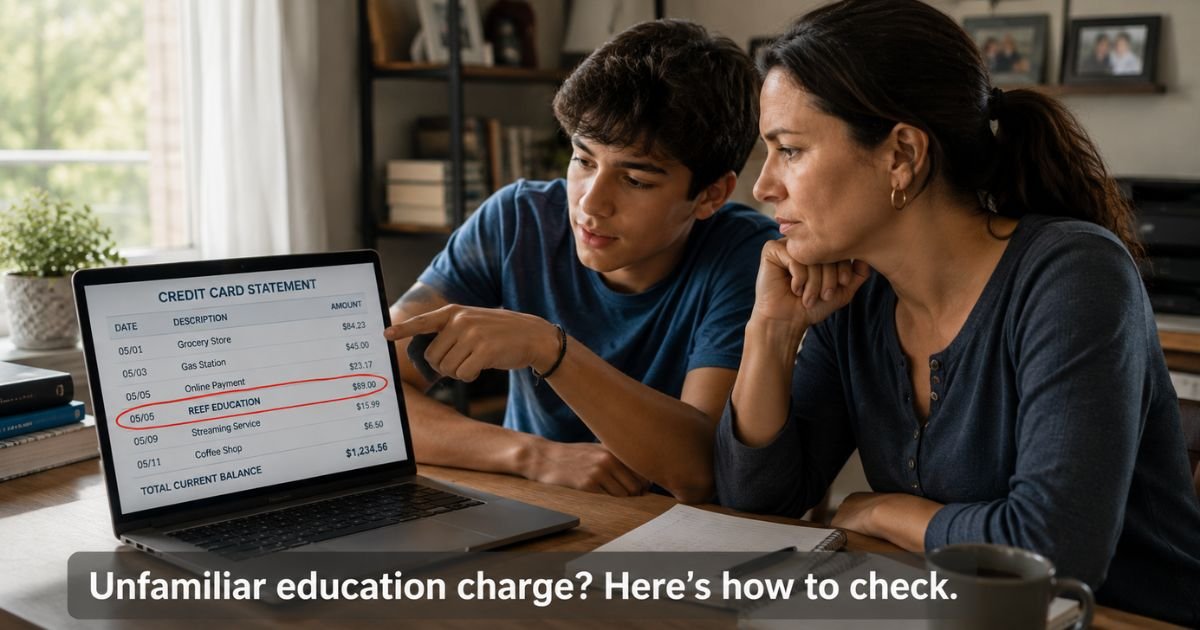
You pull up your credit card statement and see a Reef Education charge on credit card that you do not immediately recognize. It is natural to feel a moment of confusion when an unfamiliar name appears.
The Reef Education charge usually connects to educational programs, expeditions, or training offered by organizations focused on marine conservation or vocational skills.
In the next few minutes you will find straightforward explanations of why the charge appears, how to confirm whether it is yours, and exactly what to do next.
Table of Contents
What Is the Reef Education Charge?
The Reef Education charge is a billing descriptor used by entities involved in ocean education, marine conservation programs, or certain vocational training courses.
The most prominent organization behind similar charges is the Reef Environmental Education Foundation (REEF), a legitimate nonprofit that runs citizen science initiatives, educator programs, and Ocean Explorers expeditions.
Other possibilities include vocational or internship programs in marine biology, aquaculture, or medical coding offered through platforms connected to reef education.
Billing names often appear abbreviated or in slightly different forms depending on the payment processor and your card issuer.
Because these organizations work with schools, families, and individuals, charges can show up even if the original signup happened through a school, partner site, or application portal.
Why Does This Charge Appear?
Several common situations lead to a Reef Education charge:
- You or a family member enrolled in an educational program, workshop, or expedition.
- An application or registration fee was processed after submitting forms for a program.
- A deposit was required for an Ocean Explorers expedition or group visit.
- A recurring membership or program fee renewed automatically.
- Someone with access to the card made the purchase on your behalf.
In a smaller number of cases, people report charges for applications they believe they never completed.
Merchant descriptors for educational and nonprofit programs frequently look different from the original organization name, which adds to the confusion.
Is the Charge Legitimate or Unauthorized?
Most Reef Education charges are legitimate fees tied to real programs or applications. The Reef Environmental Education Foundation maintains transparent operations, publishes financial reports, and focuses on conservation education.
However, when you have no record of any application, enrollment, or family member involvement, it is reasonable to investigate further.
Application fees in particular sometimes surprise people who started a form but did not finish it, or who shared their information during a school-related process.
The safest approach is always verification first. Treat recurring or unexpected charges as worth checking, but avoid assuming fraud until you have reviewed your own records.
How to Verify the Reef Education Charge
Use this checklist to confirm the charge quickly:
- Search your email (including spam) for messages from reef.org, REEF, or any reef education program you or your family may have contacted.
- Ask other card users in your household whether they signed up for a program, expedition, or educational opportunity.
- Check recent school communications, permission slips, or activity sign-ups if you have children or teens.
- Log into your credit card account and look for any additional merchant details or contact information attached to the transaction.
- Visit reef.org and review their current programs and expedition calendar to see if anything matches the timing of the charge.
Pro Tip: Save every email and confirmation related to educational programs or applications. These records make disputes or cancellations much smoother if questions arise later.
How to Stop Future Reef Education Charges
If the charge is a legitimate program fee you no longer want, contact the organization directly through reef.org or any confirmation email you locate. Many educational nonprofits allow cancellation or withdrawal with proper notice.
For recurring charges or fees you cannot connect to any signup, call your card issuer immediately. Ask them to dispute the transaction and place a block on future charges from this billing descriptor. Provide any documentation you gathered during verification.
If the charge continues after your request, ask the issuer for a new card number. This step prevents additional billing while the dispute is processed.
Common Mistake: Assuming every unfamiliar education charge must be fraudulent without first checking with other family members or recent school and activity records. A quick conversation often reveals a legitimate program fee.
What Should You Do If You Do Not Recognize the Charge?
Begin with the verification steps above. In most cases you or someone in your household will find a connection to a school program, expedition interest, or application started earlier.
If nothing matches and the charge feels unauthorized, contact your card issuer the same day. Explain that you do not recognize the Reef Education transaction and request a dispute. Keep records of every conversation, including dates and reference numbers.
Educational program charges sometimes involve application or deposit fees that can be disputed if you never completed enrollment. Your issuer can guide you through the process and protect your account in the meantime.
Bottom line: Review your emails and household activity first. Reef Education charges are most often tied to real educational programs, but your card issuer stands ready to help when the charge does not match anything you authorized.
Common Scenarios for a Reef Education Charge
| Situation | Likely Explanation | Recommended Next Step |
|---|---|---|
| Recent program or expedition signup | Legitimate enrollment or deposit fee | Confirm details with reef.org or your records |
| Application started but not finished | Possible application or processing fee | Contact issuer to dispute if enrollment incomplete |
| Child or student in household | School-related educational program or trip | Ask family members and check school communications |
| No record of any activity | Potential unauthorized or mistaken charge | Dispute with card issuer and request merchant block |
FAQs: Reef Education Charge on Credit Card
Q. How do I cancel a Reef Education charge if I never signed up for any program?
A. Search your email thoroughly for any messages from reef.org or related programs. If you find nothing, contact your credit card issuer right away and dispute the charge as unrecognized. Request that they block future transactions from this billing descriptor while the dispute is reviewed.
Q. Is the Reef Education charge connected to a legitimate nonprofit or educational organization?
A. Yes. Many charges under this descriptor link to the Reef Environmental Education Foundation, a recognized nonprofit that runs marine conservation education programs and expeditions. Other charges may come from vocational training or internship providers in marine or medical fields. Always verify the specific transaction against your own records.
Q. What should I do if Reef Education keeps appearing on my statement after I disputed it?
A. Call your card issuer again with your dispute reference number and ask them to escalate the issue or permanently block the merchant. You can also request a replacement card with a new number. Continue monitoring your statements and keep detailed records of every contact until the charges stop.
Conclusion
Seeing a Reef Education charge on credit card statement can feel puzzling at first, especially when the name does not immediately ring a bell. These charges most often connect to real educational programs, expeditions, or application fees from established organizations focused on ocean conservation or skills training.
Take a few minutes to check your email and ask others who use the card. In the majority of cases you will find a clear connection. When the charge does not match anything you recognize, your card issuer can step in quickly to dispute it and protect your account.
Make it a habit to glance at pending transactions every few days. Catching unfamiliar charges early keeps everything under control and gives you peace of mind.
For more help with puzzling charges from educational or nonprofit organizations, browse other guides on ExplainCharges.com.
Disclaimer: The content on ExplainCharges.com is for informational and educational purposes only and does not constitute financial, legal, or professional advice. We are not affiliated with any companies or services mentioned. The information provided may not apply to your specific situation. If you suspect unauthorized charges or fraud, contact your bank or credit card issuer immediately. Always verify details directly with the source and consult a qualified professional if needed.
Meet the Author
