
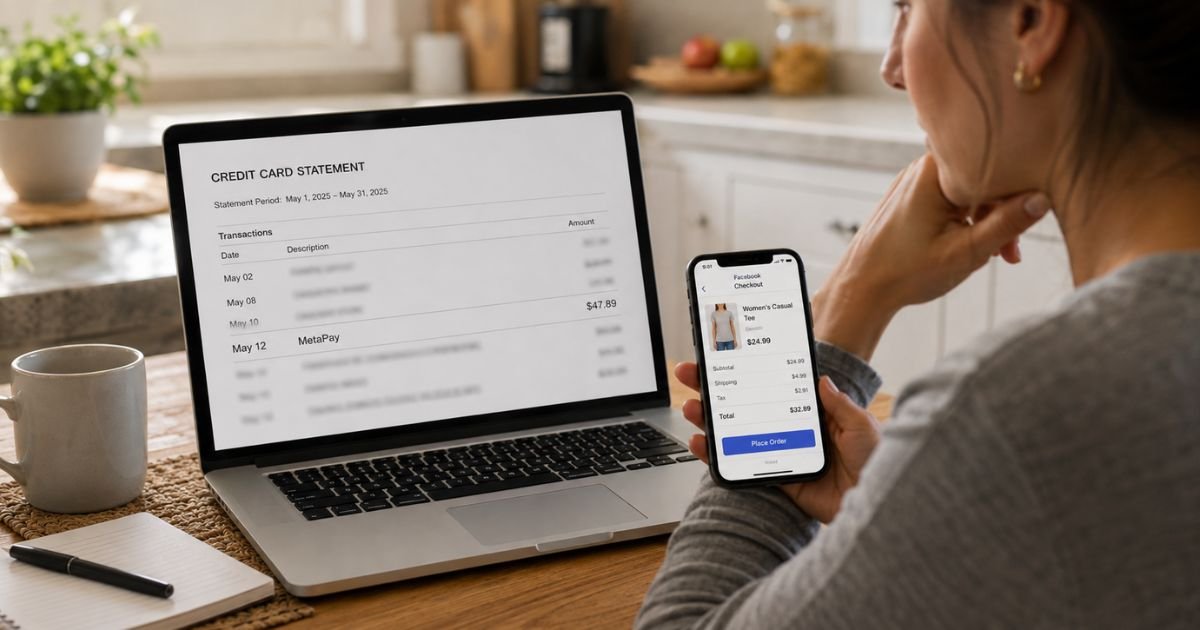
A MetaPay charge on credit card can feel confusing if you don’t recall signing up for anything. In many cases, the charge is still a real payment processed through Meta’s own wallet. It often ties to Facebook, Instagram, Messenger, Marketplace, or a card you saved earlier.
This guide explains what the charge usually means, how it may appear on your statement, and how you can check it. You’ll also see what to do if you don’t recognize it.
Table of Contents
What Is a MetaPay Charge on Credit Card?
A MetaPay charge on credit card is typically a payment processed by Meta Pay. Meta Pay is the official payment tool from Meta Platforms, Inc., the company behind Facebook, Instagram, Messenger, and WhatsApp.
Meta Pay used to be called Facebook Pay. Meta renamed it in 2022. Your saved cards and settings generally stayed the same after the name change.
Think of Meta Pay as a stored payment method inside Meta’s apps. You add a credit card, debit card, or another allowed payment method once. Then you can shop, donate, or send money without typing the card again.
The charge on your statement is usually the card network’s label for that payment. It is not a separate mystery company in most cases. Your bank often shortens the name, so the line may look vague.
Meta Pay is generally used for:
- Shopping on Facebook Marketplace or in Groups
- Buying from shops on Instagram
- Donations and fundraisers on Facebook or Instagram
- In-app or game purchases on Meta apps
- Sending money to friends in Messenger, where that feature is available
- Checkout on some participating websites that show a Meta Pay button
- Some Meta ad billing, which may use a similar label
Availability can vary by country and by app. Not every feature is offered to every account.
How a MetaPay Charge Usually Appears
Banks and card issuers truncate merchant names. Your statement may not show a full store name. You may only see Meta’s processor label.
Common wording reported by cardholders includes:
| Statement text | What it often points to |
|---|---|
| METAPAY | A general Meta Pay payment |
| META PAY | Same processor, spacing may vary by bank |
| METAPAY*PAYMENT | A purchase, donation, or transfer through Meta Pay |
| METAPAY*PAYMENT USA | Same idea, with a country tag added by the processor |
| METAPAYADS or METAADS | Often ad spend on Facebook or Instagram |
| FACEBOOK PAY or FBPay | Older Facebook Pay wording that may still appear |
| METAPAY*VIRTUAL | Often a digital or in-app item, though Meta does not publish a full public glossary of every exact label |
The amount can be small or large. A few dollars may be an in-app item or a card check. A larger amount may be Marketplace shopping or ads.
Match the date and amount to your own activity first. That is usually faster than guessing from the label alone.
Pro Tip: Open the same card’s digital statement in your bank app. The posted date, pending date, and last four digits of the card can help you tell one Meta payment from another.
Common Reasons You Might See This Charge
You may see a MetaPay charge after a purchase you forgot. That happens a lot with one-tap checkout.
Typical legitimate reasons include:
- You bought an item on Marketplace or Instagram Shop.
- You donated to a fundraiser.
- You sent money in Messenger.
- You bought a game item, ticket, or other in-app product.
- You boosted a post or ran ads on Facebook or Instagram.
- Someone in your household used a phone that stays logged into your Meta account.
- You added a card to Meta Pay and Meta asked for a payment-method check.
Meta’s help pages say the company may verify a payment method with a PIN, a CVV prompt, a code sent to you, or a temporary transaction that shows a verification code on your card history. The exact look of that check can vary by issuer.
Recurring charges can appear if you authorized a subscription inside a Meta product. Meta’s own help notes that stored payment methods can be used for renewals unless you cancel in time. Policies and timing may vary by product.
Ads billing is a separate path. If you run ads, Meta may charge when you hit a billing threshold or when a billing period ends. Those lines sometimes say ADS, FACEBK, or META PAY. Review them in Meta Business Suite, not only in the consumer Meta Pay screen.
How to Verify a MetaPay Charge
Start inside your Meta account. Then compare that history with your card statement.
On Facebook, Meta’s help center generally points you here:
- Open Facebook and go to Settings & privacy, then Settings.
- Open Accounts Center.
- Tap or click Meta Pay.
- Review Transactions or Activity.
If Accounts Center does not show Meta Pay yet, try Orders and payments, then Meta Pay. Menu names can differ by app and device.
Tap the matching date and amount. You should typically see a merchant, product, or recipient label there. That detail is often clearer than the bank line.
Also check Instagram and Messenger if you use those apps on the same Accounts Center. A charge that looks like “Meta” on your card may have started in a different app.
Meta notes one important limit. Purchases completed through Autofill may not appear in your Meta Pay order history. In that case, you may need to check the seller or the original checkout email.
Common Mistakes: People sometimes dispute the charge with the bank first and skip Meta’s activity log. Check both. A family member may have used a saved card on a shared phone. That still looks like your card to the bank.
What If You Don’t Recognize the Charge?
Stay calm and work in order. Unfamiliar does not automatically mean fake.
First, ask anyone who uses your phone, tablet, or computer. A child, partner, or coworker may have confirmed a Meta checkout.
Second, look for Meta emails about a purchase, a new payment method, or unusual activity. Use the official app or website. Do not tap a random link in a text.
Third, report the payment inside Meta if it is still listed on your account. Meta’s help article for unauthorized Meta Pay charges generally uses these steps:
- Log into Facebook.
- Go to Settings & privacy, then Settings.
- Open Meta Pay, then Activity.
- Select the payment.
- Choose Get Help with this Payment.
- Use Contact Us for chat or email, then follow the prompts.
Meta says it will update you by email and in your Support Inbox. If the payment is not in your history, the card data may have been used on someone else’s Meta account. In that case, your bank dispute is often the practical next step.
If the line looks like ad billing, use Meta’s Business Help Center instead of the consumer Meta Pay flow.
Then call the number on the back of your card. Tell the issuer the date, amount, and exact statement text. Ask whether the charge is pending or posted. Follow that bank’s fraud process if you did not authorize it.
You can usually ask the bank to block the card and send a new number. That helps if the card details were saved in more than one place.
Do not send card photos or one-time codes to anyone who messages you first. Meta support does not typically start a refund chat from a stranger’s text.
How to Stop Future MetaPay Charges
You can reduce repeat charges without guessing.
- Open Meta Pay and remove cards you no longer want saved.
- Turn off unused payment methods in Accounts Center.
- Review Instagram Shop, Marketplace, and in-app subscriptions on the same account.
- If you run ads, update or remove the payment method in Ads Manager or Meta Business Suite.
- Set a Meta Pay PIN if the app offers it, and use device lock screens.
- Log out of Meta apps on shared devices.
Cancel a subscription inside the product that billed you, when that option exists. Removing a card may stop new charges, but it does not always cancel an active subscription by itself.
If you only needed Meta Pay for one purchase, remove the card after you confirm the order is complete. That is a simple habit that limits surprise renewals.
For ads, pause or close the campaign and confirm no billing threshold remains. Ad accounts can keep charging if a campaign is still active.
Is MetaPay Legitimate?
Yes. Meta Pay is an official Meta product. You can read Meta’s own pages at meta.com/meta-pay and in the Facebook Payments help section.
Meta says it encrypts stored card numbers and keeps payment details on a separate, secured network. It also describes anti-fraud monitoring and optional PIN or device biometrics.
That does not mean every MetaPay line on a statement is safe. Consumer reports on forums often describe stolen card numbers used at Meta checkout, or a hacked Instagram or Facebook login.
In those cases, Meta is the processor. The underlying problem is usually account access or card data, not a fake “MetaPay Inc.” storefront.
Meta as a company receives a high volume of BBB complaints, as many large platforms do. Common themes include Marketplace payouts, ads billing, and account access.
Those complaints do not by themselves prove that a specific charge on your card is fraudulent. They do show that support can feel slow, so keep your own screenshots and dates.
Trustpilot and similar review sites are mixed for the same reason. Treat them as complaint signals, not as proof about your one transaction.
FAQs: MetaPay Charge on Credit Card
Q. What does a MetaPay charge on credit card mean?
A. It typically means Meta Pay processed a payment with a card saved to your Meta account. That may be a Marketplace or Instagram purchase, a donation, an in-app item, money sent in Messenger, or ad billing. Your bank may print only METAPAY or META PAY, so the line can look generic.
Q. Is a MetaPay charge on my statement a scam?
A. Meta Pay itself is a real Meta service, formerly Facebook Pay. A charge can still be unauthorized if someone used your card or your logged-in app. Compare the date and amount with Meta Pay activity. If nothing matches, treat it as possible fraud and contact your card issuer.
Q. How do I dispute or get help with a MetaPay charge?
A. First try Get Help with this Payment on the transaction in Meta Pay Activity. Meta investigates from that report and updates you in email and your Support Inbox. You can also dispute the charge with your bank using the number on your card. Refund results vary and are not guaranteed.
Q. How do I stop MetaPay from charging my credit card again?
A. Remove the card in Accounts Center under Meta Pay, and cancel any related subscription or ad campaign. Log out of Meta apps on shared devices and add a PIN if offered. If you think the card number leaked, ask your issuer for a new card number so old saved details stop working.
Conclusion
A MetaPay charge on credit card usually comes from Meta Pay, Meta’s wallet for Facebook, Instagram, Messenger, and related checkouts. Many people see the label after a saved-card purchase they barely noticed.
Check Meta Pay activity first, then match the date and amount to your statement. If the payment is not yours, report it in Meta and call your card issuer. Removing saved cards and reviewing ads or subscriptions can help prevent the next surprise.
Disclaimer: This article is for general information only. It is not financial, legal, or tax advice. Billing labels, refund rules, and support steps can vary by bank, card network, country, and Meta product. Verify account-specific questions with Meta through official in-app help or with the phone number on the back of your card.
Meet the Author
