
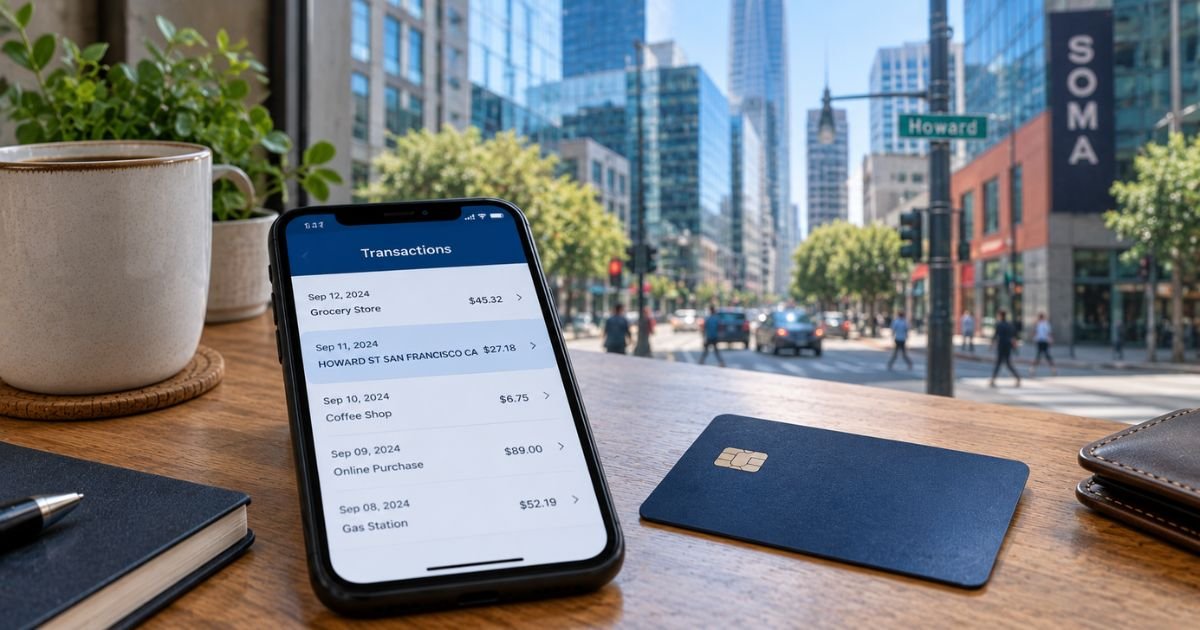
A Howard St San Francisco charge on credit card can feel confusing if you don’t recall signing up for anything. An address on the bill is not always a store name, and it is often a normal billing line.
This guide explains what that street usually means, how issuers shorten it, and how you can match it to a real purchase.
Table of Contents
What Is a Howard St San Francisco Charge on a Credit Card?
A Howard St San Francisco charge on credit card is typically an address-style descriptor. Card networks often print a merchant’s registered street and city when the brand name is missing, truncated, or stored as an office address.
Howard Street is a real commercial corridor in San Francisco. It runs through South of Market and the South Financial District.
Offices, restaurants, hotels, parking, and event venues sit along that street. The line on your statement is usually the billing city on file, not a shop called “Howard St.”
You do not have to be in San Francisco for this text to post. Online and app payments can show the merchant’s office city, not the city where you sat.
How the charge may appear on your statement
Issuers shorten text. You may see only part of the street, or a building number plus the city.
Common patterns include:
- HOWARD ST SAN FRANCISCO CA
- HOWARD STREET SF
- 405 HOWARD ST SAN FRANCISCO CA
- 405 HOWARD ST SAN FRANCISCO 94105
- A brand name plus Howard St on the same line
Look at the full details in your issuer app. The category, any phone digits, the time, and whether the item is pending often help more than the street name.
| What you see | What it typically means | Were you in San Francisco? |
|---|---|---|
| Howard St only | Billing street for a tenant or processor | Not required |
| A building number plus Howard St | A more specific office or venue file | Not required |
| Address plus a brand | Easier to match to an app or receipt | Not required |
| Small same-day hold, then a final amount | Authorization, then the real total | Not required |
| Parking or garage-style amount | A building or nearby lot is possible | More likely if you visited |
Why banks print a street instead of a brand
Merchant files have limited space. A processor may store an office address instead of a consumer brand. Your bank then copies that file onto the statement.
A pending authorization can also look odd. A merchant may hold a small amount first, then replace it with the final total. The street line can stay the same while the dollar amount changes. That is typical card processing, not proof of a new merchant.
Common Howard Street matches
Treat any tenant list as a starting point, not a verdict. Several buildings share this street name.
The most discussed public match is 405 Howard Street, ZIP 94105.
Real-estate listings call that tower Foundry Square II or the Orrick Building. It is a multi-tenant office building with ground-floor retail and a parking garage.
Law firm Orrick has long been a major tenant. Other published occupants have included PwC, Moody’s Analytics, and Fremont Group.
City business records also list food and parking uses at that address, including a café suite and a parking operator. In 2026, news reports said Anthropic took short-term space there while it prepared other Howard Street offices.
That still does not make 405 Howard one consumer store. Coffee, parking, a professional invoice, and an app payment can all reuse the same street line.
Other Howard Street numbers can appear too:
- 300, 342, 400, 500, and 505 Howard sit in the same Foundry Square / South Financial District cluster. Office tenants change over time.
- 747 Howard Street is The Moscone Center. A conference badge, catering bill, or event vendor can print that street.
- 650 Howard Street is a known address for Gold Club. Some older charge reports used other restaurant-style labels for that venue.
- Restaurants, hotels, electronics shops, and garages along Howard can print the street when the brand is cut off.
If your line includes a number, write that number down. 405, 650, and 747 are not the same merchant file.
Is this charge from Uber or an app?
Some consumer posts say a 405 Howard line matched an Uber or Uber Eats total. That report is possible for an individual purchase. It is not proof that every Howard St charge is Uber.
Public records do show a short Uber footprint at 405 Howard. San Francisco business registration listed Uber Technologies Inc. at 405 Howard St., suite 005, with that location ending in 2013.
A 2014 SEC filing also used 405 Howard Street, suite 550. Uber’s current public headquarters is 1725 3rd Street in San Francisco. Uber does not publish a consumer glossary that says “Howard St” equals Uber.
Check the Uber and Uber Eats apps if you use them. Match the date and amount. If nothing lines up, keep looking. Do not stop at the first rumor.
App and software bills can also print an office city. Fintech and SaaS firms in the 94105 ZIP code sometimes store a downtown address. Those matches are not officially confirmed for every “Howard St” line. Use your receipt and login history, not a guess.
How to identify your Howard St San Francisco charge
Work from the date and amount first. Then work from any extra digits on the statement.
- Open the same-day emails and texts. Search “receipt,” “order,” “invoice,” and “San Francisco.”
- Check rideshare, delivery, parking, hotel, and ticketing apps for that date.
- Look at household cards. A partner, teen, or shared wallet can post a charge you did not tap yourself.
- Compare pending versus posted. A hold may drop or change within a few business days.
- If you visited SoMa, think about coffee, lunch, a garage, or a conference badge.
Pro Tip: Screenshot the full transaction in your issuer app before you call anyone. Save the date, time, last four card digits, and the exact descriptor text. That record helps both the merchant and the bank.
Amounts vary too much to guess the merchant from dollars alone. A $6 coffee and a $90 parking exit can share the same street label.
What to do if you do not recognize it
Give a pending line a short window if the amount is tiny and you used a card that day. Many authorizations update on their own.
If the charge posted and you still cannot match it, contact the merchant when you have a brand or invoice. If you only have a street, call the number on the back of your card. Ask whether the item is pending or posted. Ask for any merchant phone or reference your bank can see.
For credit cards, federal billing-error rules generally give you 60 days after the statement that first showed the charge to send a written notice. Issuers often let you start a dispute in the app as well. Policies vary. Debit cards follow a different timeline, so act quickly if the line hit a checking account.
Your issuer may ask you to confirm that nobody in your household made the purchase. Answer that honestly. A family order is not the same as a stolen card.
Common Mistakes: Assuming every Howard St line is Uber. Ignoring a pending hold that later posts under a brand. Waiting weeks to screenshot the descriptor. Calling a random building tenant and treating that person as your merchant.
Lookalikes that are easy to mix up
Do not confuse this street with every other San Francisco address charge. 30 Rockefeller Plaza is a New York billing line. 1955 Broadway Oakland is a different Bay Area address file. “Amazon Retail” and “AMZN MKTP” are Amazon descriptors, not Howard Street.
Also watch for truncated sisters of the same line. “405 HOWARD,” “HOWARD ST SF,” and “HOWARD STREET 94105” can be the same file or different ones. Your issuer’s merchant category code is the clue.
FAQs: Howard St San Francisco Charge on Credit Card
Q. What is a Howard St San Francisco charge on a credit card?
A. It is typically a billing-address descriptor for a business or processor tied to Howard Street in San Francisco. It is not a separate store named “Howard St.” The most discussed match is the multi-tenant tower at 405 Howard Street, but other numbers on the same street can appear.
Q. Is this charge from Uber?
A. Not automatically. Uber once registered a short-lived location at 405 Howard Street, and some people still match the amount to Uber Eats. Uber’s current public headquarters is on 3rd Street. Check your ride and delivery history before you assume the source.
Q. Do I need to have been in San Francisco?
A. No. Online payments, app orders, and corporate invoices often print the merchant’s office city. A local visit is more likely only when the amount looks like parking, a café, or a same-day SoMa purchase.
Q. How do I dispute a Howard St San Francisco charge I do not recognize?
A. Match the date and amount to receipts and apps first. If nothing fits, contact your issuer using the number on your card. For credit cards, written billing-error notice is generally due within 60 days of the statement that first listed the charge. Ask the bank whether the item is pending or posted.
Conclusion
A Howard St San Francisco charge on credit card is usually a street-and-city billing line, not a mystery shop. Howard Street holds offices, food, parking, and event venues, and issuers often hide the brand.
Start with your date, amount, and apps. Use the building number if you have one. Then call your issuer if the purchase still does not belong to you.
Disclaimer: This article is for general information only. It is not financial, legal, or tax advice. Merchant descriptors, refund rules, and dispute timelines vary by issuer, network, and company. Verify account-specific questions with the merchant on your receipt or with the phone number on the back of your card.
Meet the Author
