
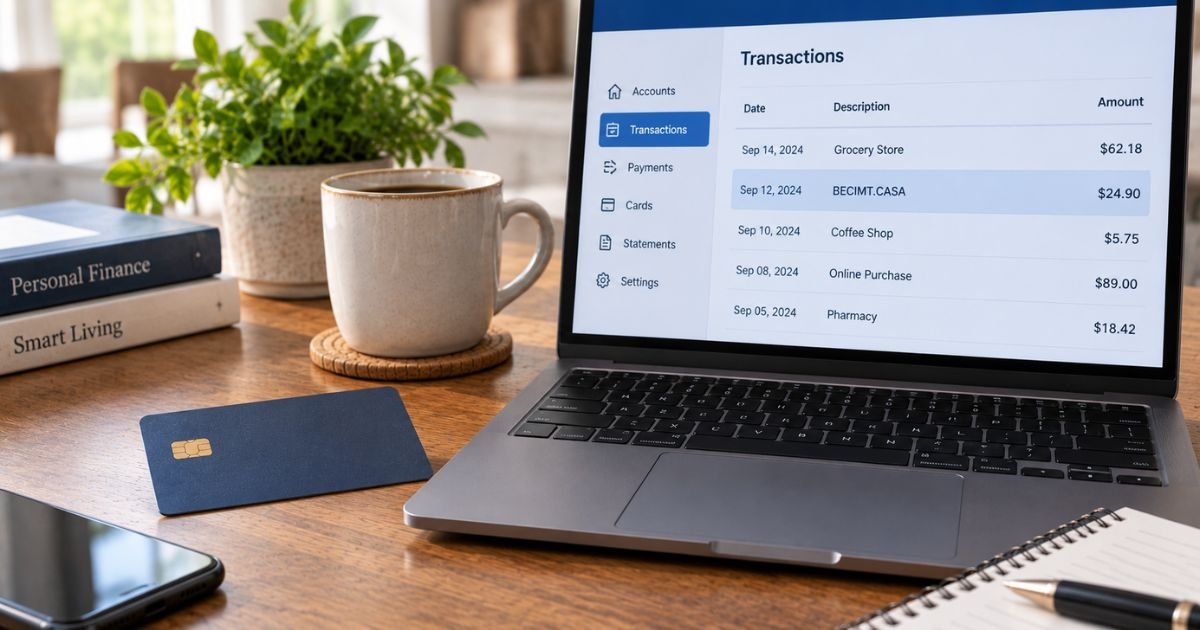
A Becimt.casa charge on credit card can feel confusing if you don’t recall signing up for anything. An odd domain on a statement is often a billing label, not a store you walked into.
This guide explains what that line typically means, what public records show, and how you can match or stop it.
Table of Contents
What Is a Becimt.casa Charge on a Credit Card?
A Becimt.casa charge on credit card is typically a domain-style merchant descriptor. Card networks often print the website name the merchant stored in the billing file. That name may not match the ad, quiz, or checkout page you remember.
Becimt.casa uses the .casa web ending. That ending is a real domain suffix. It is not proof of a house purchase, a rent app, or a bank named Casa.
Public evidence for this exact label is limited. As of mid-September 2026, the website becimt.casa did not resolve. A browser request returned a “site can’t be reached” error. That can happen when a merchant file still bills under an old domain after the shop page goes dark.
A closely spelled site, becimt.net, does load. That page brands itself as “Web Help” customer support. It describes general customer-service help, not a widely known retail brand.
A third-party scanner has listed Beneiver Inc. as the becimt.net registrant and given that domain a low trust score.
A few users on that same report said they saw unexpected card charges and froze their cards. Those comments are not a court finding. They are a signal to check your own receipt with care.
There is no clear official consumer help page that maps “Becimt.casa” to one product, one price, or one cancel button. Do not treat a generic explainer or a rumor price as the merchant’s terms.
How the charge may appear on your statement
Issuers shorten text. Punctuation and the word “casa” can move around.
Common patterns include:
- BECIMT.CASA
- BECIMT CASA
- BECIMT*CASA
- BECIMT.NET
- A small first amount, then a larger follow-up a week or a month later
Look at the full details in your issuer app. The date, time, pending-versus-posted status, and any reference digits usually help more than the domain alone.
| What you see | What it typically means | What to check first |
|---|---|---|
| BECIMT.CASA only | Domain stored as the merchant name | Emails from that week |
| BECIMT.NET | Related support or billing domain | Same inbox search |
| Tiny first charge, then a larger one | Trial or membership conversion is possible | Checkout emails and spam |
| Recurring amount on a cycle | Auto-renew may be on | Card subscriptions list |
| No email and no account | Unauthorized use is possible | Issuer dispute tools |
Why this name does not match a brand you know
Many online shops and membership pages bill under a short domain instead of a friendly product name. Social ads, pop-up quizzes, “continue to read” buttons, and free-trial checkouts often send you to a different URL than the one you clicked first.
Your bank then copies whatever string sits in the merchant file. That is why a charge can say Becimt.casa when you thought you bought a report, a club, a coupon pack, or tech help.
A dead domain does not automatically make the charge fake. Processors can keep billing after a storefront stops loading. It also does not prove the charge is yours. You still need a receipt.
What public records do and do not show
Here is what can be verified, and what cannot.
Verified or directly observed:
- The label looks like a website name, not a major U.S. retailer.
- becimt.casa did not load in a live check in September 2026.
- becimt.net loads as a “Web Help” support-style site and lists a public support email and a U.S. toll-free number in its header.
- A scanner report tied becimt.net to a 2022 registration under Beneiver Inc. and published negative user notes about surprise charges.
Not verified:
- An official product catalog for Becimt.casa
- An official published price or trial length
- A BBB business profile under this exact name
- A large set of Reddit threads that name this descriptor
- A guarantee that every charge is a membership club
If another site quotes a round monthly price for Becimt.casa, treat that figure as unconfirmed unless you see it on your own checkout email.
Lookalikes that are easy to mix up
Do not assume every “casa” line is the same company.
- BECASA is a Florida coastal clothing and home brand at shopbecasa.com. That is a different spelling.
- Casa rent-payment platforms in Canada bill housing payments. Those are not this domain.
- BECU is a credit union. Its own dispute pages are about its cards, not this merchant.
- Beemit / Beem is a payments app with its own statement text.
- Near-spellings such as Bekoche, Becotse, or other BEC-plus-dot-net labels have shown up in unrelated consumer questions. Match the exact letters on your statement.
How to identify your Becimt.casa charge
Work from the date and amount. Then hunt the inbox.
- Search email and spam for “becimt,” “casa,” “membership,” “trial,” and the exact dollar amount.
- Check texts and app-store purchase emails from the same day.
- Ask anyone who shares the card. A partner or teen can complete a checkout you never saw.
- Open your issuer app and see if the line is pending. A hold can change or drop.
- Look at browser history and saved passwords for a matching login.
Pro Tip: Screenshot the full transaction before you call anyone. Save the exact descriptor, date, time, and last four card digits. That record helps both a merchant email and a bank dispute.
If you find an account, use that site’s own cancel path if it still works. If the .casa page is down, try the related .net support contacts only as a possible merchant channel. Do not give remote-access software, gift cards, or a new card number to anyone who calls you first.
What to do if you do not recognize it
If the charge posted and you have no receipt, treat it as unrecognized.
Call the number on the back of your card. Ask whether the item is pending or posted. Ask the bank to block future charges from that merchant if the tool exists.
For credit cards, federal billing-error rules generally give you 60 days after the statement that first showed the charge to send a written notice. Issuers often let you start in the app as well. Debit cards follow a tighter clock, so act quickly.
You can also report an unwanted subscription pattern to the FTC at ReportFraud.ftc.gov. That report does not replace a bank dispute.
Do not pay a second “refund fee” to a stranger who claims they can reverse the line. A real issuer does not ask you to buy gift cards or crypto to cancel a merchant.
Common Mistakes: Calling a random number from a pop-up instead of the number on your card. Assuming a dead website means the billing file is gone. Waiting past the statement window to screenshot the descriptor. Mixing this line up with BECASA clothing or a rent-pay app named Casa.
Is it a scam, a trial, or a real purchase?
It can be any of those. The descriptor alone does not decide.
A real checkout you forgot is still a real checkout. A trial that converted after a small first charge is a common online pattern.
A stolen card number can wear the same domain label. Because the shop page may be gone and independent reviews are thin, lean on your own records.
If you cannot find an account after a careful search, tell your issuer the charge is unauthorized.
FAQs: Becimt.casa Charge on Credit Card
Q. What is a Becimt.casa charge on a credit card?
A. It is typically a domain-style billing label for an online merchant or processor. It is not a major walk-in store. The website becimt.casa did not load in a recent public check, so you may need emails and your bank’s merchant details to identify the sale.
Q. Is Becimt.casa the same as becimt.net?
A. They look related, but they are not proven to be one official product page. becimt.net currently loads as a Web Help support site. Some third-party notes about unexpected charges refer to the .net domain. Match the exact text on your statement before you assume they are the same bill.
Q. How do I cancel a Becimt.casa charge on credit card?
A. First search for a confirmation email and any login. If you find an account, cancel there and keep a screenshot. If the site is down or you never created an account, contact your issuer and ask to stop future billing. Written credit-card billing-error notice is generally due within 60 days of the statement that first listed the charge.
Q. Is a Becimt.casa charge on credit card always fraud?
A. No. It may be a purchase or trial you do not remember. It may also be unauthorized use. Public documentation for this exact name is thin, so use your receipts. If nothing matches after a careful search, report the line to your bank.
Conclusion
A Becimt.casa charge on credit card is usually a website-style billing line, not a household brand you would recognize on a storefront. The .casa page may not load, and public terms are scarce.
Start with your date, amount, and inbox. Use the related .net site only if it matches your records. Then call your issuer if the purchase still does not belong to you.
Disclaimer: This article is for general information only. It is not financial, legal, or tax advice. Merchant descriptors, refund rules, and dispute timelines vary by issuer, network, and company. Verify account-specific questions with the merchant on your receipt or with the phone number on the back of your card.
Meet the Author
