
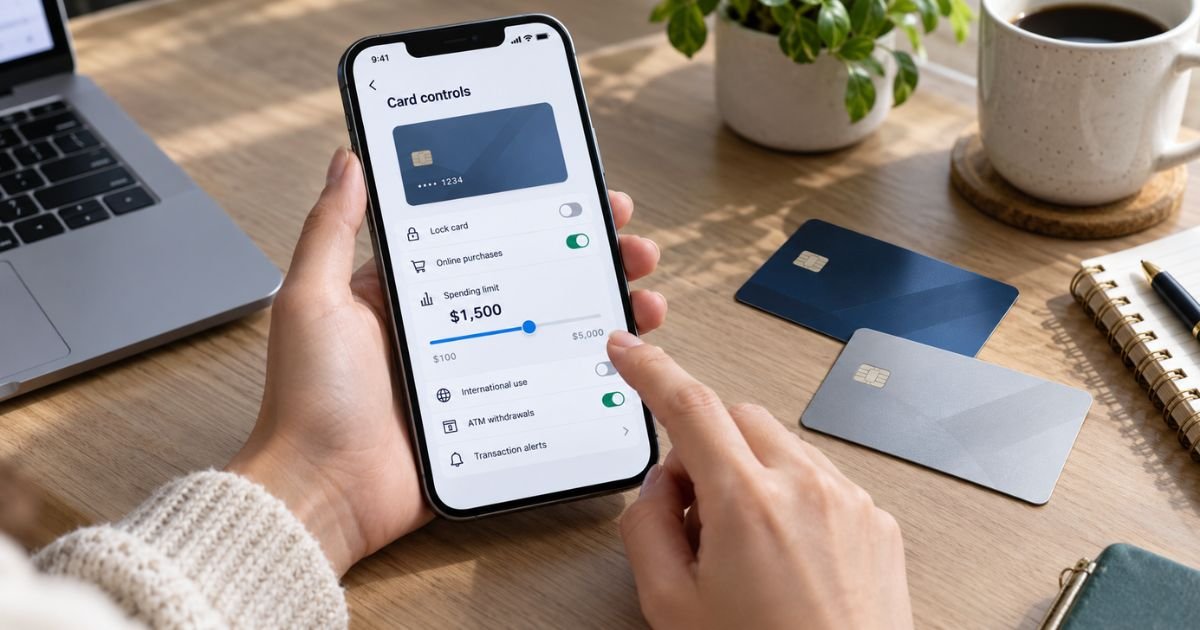
Seeing your card balance climb can feel confusing or stressful when you don’t remember spending that much. Fortunately, many unfamiliar or higher-than-expected transactions are legitimate, and spending controls may help you stay ahead of them.
You can set spending limits on bank cards in several ways. Your options typically depend on your bank, card type, and whether you’re the primary cardholder or an authorized user.
Table of Contents
How Do Spending Limits On Bank Cards Work?
A spending limit controls how much you can charge to a card during a certain period. Depending on your bank, the limit may apply per transaction, per day, per month, or to certain types of purchases.
Banks don’t all offer the same controls. Some let you set a true limit that can cause transactions to decline, while others only provide alerts when your spending reaches a chosen amount.
This distinction matters. A spending alert warns you, but it generally doesn’t stop your card from working.
A card lock is different again. It typically blocks many new purchases until you unlock the card, although recurring charges or certain digital wallet transactions may still go through.
For example, Capital One says you can lock its debit card through its app or website. The bank notes that scheduled payments and transfers may continue even while the card is locked.
Chase similarly lets customers lock eligible debit and credit cards through its app or website. Chase states that recurring transactions may still process on a locked card.
Types of Card Limits You May Be Able to Set
Your bank may offer one or several types of controls.
| Control | What it typically does | Best use |
|---|---|---|
| Daily purchase limit | Caps purchases during one day | Managing debit card spending |
| Per-transaction limit | Restricts individual purchase amounts | Preventing unusually large purchases |
| Monthly spending limit | Caps spending during a billing period | Budgeting |
| ATM withdrawal limit | Limits cash withdrawals | Reducing cash access |
| Spending alert | Sends a notification at a chosen level | Monitoring without blocking purchases |
| Card lock | Temporarily blocks many new transactions | Pausing spending or protecting a misplaced card |
| Authorized-user limit | Restricts another user’s card spending | Family or household budgeting |
Debit cards commonly have bank-set daily transaction or ATM limits. You may not always be able to lower or raise those limits yourself.
Credit cards work differently. Your credit limit is the maximum revolving credit the issuer makes available, not necessarily a budgeting limit you choose yourself.
How to Set a Spending Limit in Your Banking App
Start by opening your bank’s official mobile app or website. Select the checking, debit card, or credit card account you want to manage.
Look for menus such as:
- Card controls
- Manage card
- Spending controls
- Transaction limits
- Account services
- Alerts and notifications
- Lock or unlock card
If your bank offers adjustable limits, choose the type of spending you want to control. You may be able to enter a daily, weekly, or monthly amount.
Review the settings carefully before saving them. Some banks separate purchase limits, ATM limits, online transactions, and international transactions.
The exact menu names vary considerably by issuer.
Pro Tip: Turn on transaction alerts even if you set a spending limit. Alerts can help you catch unusual activity quickly and show you when you’re getting close to your budget.
What If Your Bank Doesn’t Offer a Custom Spending Limit?
Many major credit cards don’t let the primary cardholder create a separate hard monthly budget below the card’s actual credit limit.
Consumer reports reflect this limitation. In Reddit discussions, users frequently report finding spending alerts more widely available than hard self-imposed credit card limits. Some users instead combine alerts with a card lock or use a separate debit or prepaid account for discretionary spending.
You still have several options.
You can set a purchase alert at your target amount. Capital One, for example, offers purchase notifications and balance-related alerts on eligible accounts.
You can also keep your discretionary money in a separate checking account. Your debit card can then access only the amount you intentionally place there, subject to overdraft settings and the bank’s rules.
Another option is to ask your issuer whether it can lower your credit limit. However, lowering a credit line is different from setting a temporary spending budget.
The Consumer Financial Protection Bureau says issuers generally can increase or decrease credit limits. A lower credit limit also changes how much available credit you have, which may affect your credit utilization.
Common Mistakes: Don’t reduce your credit limit simply because you want a monthly budgeting tool without first considering how that change could affect your available credit. A spending alert or separate spending account may accomplish your goal without permanently reducing the credit line.
Setting Limits for Authorized Users
Some credit card issuers provide stronger controls for authorized users than they do for the primary account holder.
An authorized user is someone you allow to make purchases on your credit card account. You remain responsible for charges under the account agreement.
Depending on the issuer, you may be able to give an authorized user a separate spending limit. Policies and minimum amounts vary by card product.
Recent consumer discussions also describe authorized-user limits as one of the more common ways to enforce a true spending ceiling on a credit card. However, you should confirm the feature directly with your issuer before relying on it.
Debit Card Limits vs. Credit Card Limits
Debit card and credit card limits aren’t interchangeable.
A debit card pulls money from your checking account. Banks also commonly impose their own daily purchase and ATM limits for security and fraud control.
A credit card uses a revolving credit line. Once you reach the available credit limit, additional purchases may be declined unless your issuer permits transactions beyond that limit.
Under federal rules, a credit card issuer generally can’t charge an over-the-limit fee unless you’ve opted in to allow transactions that exceed the credit limit. You can generally revoke that consent later.
Your bank’s internal limit can also cause a debit purchase to decline even when you have enough money in your checking account. If you’re planning a large purchase, contact your bank before assuming your card will work.
Can You Use a Card Lock as a Spending Limit?
You can use a card lock as a manual budgeting tool, but it isn’t the same as a true spending limit.
For example, you could set an alert when spending reaches $500. Once you receive the alert, you could lock the card for the rest of the month.
This method requires you to take action yourself. It also may not block subscriptions or other recurring transactions.
Capital One states that locking its debit card prevents card transactions until you unlock it, but scheduled payments and transfers may continue. Chase also states that locking a card doesn’t necessarily stop recurring transactions.
Are Bank Card Spending Controls Reliable?
Spending controls are legitimate features offered by many banks, but availability varies significantly.
The CFPB has previously noted that card issuers increasingly offer tools such as card freezing, virtual card numbers, alerts, and controls over where or how cards can be used.
Consumer reviews show that experiences with large banks can vary. BBB and Trustpilot records for major issuers include complaints about customer service, account restrictions, transaction problems, and other banking issues.
These reviews don’t prove that spending controls themselves are unreliable, but they show why you should verify your own account settings directly with your bank.
FAQs: How To Set Spending Limits On Bank Cards
Q. Can I set a daily spending limit on my debit card?
A. Sometimes. Your bank may let you adjust daily purchase or ATM limits through its app, website, or customer service, but many limits are set internally and can’t be customized.
Q. Can I set my credit card to stop working after I spend a certain amount?
A. Some issuers or card products may support this, especially for authorized users. Many standard credit cards only offer alerts rather than a customizable hard spending cutoff.
Q. Will a locked card stop subscriptions?
A. Not necessarily. Some banks specifically state that recurring or previously authorized transactions may continue even after you lock the card. Check your issuer’s card-lock terms before relying on a lock to stop subscriptions.
Q. Does lowering my credit limit help control spending?
A. It can reduce your available credit, but it isn’t the same as creating a monthly budget. A lower limit may also increase your credit utilization if you carry a balance, so consider alerts or separate spending accounts first.
Conclusion
You can set spending limits on bank cards when your issuer provides adjustable card controls. However, many banks offer alerts, card locks, or bank-set daily limits instead of a customizable hard spending cap.
Check your bank’s app under card controls, account services, or alerts. If you can’t find the feature, contact the issuer using the number on the back of your card and ask specifically about purchase limits, ATM limits, authorized-user controls, and spending alerts.
Disclaimer: This information is for general educational purposes only and isn’t financial or legal advice. Card controls and account policies vary by issuer, so verify account-specific questions directly with your bank or card company.
Meet the Author
