
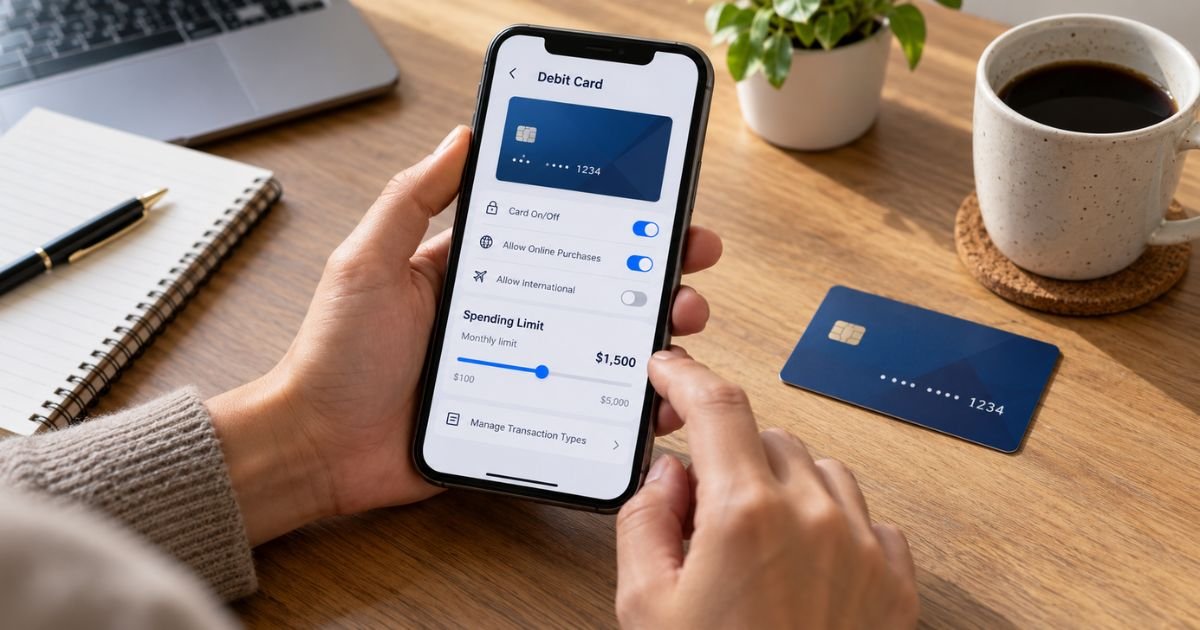
Learning how to set a spending limit on your debit card can help when you want tighter control over everyday purchases. It can also feel confusing if your banking app doesn’t show an obvious spending-limit setting.
You usually have several options, including daily purchase limits, ATM withdrawal limits, transaction alerts, and card locks. This guide explains how each option works and what you can do if your bank doesn’t let you choose a custom limit.
Table of Contents
What Is a Debit Card Spending Limit?
A debit card spending limit is the maximum amount your bank allows you to spend with your card during a certain period. Your bank will typically set a daily purchase limit and a separate ATM withdrawal limit.
Your purchase limit doesn’t determine how much money you have in your checking account. You still need enough available funds to cover the transaction.
For example, Wells Fargo states that its debit cards have daily maximums for purchases and cash withdrawals. You can view or manage those limits through Wells Fargo Online, its mobile app, or by contacting the bank.
Chase also explains that debit card purchase limits and ATM withdrawal limits can be separate. Your exact limits generally depend on your account and card type.
Can You Choose Your Own Debit Card Spending Limit?
Sometimes. Your ability to set a spending limit depends on your bank and the type of debit card you have.
Some banks let you raise or lower your daily limits through online or mobile banking. Other banks may require you to call customer service or visit a branch.
Wells Fargo, for example, says customers can use its Manage Debit Card Limits feature to view or adjust certain dollar limits. You can also request an increase or decrease using the phone number on the back of your card.
Chase says its standard card limits come with the card, although you may contact the bank to request a different ATM or purchase limit. Any requested change can be subject to approval.
This means you shouldn’t assume every bank lets you enter any dollar amount you want.
How to Set a Spending Limit on Your Debit Card in an App
Start with your bank’s official mobile app. Menu names differ, but you can usually find card settings under your checking account or debit card.
Try these steps:
- Sign in to your bank’s official mobile app.
- Open the checking account connected to your debit card.
- Select your debit card or card management settings.
- Look for Card Controls, Manage Card, Card Limits, or Transaction Limits.
- Check your current daily purchase and ATM limits.
- Choose a lower limit if your bank allows changes.
- Review the new amount before confirming it.
- Turn on transaction alerts if they’re available.
Your bank may apply the change immediately, or it may require additional verification. The timing and available amounts can vary by issuer.
Pro Tip: Check whether you’re changing your purchase limit, ATM limit, or both. Lowering your ATM withdrawal limit won’t necessarily reduce how much you can spend at stores or online.
Daily Purchase Limits vs. ATM Withdrawal Limits
Your debit card may have several limits at the same time.
| Limit | What it typically controls |
|---|---|
| Daily purchase limit | How much you can spend on debit card purchases in one day |
| ATM withdrawal limit | How much cash you can withdraw from ATMs |
| Per-transaction limit | The maximum allowed for one transaction, when offered |
| Contactless limit | Certain tap-to-pay transactions, depending on the bank and network |
| Bank security limit | Additional restrictions the bank may apply to certain transactions |
Chase notes that purchase limits can be higher than ATM withdrawal limits. Some banks may also apply a combined daily transaction limit.
Wells Fargo says purchases and ATM withdrawals are also subject to your available account balance. Its card terms also state that additional security limits may apply based on factors such as transaction type or location.
As a result, having $5,000 in your checking account doesn’t necessarily mean your debit card will approve a $5,000 purchase.
What to Do If You Can’t Find a Spending Limit Setting
Your bank may not offer customer-controlled purchase limits for your particular account.
First, check your bank’s app and online banking site. Search for card controls or debit card settings rather than only looking under account preferences.
Next, call the number printed on the back of your debit card. Ask whether you can lower your daily purchase limit and ATM withdrawal limit.
You can ask specifically:
- What is my current daily purchase limit?
- What is my current ATM withdrawal limit?
- Can I lower either limit?
- Can I change the limits through the mobile app?
- Can I set a temporary limit?
- When would a new limit take effect?
Use official bank contact information from your card or authenticated banking app. Don’t rely on a phone number from an unsolicited text message or email.
Use Debit Card Alerts If You Can’t Set a Hard Limit
A spending alert can be useful when your bank won’t let you create a custom hard limit.
An alert doesn’t normally block the transaction. Instead, your bank sends you a push notification, email, or text when card activity meets your selected conditions.
Wells Fargo says debit card alerts can help you track purchases and ATM withdrawals. Capital One also promotes instant alerts as a way to monitor debit card spending.
For example, if your weekly discretionary budget is $300, you could set alerts for larger purchases and monitor your account balance throughout the week.
You may also be able to receive alerts whenever your debit card is used. That can make unusual transactions easier to notice.
Common Mistakes: Don’t confuse an alert with a spending limit. An alert usually tells you that a transaction happened. It generally doesn’t prevent another purchase from going through.
Can You Lock Your Debit Card After Reaching Your Limit?
You can sometimes use your card’s lock feature as a manual spending control.
For example, you might decide to stop discretionary debit card purchases after you’ve spent $500. Once you reach that amount, you could temporarily lock the card in your banking app.
Capital One says locking its debit card prevents debit card transactions until you unlock it. However, automatic bill payments and certain scheduled transfers can continue.
That distinction is important if you’re trying to control subscriptions. Locking your card shouldn’t be treated as a reliable way to cancel a recurring service.
Cancel an unwanted subscription directly with the merchant whenever possible.
Can You Set Spending Limits on a Child’s Debit Card?
Some youth and family banking products give parents more control than standard checking accounts.
For example, Chase First Banking lets a parent set controls for where and how much a child can spend or withdraw. Chase currently lists a $400 daily purchase limit and a $100 daily ATM withdrawal limit for that product.
Those features don’t mean the same controls are available on ordinary adult debit cards.
If you’re choosing an account for a child or teenager, check whether you can set merchant categories, purchase amounts, ATM limits, or individual spending controls before opening the account.
Why Banks Set Debit Card Limits
Spending limits aren’t only budgeting tools. Your bank may also use them to manage security and reduce exposure to unauthorized transactions.
For example, an ATM limit can restrict the amount someone could withdraw if your card and PIN were compromised.
Banks may also change or restrict limits based on account history, transaction patterns, and security considerations. Wells Fargo states in its debit card terms that additional limits may apply to the amount, number, or type of transactions you can make.
This is one reason a transaction can sometimes be declined even when your account has enough money.
What Consumers Report About Debit Card Limits
Consumer experiences vary significantly by bank.
Reddit discussions commonly show confusion about whether a limit applies per transaction, per day, or to a specific payment method. Those reports are anecdotal, but they reinforce why you should confirm your exact limit through your own bank rather than relying on another customer’s experience.
BBB complaints involving large banks also include reports about debit card transactions, account restrictions, and unauthorized charges. BBB complaints represent individual consumer claims and don’t establish that a bank’s overall debit card controls are defective.
Trustpilot reviews for Chase similarly include complaints about account access, security restrictions, and customer service. Online reviews can help identify recurring concerns, but they aren’t a substitute for your account agreement or your bank’s official policies.
What Happens When You Reach Your Debit Card Limit?
Your transaction will typically be declined if it would put you over an applicable debit card limit.
You may still have enough money in your checking account. The decline can occur because the card limit and your account balance are separate restrictions.
If you’re making an unusually large legitimate purchase, contact your bank before trying the card repeatedly. Your bank may be able to explain your current limit or approve a requested change.
Avoid splitting a transaction into multiple smaller purchases unless your bank and merchant confirm that doing so is permitted and useful. Banks can apply cumulative daily limits, so several smaller transactions may still reach the same cap.
FAQs: How to Set a Spending Limit on Your Debit Card
Q. Can you lower your debit card spending limit?
A. You generally can at some banks, but policies vary. Check your bank’s card controls or call the number on the back of your debit card to ask whether your daily purchase and ATM limits can be reduced.
Q. Can you set a monthly limit on a debit card?
A. Most standard debit card limits are typically daily rather than monthly. Your bank may offer budgeting alerts or specialized family card controls if you want a monthly spending target.
Q. Does a debit card limit include ATM withdrawals?
A. Not always. Banks commonly maintain separate purchase and ATM withdrawal limits, although some may also apply combined or additional transaction restrictions.
Q. Will recurring payments stop when you reach your debit card limit?
A. Not necessarily. Recurring payments can be handled differently from ordinary card purchases, and a card lock may not stop certain scheduled payments. If you want to end a subscription, cancel it directly with the merchant.
Conclusion
Knowing how to set a spending limit on your debit card can give you more control over purchases and cash withdrawals. Your bank may let you adjust daily limits directly, or you may need to contact customer service.
If custom limits aren’t available, you can still use transaction alerts, balance notifications, budgeting tools, or a temporary card lock. Always confirm the exact rules through your bank because debit card controls, approval requirements, and transaction limits can vary by account.
Disclaimer: This article is for informational purposes only and isn’t financial or legal advice. Debit card limits and banking policies vary by issuer, so verify account-specific questions directly with your bank.
Meet the Author
