
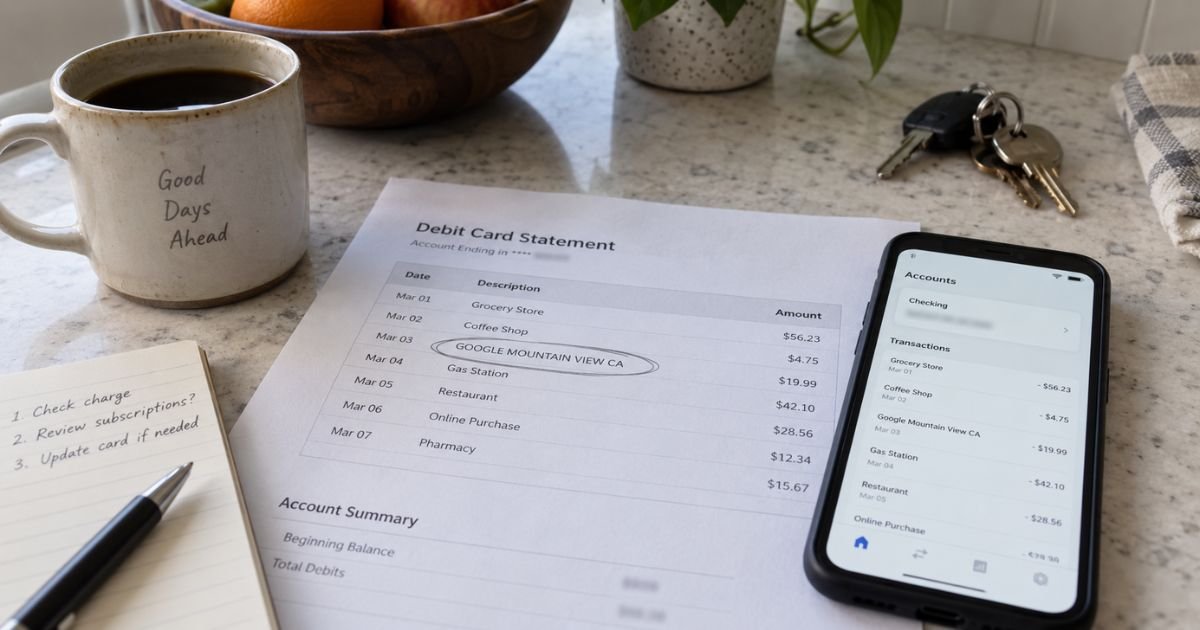
A Google Mountain View charge on a debit card can feel confusing if you don’t recall signing up for anything. Mountain View is Google’s headquarters city, not a shop you visited. Many of these lines are everyday Play, YouTube, storage, or ads billing that your bank shortened.
This guide explains how official Google help maps those labels, how to match the debit in your Google account, and what to do if the charge is not yours.
Table of Contents
What Is a Google Mountain View Charge on a Debit Card?
A Google Mountain View charge on debit card is typically a payment billed through Google. Official Google Pay help says a Google purchase generally starts with GOOGLE* and then names the product or another short descriptor. Your bank may cut that text and add the merchant city.
That city is usually Mountain View, California. Google LLC lists its address as 1600 Amphitheatre Parkway, Mountain View, CA 94043. Banks often print that city on the statement even when you bought an app from your couch.
The line is not proof you traveled to California. It also is not automatically fraud. Google sells many products under one payment system, so the city stays the same while the words after GOOGLE* change.
Official Google Play help is more specific for app-store buys. Play purchases generally show as GOOGLE* plus an app developer name, an app name, or a content type such as Books.
If your debit line does not follow a Google format at all, official Play help says it did not come from Google Play. In that case, start with your bank.
How the line may appear on a debit statement
Issuers add their own prefixes. The useful part is still the Google text and any product name next to Mountain View.
| What you may see | What official help generally maps it to |
|---|---|
| GOOGLE *GOOGLE or GOOGLE *YouTube, plus Mountain View CA | Often YouTube Premium or a related YouTube paid product |
| GOOGLE* Google Storage | Often Google One or Drive storage |
| GOOGLE *Play, GOOGLE *{app}, or GOOGLE *{developer} | Google Play apps, games, or in-app items |
| GOOGLE *YouTube Videos | YouTube movie or video purchases |
| GOOGLE *SERVICES | Official table lists Google Fiber and YouTube TV |
| GOOGLE *Devices or GOOGLE STORE | Google Store hardware |
| GOOGLE *Ads, GOOGLE *ADWS, or similar | Google Ads spend |
| GOOGLE *TEMPORARY HOLD, GOOGLE *CHROME TEMP, GOOGLE *ANDROID TEMP, GOOGLE *GPAY TEMP | Card checks or Autofill tests, not a finished sale |
| CHKCARD / POS DEBIT / PRE-AUTH plus Google Mountain View | Your bank’s debit wording around the same merchant |
Some statements also show G.CO/HELPPAY or a fragment of 1600 Amphitheatre Parkway. Those are Google help or address leftovers, not a second company.
A pending hold is different from a posted debit. Official Google help says GOOGLE *TEMPORARY HOLD is a check that the card works. The hold should drop when the real sale posts, or when the check ends. Timing varies by bank.
Common reasons this debit posts
Match the amount and date before you assume the worst.
- A Play Store app, game, movie, book, or in-app item
- A YouTube Premium, YouTube Music, or YouTube TV renewal
- Google One or Drive storage
- A Google Workspace plan on a domain you manage
- Google Ads or Cloud billing on a business profile
- A Google Store device order
- A Play Family Group buy billed to the family manager’s card
- A card-on-file check when you added the debit card to Wallet, Chrome, or a Google product
Household use is a frequent surprise. A child on a shared tablet, a partner on Family Library, or a second Gmail account with the same debit card can create a Google Mountain View line you did not tap yourself.
Pro Tip: Check every Google account that might hold that debit card. Official community experts repeat this because Google support can only see the account you are signed into. Open payments.google.com, Play order history, and myaccount.google.com/subscriptions on each address.
How to identify the charge in your Google account
Use Google’s own ledgers first. They usually show the product name your bank hid.
- Sign in at payments.google.com and open Activity.
- Open play.google.com, then Payments & subscriptions, then Budget & order history.
- Open myaccount.google.com/subscriptions for Google-billed plans.
- For YouTube, also check youtube.com/paid_memberships or youtube.com/purchases.
- Search Gmail for receipts from google.com or youtube.com with the same dollar amount.
- Repeat those steps on work, school, old, and family Google accounts.
If the debit matches a receipt, the charge is generally a real Google payment. Then decide whether you want to keep the product.
If nothing matches any account you control, official Play help says to contact your payment method’s fraud department. Google generally cannot map a bank line to an account it does not have in front of it.
How to cancel a Google plan tied to the debit card
Cancel on the platform that billed you. Deleting an app generally does not stop renewal. Official Play help says uninstalling the app will not cancel the subscription.
Google Play subscriptions
- On Android, open Google Play subscriptions, tap the plan, then Cancel subscription.
- Follow the on-screen steps and save the confirmation.
YouTube Premium or YouTube Music billed by Google
- Official YouTube help lets you cancel from Paid memberships in the app or on the web.
- If you joined through the iPhone app, cancel in Apple Subscriptions instead.
- If Play billed the membership, cancel inside Google Play.
Google One or other Google subscriptions
- Manage them in the product account or at Google subscriptions.
- Confirm an end date so you know when access stops.
Official YouTube help says benefits generally last until the end of the period you already paid. You typically are not charged again unless you resubscribe. Refund rules vary by product and are not automatic.
What to do if the Google Mountain View debit is not yours
Stay calm and move in two tracks: Google, then your bank.
On Google, use the official unrecognized-transaction tools while signed into the account that shows the purchase.
Official Play help says Google can generally act on card or PayPal Play claims only within 120 days of the transaction date. After that window, Play help tells you to go to the card or PayPal fraud team.
If the debit does not appear on any Google account you own, skip the hunt for a mystery merchant phone. Call the number on the back of your debit card.
Debit cards follow the Electronic Fund Transfer Act and Regulation E, not the same clock as a credit card.
- Report a lost or stolen debit card quickly. Federal rules generally cap liability at $50 if you notify the bank within two business days after you learn the card is missing.
- Wait longer than two business days, and that cap can rise to $500 for transfers the bank shows it could have stopped.
- Report an unauthorized transfer that appears on a statement within 60 days after the bank sent that statement. Missing that window can leave you open to later unauthorized transfers.
After a proper error notice, the bank generally has 10 business days to investigate. If it needs more time, it may take up to 45 days if it gives provisional credit within those 10 business days.
Some point-of-sale debit reviews can run longer, up to 90 days. New accounts can use a longer first window.
Ask the bank to block further Google merchant activity on that card number if it offers that control. Replacing the debit card typically stops new charges on the old number. It does not cancel a Google plan stored on a different card.
Common Mistakes: Checking only one Gmail address. Deleting YouTube or a game and thinking billing stopped. And waiting weeks on a debit line while the Regulation E clock runs. Match the charge the same day you see it.
Also turn on purchase authentication in Play so a PIN, password, or biometric is required for every buy. That does not erase a posted debit, but it can stop the next surprise.
FAQs: Google Mountain View Charge on Debit Card
Q. Is a Google Mountain View charge on a debit card a local California store?
A. Generally no. Mountain View is the city in Google’s headquarters address. Official help describes Google purchases as GOOGLE* plus a product or other descriptor. Your bank adds the city. You typically did not shop in person at the Google campus.
Q. Why don’t I see the app name on my bank statement?
A. Banks shorten merchant text. Official Play help says Play buys should still start with GOOGLE* and then an app, developer, or content type, but issuers often keep only Google and Mountain View. Open Play order history and payments.google.com to see the full item name.
Q. How long do I have to report an unauthorized Google Play debit?
A. Official Play help says Google can generally act on card or PayPal Play transactions within 120 days of the transaction date. Your bank’s Regulation E notice window is separate. Report a statement error to the bank within 60 days after that statement was sent, and report a missing debit card even faster.
Q. Can a child or family member cause this charge?
A. Yes. Official Google pages note family and friends as a common reason people do not recognize a charge. A Play Family Group, a shared Android tablet, or a second Google account with your debit card on file can post as Google Mountain View on your statement. Check those accounts, then change the payment method or purchase PIN.
Conclusion
A Google Mountain View charge on a debit card is usually Google’s own billing label plus its headquarters city. Official tables point you to Play, YouTube, storage, ads, Workspace, or a short card check.
Match the date and amount in payments.google.com and Play order history first. Cancel any plan you no longer want, and use your bank’s debit dispute path when the line is not on an account you control.
Disclaimer: This article is for general information only. It is not financial, legal, or tax advice. Google descriptors, refund windows, and bank Regulation E procedures vary by product and issuer. Verify account-specific questions with Google help for the signed-in account or with your bank.
Meet the Author
