
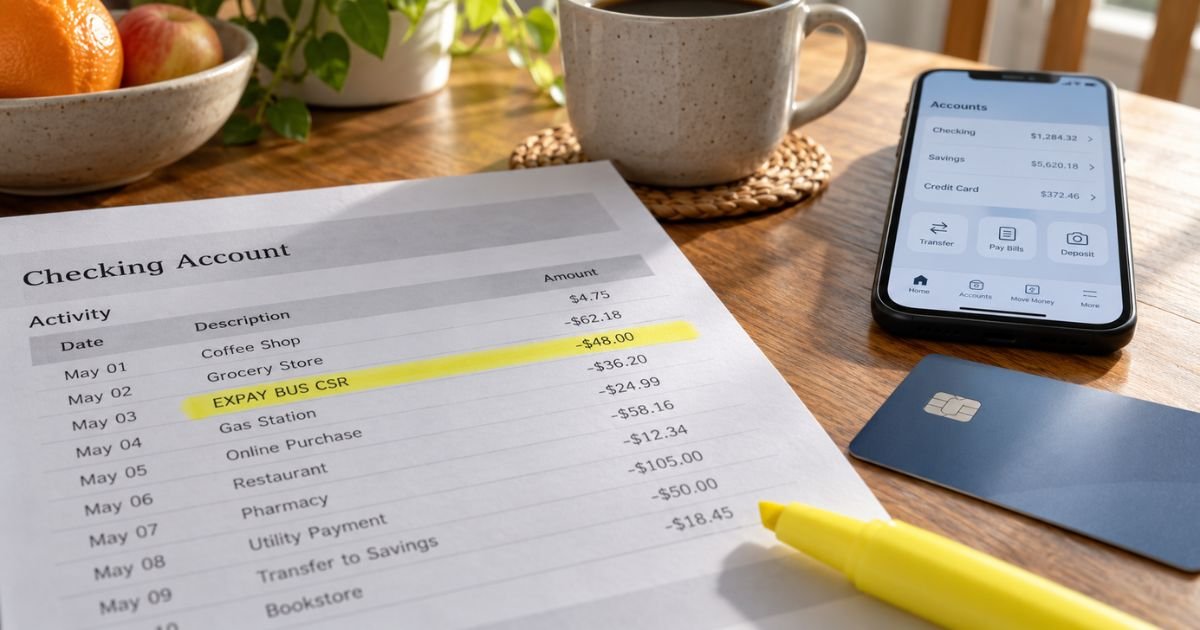
An EXPAY BUS CSR on bank statement can feel confusing if you don’t recall signing up for anything. Unfamiliar wording is often a shortened merchant name, not proof of fraud.
This guide explains what the letters may mean, what they do not prove, and how to match or dispute the line.
Table of Contents
What Is an EXPAY BUS CSR Charge on a Bank Statement?
An EXPAY BUS CSR charge on bank statement is a card or debit descriptor. It is the short merchant text your bank prints next to the amount. Banks typically cut long names to fit a tight field. That is why the line can look like code instead of a store you remember.
No official US consumer company help page reviewed for this article publishes EXPAY BUS CSR as a confirmed billing name. The string has shown up in recent cardholder searches and public reports. Some versions add extra letters or a city. That still does not name one verified seller by itself.
Treat the line as a clue. Match the date, amount, and card first. Then ask your issuer for the expanded merchant record if the wording stays unclear.
How the wording usually appears
Issuers shorten the same sale in different ways. Reported or indexed variations include:
- EXPAY BUS CSR
- EXPAY BUS CSR CVGS
- EXPAY BUS CSR CVGS AGS
- EXPAY BUS CSR CVGS AGS DALLAS TX
- EXPAY BUS DALLAS TX
- PENDING EXPAY BUS CSR
- DEBIT CARD EXPAY BUS CSR
- POS PURCHASE EXPAY BUS CSR
The longer string is more useful for a search. It still does not prove one company. PENDING generally means an authorization hold, not a final posted sale. POS typically means a card-present or processor-coded purchase, not a separate brand.
Pro Tip: Copy the full descriptor from your app, not just the first two words. Ask your issuer for the merchant name, city, phone, and category code. That extra record is often clearer than the printed line.
Is this an Expedia charge?
Expedia is a possible lead, not a confirmed match for your line. One current third-party merchant-code database groups several EXPAY BUS CSR and CVGS AGS variations under Expedia. Official Expedia materials reviewed for this article do not publish EXPAY BUS CSR as a statement name.
Expedia’s better-documented wording is usually closer to EXPEDIA, EXPEDIA*TRAVEL, or EXPEDIA plus an itinerary-style number. Expedia Group’s US headquarters is in Seattle, not Dallas. A Dallas suffix therefore does not prove an Expedia store visit.
If you used Expedia, Hotels.com, Vrbo, or a linked package around the same date, open Trips or your confirmation email. Compare the total, taxes, and add-ons. Packages can split into more than one card line. A hotel or airline partner may bill separately.
If nothing in your Expedia account matches, do not assume the charge is Expedia just because the letters look similar. Similar spelling is not proof.
What BUS, CSR, CVGS, and AGS might mean
These abbreviations are not officially defined for this descriptor. Educated guesses are only guesses.
BUS may mean business. It may also mean bus travel. It may be the leftover middle of a longer truncated word.
CSR may mean customer service, consumer services, or an internal merchant code. It is not proof of a corporate “CSR” report, and it is not a certificate file from a digital wallet.
CVGS and AGS have no confirmed public expansion tied to this exact string. They may be processor codes, product codes, or leftover fragments. Do not call a company based only on those four letters.
Why Dallas TX can show up
Some longer versions add DALLAS TX. That city is usually the merchant-account or processor location sent through the card network. It does not prove you used a card in Dallas. It also does not prove a Dallas bus, toll, airport, or city bill.
Online guesses have linked the city to local transit or parking. No official source reviewed for this article confirms that link for EXPAY BUS CSR. Compare the date with any Texas travel you actually took. Then rely on the issuer’s expanded record, not the city alone.
Lookalike names to rule out
Several real businesses share part of the wording. Shared letters are not the same as a match.
| Name | What it is | Why it may not be your charge |
|---|---|---|
| Expedia / Expedia Group | Online travel bookings | Official help does not list this exact string |
| EXPAY Corporation | QR-code payment service described on its public profile | No official link to this US descriptor was found |
| Exectras ExPay | Texas payment products for merchants (Sugar Land area) | Processor brand for businesses, not a confirmed consumer storefront for this line |
| Experian | Credit-report company | Similar start letters only |
| Bus tickets or city transit | Greyhound, FlixBus, local agencies, and similar | BUS on a statement is often “business,” not a coach ticket |
Do not email or accuse a lookalike firm unless your bank’s expanded record, a receipt, or an official site confirms that firm.
Common Mistakes: Searching only “Expay” and calling the first number that appears. Scam pages and lookalike payment brands show up in those results. Use the number on your card or the company’s official site.
How to match the charge
Work through this list before you dispute.
- Match the exact date, amount, last four card digits, and pending versus posted status.
- Check email and texts for travel, tickets, memberships, or “card on file” receipts from that week.
- Ask every authorized user, including a partner, teen, or household member with the card or wallet.
- Search your phone for Expedia, Hotels.com, Vrbo, bus apps, parking apps, and any EXPAY-style wallet.
- Look at the issuer category. Travel or transportation can jog your memory even when the name does not.
- Call the number on the back of your card and ask for the full merchant name, city, phone, and reference number.
A pending line may drop in a few business days if it was only a card check. A posted line needs a refund or a formal dispute if nobody recognizes it.
If an Expedia trip does match, use Expedia’s official contact page at expedia.com/lp/b/getintouch or Help inside the app.
Official Expedia pages warn that fake phone numbers circulate online. Start on the real site or app. Do not give a one-time passcode or wire money to anyone who calls you first.
What to do if you still do not recognize it
If no receipt or household user explains the posted charge, treat it as unrecognized.
On a credit card, federal billing-error rules under the Fair Credit Billing Act generally give you 60 days from the statement that first showed the charge to send a written notice.
The CFPB explains that issuers generally must acknowledge a billing-error claim within 30 days and resolve it within two billing cycles, not more than 90 days. Pay any amount you do recognize while the rest is under review.
On a debit card or bank account, report the problem quickly. Electronic fund transfer rules use different clocks than credit cards. Fast notice generally gives you stronger protection if the card or number was stolen.
Keep screenshots of the descriptor, amount, date, and reference number. Write down every call. Ask whether the card or digital-wallet token should be replaced if the merchant cannot be identified.
Do not click a surprise “refund” text. Do not read a card number to a caller who found you. Start with your issuer.
FAQs: EXPAY BUS CSR on Bank Statement
Q. What is EXPAY BUS CSR on my credit card?
A. It is a shortened statement descriptor, not a confirmed brand name by itself. One third-party database groups some versions with Expedia, but Expedia does not officially publish this string. Ask your issuer for the expanded merchant record and match the date and amount to receipts.
Q. Does EXPAY BUS CSR mean I bought a bus ticket?
A. Not necessarily. BUS may mean business or another truncated word. Compare the date with any coach, transit, or parking purchase you actually made. If nothing matches, use the issuer record instead of guessing from three letters.
Q. Why does my statement say Dallas TX?
A. Dallas is typically the city stored on the merchant account, not proof you shopped there. It does not identify the company by itself. Ask the bank for the full merchant name and phone before you call anyone.
Q. How do I dispute an EXPAY BUS CSR charge I do not recognize?
A. Freeze the card if the sale looks unauthorized. Save the statement line. Ask other card users. Then contact the issuer using the number on the card. For credit cards, send written notice within 60 days of the statement that first listed the charge. Follow the issuer’s fraud or billing-error steps.
Conclusion
An EXPAY BUS CSR on bank statement is usually a compressed billing label, not a clear storefront name. Expedia is the strongest public lead found in third-party descriptor data, but it is not official confirmation.
Match your own receipts first. Use the issuer’s expanded merchant record next. Dispute only the lines nobody in your household can explain.
Disclaimer: This article is for general information only. It is not financial, legal, or tax advice. Merchant names, refund rules, and dispute timelines vary by company and issuer. Confirm account-specific questions with the merchant your bank identifies or with your bank or card issuer.
Meet the Author
