
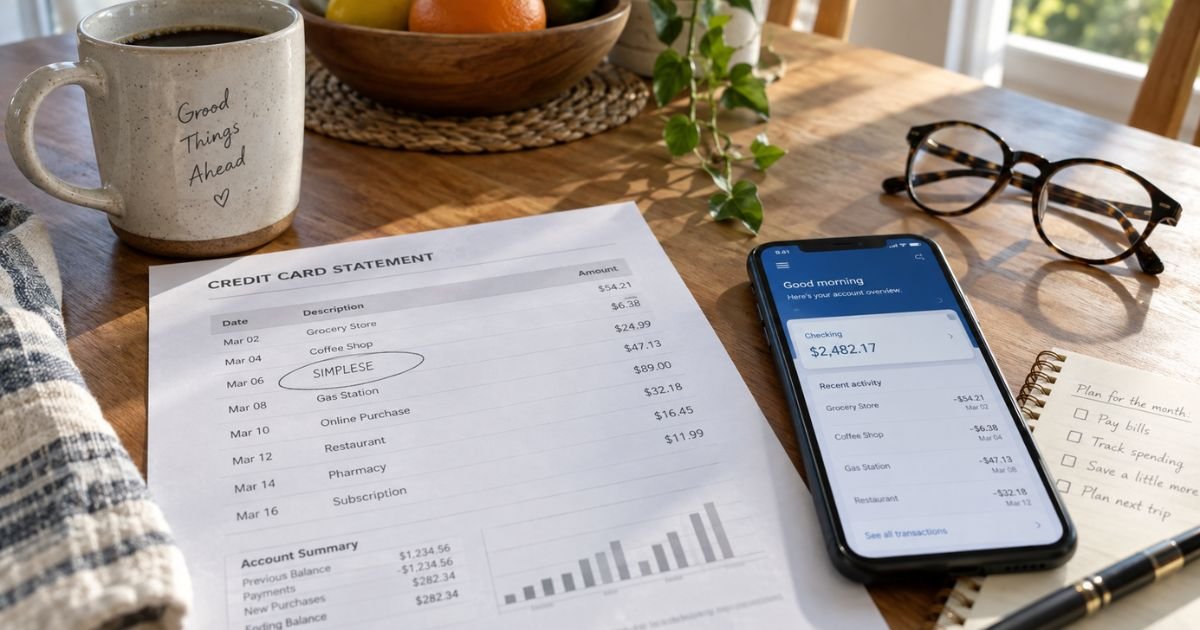
A Simplese charge on a credit card can feel confusing if you don’t recall signing up for anything. An unfamiliar merchant name is often a shortened billing label, a parent company, or a lookalike brand. It is not automatically fraud.
This guide explains what public records show about Simplese, which similar names get mixed up with it, and the calm steps to match, cancel, or dispute the line.
Table of Contents
What Is a Simplese Charge on a Credit Card?
A Simplese charge on credit card is a statement descriptor. That is the short name your issuer prints next to a purchase. Banks generally have tight character limits, so names get cut, misspelled, or rewritten.
There is no single official U.S. consumer help page that lists SIMPLESE as one company’s published billing name. Charge-lookup sites first logged the string around late December 2024.
Community comments since then have been mixed. Some people said their bank treated the debit as unauthorized and replaced the card. Other users marked a similar line as a purchase they later recognized.
Treat that public trail as a starting point, not proof. User-submitted “authorized” and “unauthorized” tallies are unofficial. They do not identify the legal merchant behind every Simplese line.
The safest read is this. Your Simplese charge is typically one of four things:
- A truncated or mistyped name for a “Simple” or “Simplee” brand
- A custom DBA set by a small merchant or payment processor
- A pending authorization that later posts or drops
- An unrecognized charge that you should match, then dispute if it is not yours
Your issuer’s extra details often help more than the name alone. Look for a city, state, phone fragment, website, or category code on the same line.
How a Simplese line may appear
Issuers format the same merchant in different ways. Public lookup pages have listed variants such as:
| What you may see | What it usually means |
|---|---|
| SIMPLESE | Short merchant or DBA name |
| CHKCARD Simplese / CHECKCARD Simplese | Debit or check-card posting language from your bank |
| POS PUR / POS PURCHASE Simplese | Point-of-sale purchase wording |
| PRE-AUTH Simplese / PENDING Simplese | Temporary hold that may post or fall off |
| POS REFUND Simplese | A credit or reversal from the same descriptor |
| Misc. Debit Simplese | Generic bank category, not a product name |
The prefix is often your bank’s label, not the seller’s brand. Focus on the word Simplese, the date, the amount, and any city or phone that sits next to it.
Brands that get confused with Simplese
Several real businesses use a close spelling. None of them has an official public glossary that confirms every SIMPLESE line belongs to them. Use these as match-checks only.
| Lookalike | What it typically is | How it often bills |
|---|---|---|
| Simplee (now part of Flywire) | Hospital and clinic patient-payment software | Often the health system’s name; Simplee may appear in billing emails or portals |
| Simple Premium / Simple Life app | Intermittent-fasting and coaching app at simple.life | Reports often show Simple Premium or Simple App Premium, sometimes with Dover DE |
| SimplePractice | Practice software. Therapists charge clients through it | Official default descriptor is SimplePractice LLC if the practice does not set a custom name |
| Shop Simplee | Online clothing shop at shopsimplee.com | Typically an ecommerce clothing order, not a mystery fee |
| PaySimple / SwipeSimple | Merchant payment tools | Usually a store or invoice you paid, billed under the processor or the shop name |
| Simple Sign | Contract and e-signature software | Typically a business SaaS invoice, not a random retail buy |
If your statement also says Premium, Dover DE, LLC, or a clinic name, you are probably looking at one of those lookalikes rather than a unique “Simplese store.”
If you bought clothes, paid a medical bill online, sat with a therapist, or started a fasting-app trial that week, start there. Match the date and amount before you assume fraud.
Pro Tip: Search your email for the exact dollar amount plus words like Simple, Simplee, receipt, or order. Also check Apple Subscriptions, Google Play subscriptions, PayPal, and any hospital or therapy portal. The statement name is often shorter than the brand in your inbox.
How to match a Simplese charge
Work from facts you already have. You generally do not need the merchant’s phone number to start.
- Copy the full descriptor, date, amount, and last four card digits.
- Open your issuer app and tap the line for merchant city, category, or phone.
- Check household cards and authorized users for that date.
- Search email and texts for the amount.
- Review Apple, Google, Amazon, PayPal, and store accounts for the same day.
- Think about ads, quizzes, free trials, and in-app upgrades from that week.
A pending Simplese line is not always a finished sale. Hotels, gas pumps, and some online checkouts place a short hold first. Holds typically drop in a few business days if the sale does not settle. Timing varies by issuer.
A posted charge that matches a receipt is generally a real purchase, even if the name looks odd.
What to do if you do not recognize it
Stay methodical. Unfamiliar is not the same as unauthorized.
Call or chat with the merchant only if you can confirm an official site from a receipt, app listing, or hospital portal. Do not use a number from a pop-up, text, or unexpected email.
If you find a subscription, cancel it on the platform that billed you:
- Apple: Settings, then your name, then Subscriptions
- Google Play: profile, then Payments & subscriptions, then Subscriptions
- A website account: billing or plan-management page for that exact brand
Deleting an app generally does not stop billing. Cancel the plan, then watch the next statement.
If you cannot find any signup, treat the charge as unrecognized. Contact your card issuer using the number on the back of the card. Ask the bank to add merchant details if the line is still thin.
Common Mistakes: Waiting for “one more cycle” to see if it repeats. Paying a caller who claims to be Simplese support. And assuming a pending hold is a second purchase. Act on posted lines you do not recognize, and ignore random payment links.
How to dispute a Simplese charge
For a U.S. credit card, unauthorized use and billing errors generally fall under federal card rules.
The Fair Credit Billing Act typically gives you 60 days from the statement date that first showed the error to send a written dispute.
Your issuer generally must acknowledge a proper written billing-error notice within 30 days and finish the investigation within two billing cycles, not more than 90 days.
Unauthorized use of a credit card is generally capped at $50 under federal law. Many large issuers advertise $0 liability when only the card number was used, but that is a network or issuer policy, not a promise in this article. Confirm your card’s rules in writing.
Debit cards follow different Electronic Fund Transfer clocks. Report a debit problem quickly. Waiting can raise your exposure if the card itself was lost or stolen.
When you dispute:
- Say you do not recognize the Simplese merchant
- Include the date, amount, and descriptor exactly as printed
- Note that you already checked household users and email
- Ask the issuer to block future charges from that merchant ID if available
- Keep paying any amount you do recognize by the due date
Your issuer may close the card number and send a replacement. That typically stops new charges on the old number. It does not automatically cancel a subscription tied to a different stored card.
You can also report unwanted recurring billing to the FTC at ReportFraud.ftc.gov and, if you want a written record with the company, file a complaint through the CFPB complaint portal. Those steps do not replace the issuer dispute clock.
How to reduce the chance of another surprise line
A few habits catch truncated names early.
- Turn on issuer alerts for every posted transaction
- Review pending and posted activity weekly
- Keep a simple folder for receipts and trial emails
- Use virtual card numbers for new websites when your issuer offers them
- After a dispute, watch the next two statements for a reversal and for a repeat attempt
If a refund posts as POS REFUND Simplese, match it to the original amount. A partial credit is not always a full reversal.
FAQs: Simplese Charge on Credit Card
Q. Is a Simplese charge on a credit card always fraud?
A. No. Public reports are mixed, and no official company glossary pins every SIMPLESE line to one store. Many unfamiliar names are truncated brands or processor labels. It may still be unauthorized if you find no receipt, trial, household purchase, or matching email. Match first, then dispute what you cannot explain.
Q. Could Simplese be the Simple fasting app or Simplee medical billing?
A. It could be a lookalike, but that is an educated inference, not a confirmed official descriptor. The Simple Life app is more often reported as Simple Premium. Simplee by Flywire is hospital payment software and may show the health system instead. Use the date, amount, and any city on your line before you assume either one.
Q. How long do I have to dispute a Simplese charge?
A. For a credit card billing error, written notice is generally due within 60 days of the statement that first listed the charge. Issuers typically acknowledge that notice within 30 days and resolve it within 90 days. Unauthorized-use claims should be reported as soon as you see them. Debit timing is stricter, so call the bank the same day if the charge hit checking.
Q. Will closing my card stop Simplese billing?
A. Closing or replacing the card typically stops new charges on that card number. It does not cancel a merchant subscription by itself. If you later identify a real plan, cancel it in Apple, Google, or the company’s account page. Ask your issuer whether it can block that merchant ID on the new card.
Conclusion
A Simplese charge on a credit card is a short billing label, not a full company profile. Public evidence does not identify one official consumer storefront behind every line, so your date, amount, and inbox are the real clues.
Match the charge to a lookalike brand or receipt when you can. If nothing fits, use your issuer’s dispute path and cancel any plan you do find.
Disclaimer: This article is for general information only. It is not financial, legal, or tax advice. Card rules, merchant names, and refund practices vary by issuer and company. Verify account-specific questions with your card issuer or the business that billed you.
Meet the Author
