
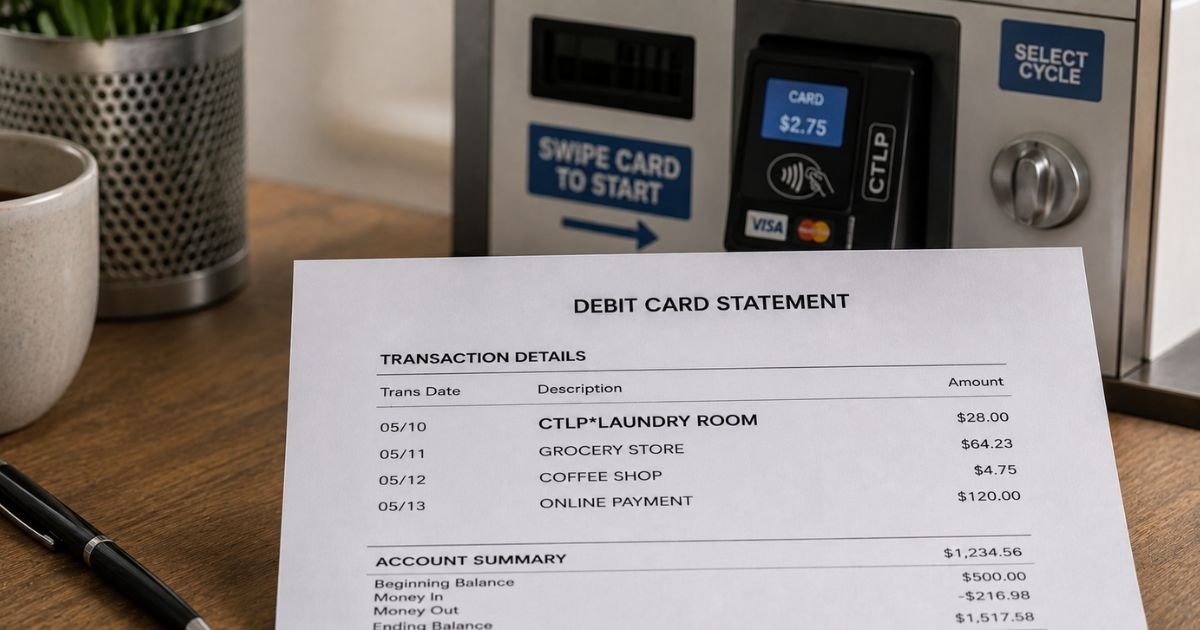
Seeing a CTLP charge on debit card statement can be confusing. The short code does not look like a regular store name, which often leads people to wonder if the charge is legitimate or something to dispute.
This article explains what the charge means, why it appears, how to verify it, and what to do if you need to dispute it.
Table of Contents
What Is the CTLP Charge?
CTLP is the billing descriptor (and stock ticker) used by Cantaloupe, Inc. Cantaloupe specializes in cashless payment technology for unattended retail locations.
When you tap, insert, or swipe your debit card at one of these machines, the transaction is often processed through Cantaloupe’s system and appears on your statement as CTLP.
The full descriptor may include additional details such as:
- CTLP*
- CTLP followed by a merchant or operator name (for example, CTLP*InReach, CTLP Continental, CTLP National Entertainment, or CTLP CSC ServiceWorks)
- A city or location code
These charges are almost always for small, everyday purchases at machines that accept cards instead of cash.
Why Did This Charge Appear?
Common reasons include:
- Buying a snack or drink from a vending machine
- Using a self-service laundry machine or laundry card reader
- Paying at a car wash, air pump, or vacuum station
- Playing an arcade game, claw machine, or kiddie ride
- Using a micro-market, self-service kiosk, or similar unattended point of sale
- A family member or household member who used the card at one of these locations
Because the machines often display only a generic payment terminal, the processor name (CTLP) appears on your statement instead of a familiar brand name. Amounts are typically small, often between $1 and $10.
How to Verify the Charge
Follow this checklist:
- Note the exact date, amount, and full descriptor on your statement (including any city or merchant name after CTLP).
- Think about recent visits to offices, schools, apartment buildings, gas stations, laundry rooms, or entertainment venues around that date.
- Ask household members if they used a vending machine, laundry machine, or similar card-accepting device.
- Check whether the amount matches a typical snack, drink, or laundry cycle price.
- Look at the location information on the statement if available — it can help jog your memory.
- Review your debit card transaction history in your banking app for any matching pending or posted items.
Matching the date, amount, and possible location to a real purchase confirms the charge is valid.
Is It Legitimate or Fraud?
In the large majority of cases, a CTLP charge is legitimate. Cantaloupe is a publicly traded company that powers card readers on millions of unattended machines across the United States.
The charge simply reflects a real purchase you (or someone using your card) made.
Common legitimate scenarios:
- You bought something from a vending machine or used a laundry card reader.
- The amount is small and matches a typical machine purchase.
- The date and location align with your recent activity.
Warning signs that need investigation:
- No one in the household remembers using any card-accepting machine around that date.
- Multiple unexpected charges appear in a short period.
- The amount is unusually high for a vending or laundry purchase.
- Charges continue from unknown locations with no matching activity.
If the charge does not match anything you recognize, treat it as potentially unauthorized.
How to Cancel or Stop Future Charges
CTLP charges are almost always one-time purchases. There is typically no ongoing subscription or recurring billing from Cantaloupe itself.
To avoid similar surprises:
- Be mindful when using card readers on vending machines, laundry equipment, or other self-service devices.
- Ask household members to tell you about any small machine purchases they make with a shared card.
- Consider using cash for very small purchases at unattended machines if you prefer clearer statement descriptors.
If a specific operator (such as a laundry company) is repeatedly charging you and you no longer use the service, contact that operator directly.
Cantaloupe processes the payment on the merchant’s behalf and generally cannot reverse individual consumer charges without the merchant’s involvement or a formal dispute.
Can You Get a Refund?
Refunds depend on the underlying merchant, not on Cantaloupe alone.
- Contact the business that operates the machine (if you can identify it from the full descriptor or location) and request a refund according to their policy.
- If the merchant agrees, they can process a refund through their payment system, which will return the money to your debit card.
- For unauthorized charges, dispute the transaction with your bank. Debit card protections under Regulation E generally require you to report unauthorized activity promptly (often within 60 days of the statement date for full protection).
Start with your bank if you cannot identify the specific merchant. Provide the date, amount, and full descriptor. Keep records of all communications.
What to Do If the Charge Is Unauthorized
If you confirm no one authorized the payment:
- Call the number on the back of your debit card and report the charge as unauthorized.
- Ask your bank to investigate and, if appropriate, reverse the charge.
- Request that the bank monitor the account for similar activity.
- Consider requesting a new debit card number if fraud is confirmed.
- Change any related online banking passwords and enable transaction alerts.
- Document the date, amount, descriptor, and all reference numbers from your conversations.
Report the issue quickly. Debit card liability rules are time-sensitive, so prompt action is important.
Prevention Tips
- Review debit card and bank statements every month.
- Turn on transaction alerts for new merchants or small amounts.
- Be aware that many modern vending machines, laundry rooms, and self-service kiosks accept cards and will show processor names like CTLP.
- Ask household members to note any machine purchases they make with a shared card.
- Prefer cash for very small purchases at unattended machines if clearer statement details matter to you.
- Use virtual card numbers or spending limits for everyday cards when available.
- Double-check the amount on the card reader screen before authorizing payment.
- Keep a simple mental note of recent vending or laundry use when reviewing statements.
Common Sources of CTLP Charges
| Situation | Typical Amount | What to Check |
|---|---|---|
| Vending machine (snack/drink) | $1 – $5 | Recent office, school, or public use |
| Laundry or laundry card reader | $1 – $10 | Apartment, hotel, or college laundry |
| Car wash / air / vacuum | $1 – $10 | Gas station or parking lot visits |
| Arcade, claw machine, kiddie ride | $1 – $5 | Entertainment or family venues |
Statement Descriptor Variations
| Descriptor Example | Meaning |
|---|---|
| CTLP or CTLP* | Standard Cantaloupe processor prefix |
| CTLP* [Merchant Name] | Includes the machine operator |
| CTLP [City/State] | Includes location information |
| CTLP CSC ServiceWorks / similar | Specific laundry or amenity operator |
FAQs: CTLP Charge on Debit Card
Q. What is a CTLP charge on my debit card?
A. It is almost always a payment processed through Cantaloupe, Inc. for a purchase at a vending machine, laundry machine, self-service kiosk, or similar unattended card reader.
Q. Is a CTLP charge a scam?
A. No. CTLP is a legitimate payment technology company. The charge is legitimate when it matches a real machine purchase you or someone using your card authorized. Unrecognized charges should still be investigated.
Q. Why doesn’t the machine name appear on my statement?
A. Many unattended machines use Cantaloupe’s payment system. Banks often display the processor name (CTLP) rather than the individual machine operator’s full name, especially when space is limited.
Q. How do I dispute a CTLP charge?
A. Contact your bank using the number on the back of your debit card, report the charge, and follow their dispute process. Provide the date, amount, and full descriptor. Act promptly to protect your rights under debit card rules.
Conclusion
A CTLP charge on debit card is typically a legitimate payment for a small purchase at a vending machine, laundry facility, or other self-service equipment that uses Cantaloupe’s cashless payment technology.
Match the date and amount to recent activity, ask household members if needed, and contact your bank if the charge is completely unfamiliar.
Reviewing statements regularly and noting small machine purchases helps you quickly recognize these processor-named charges in the future.
Disclaimer: This article is for informational purposes only and is not financial, legal, or professional advice. Payment descriptors and merchant practices can change. Always verify details directly with your financial institution when possible.
Meet the Author
