
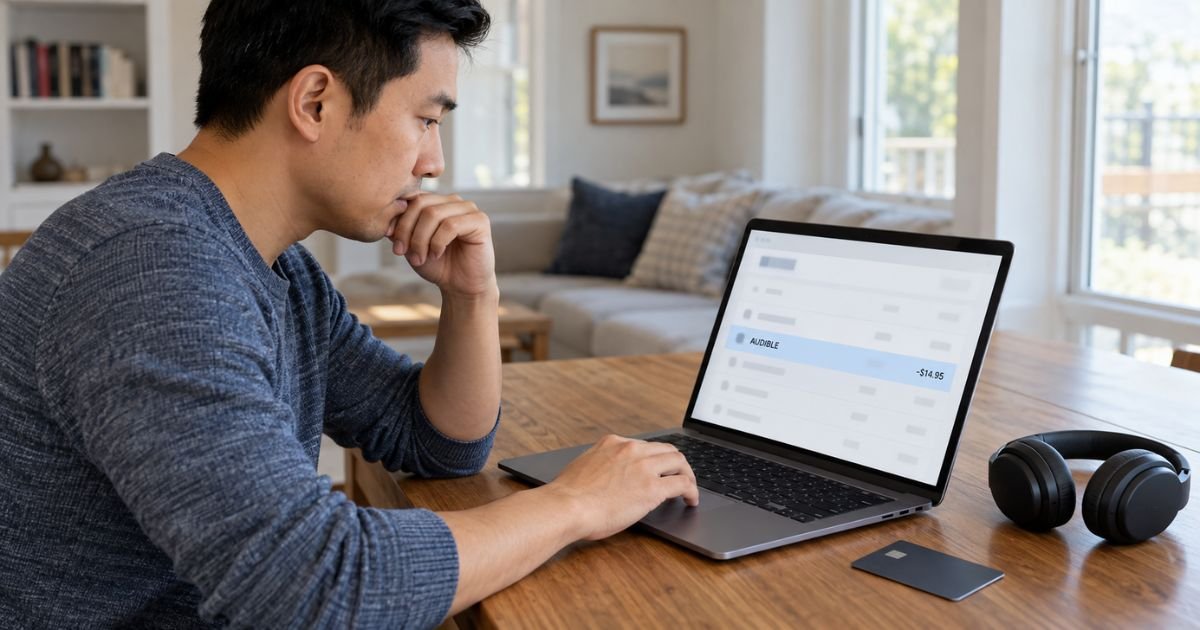
Audible charges on your credit card statement can feel confusing if you don’t remember buying an audiobook or starting a membership. In many cases, the charge comes from an Audible subscription, audiobook purchase, or temporary card authorization.
Audible is an Amazon company that sells audiobooks and operates paid membership plans. Here’s how you can identify the charge, stop recurring billing, and respond if nobody authorized the transaction.
Table of Contents
What Are Audible Charges on Credit Card Statement?
Audible charges on credit card statement generally come from an Audible membership, an audiobook or other purchase, or a temporary payment authorization.
Audible’s current U.S. help information says unfamiliar charges are commonly caused by membership billing, applicable taxes, or temporary authorization activity. Its current membership information lists a Premium plan at $14.95 and a Standard plan at $7.95, before applicable taxes.
| Statement clue | What it may mean |
|---|---|
| AUDIBLE | Audible purchase or membership |
| Repeating monthly Audible amount | Recurring membership |
| Audible plus tax | Membership or purchase with applicable tax |
| $1 Audible pending charge | Temporary card authorization |
| Different recurring amount | Another plan, tax, or billing arrangement |
| Audible charge you cannot match | Needs account and card review |
Your exact statement wording may vary by issuer. Audible’s customer-service page says its charges may include a nine-character transaction code that can help support locate the payment.
Why Is Audible Charging Your Credit Card?
A recurring Audible charge most often comes from an active membership.
Audible currently says its membership charges can begin when a 30-day free trial ends. A discounted membership offer can also renew into a regular paid membership if you do not cancel it before the offer ends.
Other possible reasons include:
- An audiobook purchased with your card
- A recurring Audible membership
- A free trial that became paid
- Applicable sales tax
- A card authorization
- A purchase by another authorized user
- Billing connected with another Amazon or Audible account
Check your Audible purchase history and membership charges first. You should compare the exact amount and posting date with your account records.
Pro Tip: Search your email for “Audible,” the exact dollar amount, and the transaction date. You may find a trial confirmation, membership renewal, or audiobook receipt that explains the charge.
What Is the $1 Audible Charge?
A $1 Audible transaction is generally a temporary authorization rather than a completed purchase.
Audible says it may place a $1 authorization to confirm that your credit card is valid. The amount should release back to your available balance after processing, although your bank may take several business days to remove it.
If the $1 transaction remains fully posted instead of disappearing, contact your card issuer. Ask whether it is still an authorization or has become a completed charge.
Why Did Audible Charge You After a Free Trial?
Audible’s U.S. membership trial generally converts into a paid membership unless you cancel before the trial ends.
Audible specifically lists expired free trials and discounted offers among the reasons customers may see a full membership charge.
You may forget about the trial if you started it while buying a book or accepting a promotional offer.
Check your membership details for the signup date, current plan, and next billing date. Those details can help you determine whether the charge followed a trial.
Could the Charge Belong to Another Amazon Account?
It may.
Audible says an unfamiliar payment can sometimes result from a family member or friend who has access to your card information. Its complaint responses also show cases where support investigated whether a card had been used on another Amazon account.
This can make an Audible charge especially confusing if your own Audible account shows no active membership.
Check:
- Other email addresses you use with Amazon
- A spouse or partner’s Amazon account
- Family members with access to your card
- Older Audible accounts
- Cards saved in Amazon payment settings
Reddit discussions also contain reports from people who found Audible billing tied to shared Amazon payment methods or another account. These reports are anecdotal, so your own account records remain more reliable.
How to Check Audible Membership Charges
Sign in to Audible and review your membership details and purchase history.
Audible’s current customer-service page provides direct links for viewing orders and membership charges. It also asks customers with billing problems to have the nine-character transaction code from the statement available when contacting support.
Compare:
- Membership charges
- Audiobook orders
- Your active membership plan
- The card used for billing
- Your next renewal date
- Refund history
If you use more than one email address, check each account. An old Audible membership may still be active under an address you rarely use.
How to Cancel Audible Charges
You can generally cancel an Audible membership through the Membership details section of the Audible website.
Audible says deleting the app does not cancel your membership. It also notes that subscriptions billed through Apple or Google require different cancellation steps through those platforms.
After you cancel, Audible says you can still access titles you purchased with money or credits. However, you should review unused credits before canceling because membership benefits can change when the plan ends.
Common Mistakes: Don’t delete the Audible app and assume the billing has stopped. Cancel the membership through the correct Audible, Apple, or Google subscription settings and save the confirmation.
Can You Get an Audible Charge Refunded?
A refund may be possible, but it is not guaranteed.
Audible’s customer-service tools let you check refund history and whether eligible audiobook purchases can be returned. Membership billing concerns generally need to be reviewed based on the account and transaction involved.
If you forgot to cancel a recent renewal, contact Audible promptly and ask whether a refund is available.
Have the charge date, amount, Audible account email, and transaction code ready. Your credit card issuer can also explain your dispute options if the payment was not authorized.
Is Audible a Legitimate Company?
Yes. Audible is an established Amazon company offering audiobooks, podcasts, original audio content, and memberships.
That does not mean every Audible charge on your card is necessarily yours.
As of October 2026, BBB lists 277 Audible complaints over the previous three years, including 84 categorized as billing issues. Complaints include reports involving recurring memberships, unknown charges, refunds, and cancellation problems.
Trustpilot currently shows a low overall consumer rating for Audible, with recent reviews frequently discussing unexpected subscription charges and cancellation difficulties. Reviews describe individual experiences and do not establish whether your own charge is incorrect.
What If You Never Signed Up for Audible?
First, ask anyone who has permission to use your credit card whether they recognize the charge.
Then check every Amazon and Audible account associated with your household. Audible itself recommends considering whether another person with access to your card may have made the purchase.
If you still cannot find the charge, contact Audible customer service. Its current U.S. contact page lists 1-888-283-5051 and recommends having the transaction code from your statement available.
Do not send your full card number, security code, Amazon password, or one-time login code through ordinary email.
How to Dispute an Unauthorized Audible Charge
If Audible cannot connect the payment to something you authorized, contact your credit card issuer promptly.
Give the issuer the amount, posting date, full Audible descriptor, and any transaction code shown on the statement. Explain whether Audible found a matching account.
BBB complaint records show Audible has advised some consumers with charges that could not be matched to their account to contact their financial institution and monitor for additional activity.
Your issuer may recommend replacing the card if it believes the card number has been used without permission.
FAQs: Audible Charges on Credit Card Statement
Q. Why does Audible keep charging your credit card?
A. You may have an active monthly membership or a trial that converted to paid billing. Check Membership details and your membership charge history to confirm the active plan.
Q. Is a $1 Audible charge real?
A. It is generally a temporary card authorization. Audible says the $1 amount is used to verify the card and should later be released by your bank.
Q. Does deleting Audible stop the subscription?
A. No. Audible specifically says deleting the app does not cancel the membership. You need to cancel through Audible or the app store that bills your subscription.
Q. What should you do if you never authorized Audible?
A. Check family members, other Amazon accounts, and your Audible history first. If nothing matches, contact Audible with the transaction information and then report the charge to your credit card issuer if it remains unauthorized.
Conclusion
Audible charges on your credit card statement typically come from a membership, audiobook purchase, tax, or temporary authorization. A free trial or discounted membership may also begin regular billing when the promotional period ends.
Check your membership details, purchase history, other Amazon accounts, and authorized card users first. If you still cannot identify the charge, contact Audible and your credit card issuer so you can stop future billing and dispute an unauthorized payment.
Disclaimer: This article is for informational purposes only and is not financial or legal advice. Membership pricing, cancellation rules, refunds, and dispute policies may vary by account and card issuer. Verify account-specific questions with Audible or your financial institution.
Meet the Author
