
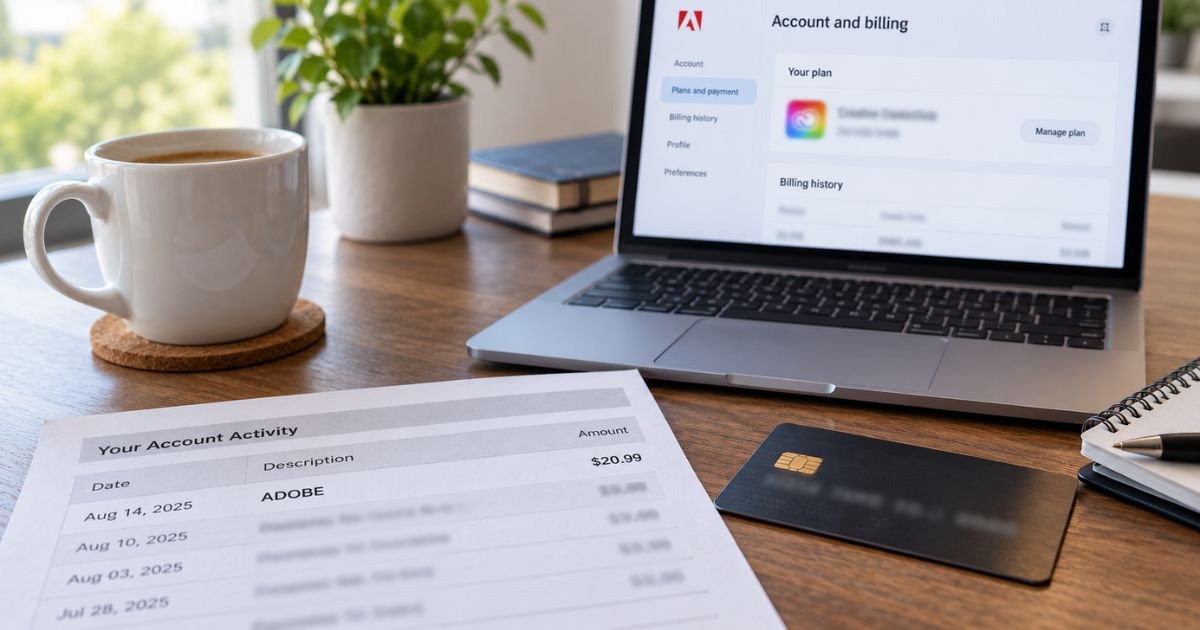
An Adobe charge on credit card can feel confusing if you don’t recall signing up for anything. In many cases it is a real Adobe plan, trial that converted, or renewal tied to an email you rarely use.
This guide shows how the charge usually appears, how to match it to an account, and how to cancel or dispute it.
Table of Contents
What Is an Adobe Charge on Credit Card?
An Adobe charge on credit card is typically a payment to Adobe Inc. for software or cloud services.
Common products include Creative Cloud, Acrobat, Photoshop, Illustrator, Premiere Pro, Lightroom, Adobe Stock, Adobe Express, and PDF tools.
The company is a long-running US software firm based in San Jose, California.
Most consumer charges are subscriptions, not a one-time boxed product. Plans may bill monthly or once a year.
Some annual plans still collect a payment every month. That “annual, billed monthly” setup is easy to miss if you only remember a trial or a student promo.
Adobe also publishes a Charge Finder tool for card payments that show ADOBE on the statement. You can look up the linked email, product, invoice, and charge type without signing in.
Official help says new charges can take up to 48 hours to appear in that tool.
| Statement wording you may see | What it typically points to |
|---|---|
| ADOBE or ADOBE INC | General Adobe billing |
| ADOBE *CREATIVE CLOUD or similar | Creative Cloud plan or renewal |
| ADOBE *ACROBAT or ACROPRO | Acrobat or PDF subscription |
| ADOBE *PHOTOSHOP or PHOTOGPHY PLAN | Photography or single-app plan |
| ADOBE *STOCK | Stock credits or a Stock plan |
| ADOBE SYSTEMS SOFTWARE IRELAND | Adobe’s Ireland billing entity, still Adobe |
| PAYPAL *ADOBE or similar | Adobe billed through PayPal |
Your bank may add extra words like RECURRING, SAN JOSE CA, or a phone fragment. Those extras come from the processor or issuer. They do not always name the exact app.
Why You Might Not Recognize It
Adobe’s own help lists several everyday reasons a charge looks unfamiliar.
- You have more than one Adobe ID. Work, school, and personal emails can each hold a plan.
- A family member, roommate, or coworker used your card.
- A free trial converted to a paid plan.
- Auto-renew ran after a promo or student price ended.
- Your bank moved the payment to a new card when the old one expired.
- A prior payment failed, then Adobe retried and you see more than one hit.
Official billing help also notes that each Adobe plan bills on its own. Canceling Acrobat does not cancel Creative Cloud. Two plans on one card can look like a “mystery extra” charge.
Pro Tip: Use Adobe’s Charge Finder first if the line says ADOBE. Official FAQ pages say you enter the last four card digits, expiration date, transaction date, amount, and currency. The result can show the email you need to sign in with.
How Adobe Charges Usually Appear
You may see a pending authorization, then a posted amount a day or two later. The posted line is the one to match against invoices.
Some statements show a transaction ID after the word ADOBE. Adobe’s Charge Finder FAQ describes that pattern as ADOBE (transaction ID). Keep a screenshot. The date and amount must match what you type into the tool.
PayPal and app-store purchases are different. Adobe says Charge Finder works for card payments labeled ADOBE, not PayPal.
If you bought through Apple, Google, or Microsoft, that store’s billing name may appear instead of Adobe. Cancel those plans in the store account, not only on adobe.com.
Invoices live in your Adobe account. Official help says you can view, download, or email PDFs from billing history. Individual accounts generally keep invoice history for a limited period, so save copies if you plan to dispute.
Common Adobe Products Behind the Charge
You do not need every product name memorized. These are the groups people see most often:
Creative Cloud: Bundled desktop apps such as Photoshop, Illustrator, and Premiere. Adobe’s cancellation examples for North America have used a Creative Cloud Pro monthly figure of US$69.99 on an annual-billed-monthly plan. List prices change, so check your own plan page.
Single-app plans: One main app plus cloud storage. Adobe’s own examples have used US$22.99 a month for a common single-app annual-billed-monthly plan.
Acrobat and PDF tools: Paid PDF edit, convert, or sign features after a trial.
Photography plans: Photoshop and Lightroom packaged together.
Adobe Stock or extra credits: Image or video downloads, or a Stock subscription.
Adobe Express or other web tools: Smaller recurring plans that still print as ADOBE.
Teams or business licenses can bill a different admin. If this is a work card, ask who manages the Adobe Admin Console before you cancel.
Why the Amount May Be Higher Than You Expected
Adobe’s “charged higher than expected” help page covers the usual gaps.
A promo or student price may have ended. Introductory pricing is often for a limited first term. After that, the account renews at the then-current rate unless you change or cancel.
You may also be looking at an early termination fee. Official subscription terms for many annual plans billed monthly say that after 14 days, a cancellation fee of 50% of the remaining contract balance may apply.
Adobe’s help gives this example: if you cancel in the ninth month, you pay 50% of the fee for the three months left. Prepaid annual plans are generally not refunded after that 14-day window. Month-to-month plans with no annual commitment typically do not carry that same early-end fee.
A failed card can create extra attempts. Official help says a declined, expired, or updated card can lead to more than one charge when Adobe retries a missed cycle. Check whether one line is a retry and another is the current period.
US regulators have also focused on Adobe’s cancellation and fee disclosures.
In 2026 Adobe announced a settlement with the US government over subscription practices and said it would provide free services to qualifying customers.
That history helps explain why so many people search this charge. It does not automatically make your specific line a billing error.
How to Find the Account and Cancel
Start with identification, then cancel the exact plan.
- Run Charge Finder at Adobe’s official unknown-charge page if the descriptor includes ADOBE.
- Sign in at account.adobe.com with every email you use.
- Open Plans and review every active trial or paid plan.
- Download the matching invoice from Orders and invoices.
- Select Manage plan, then Cancel your plan, and confirm.
Official cancel help says you cannot cancel while a payment is still processing. Wait about 24 hours and try again. If you have several plans, cancel each one separately. Check email for confirmation, then look at account.adobe.com/plans to be sure the status changed.
Access to paid apps generally continues until the current billing period ends. Adobe says a charge that posts right after you cancel is often the final payment for that period, not proof the cancel failed.
Bought through Apple, Google, or Microsoft? Follow that store’s cancel steps. Adobe’s own site cannot always stop a store-billed plan.
Refunds depend on timing and plan type. Official terms say most plans purchased directly from Adobe qualify for a full refund if you cancel within 14 days of the initial purchase.
After that, annual-billed-monthly plans may show the 50% remaining-balance fee on the cancel screen. Read that screen before you confirm.
Common Mistakes: Canceling one plan and assuming the others stop. Disputing a renewal before you check a second Adobe email. Skipping Apple or Google billing when that is where you originally subscribed. Waiting past your issuer’s dispute window because the Charge Finder was empty on day one.
How to Dispute an Adobe Charge
If Charge Finder finds no match, or the email belongs to someone you do not know, treat the charge as possibly unauthorized.
- Lock or replace the card in your issuer’s app.
- Note the exact descriptor, date, amount, and any transaction ID.
- Tell Adobe Support through official help pages if you need a ticket number.
- File a billing-error dispute with your card issuer.
For credit cards, the Fair Credit Billing Act generally gives you 60 days after the statement was sent to give written notice of a billing error.
Issuers often acknowledge that notice within 30 days and aim to finish within two billing cycles, not to exceed 90 days. Debit cards follow a different clock, so act quickly if the hit came from checking.
A legitimate subscription you forgot is not the same as fraud. Cancel the plan first if Charge Finder ties the charge to your household. Dispute if nobody authorized it.
FAQs: Adobe Charge on Credit Card
Q. Is an Adobe charge on credit card always a subscription?
A. Usually yes for consumer cards, but not always. Many lines are Creative Cloud, Acrobat, or similar renewals. You can also see Stock credits, a converted trial, or a cancellation fee. Charge Finder and your Adobe invoices show the type.
Q. How do I tell which Adobe email was billed?
A. Use Adobe’s Charge Finder with the card’s last four digits, expiration date, transaction date, amount, and currency. Official FAQ pages say the tool can return the linked email, product name, invoice number, and charge type. It does not replace PayPal or app-store lookups.
Q. Can I cancel without a fee?
A. It depends on the plan and timing. Official terms generally allow a full refund within 14 days of the initial purchase for most direct Adobe plans. After that, an annual plan billed monthly may charge 50% of the remaining contract balance. Prepaid annual plans are typically not refunded after 14 days. Month-to-month plans with no annual commitment usually avoid that early-end fee.
Q. What if I already canceled and Adobe charged me again?
A. Official help says a charge after cancel is often the last payment for the period you already used. Confirm the cancel status at account.adobe.com/plans and save the confirmation email. If a second plan is still active, cancel that plan too. If Charge Finder shows an account you never owned, contact your issuer.
Conclusion
An Adobe charge on credit card is typically a Creative Cloud, Acrobat, or related Adobe payment, often tied to auto-renew or a second email. Match the line with Charge Finder and your invoices, then cancel each plan you do not want.
If the account is not yours, use your card issuer’s dispute process and do not wait on the next statement.
Disclaimer: This article is for general information only. It is not financial, legal, or tax advice. Adobe products, prices, refunds, cancellation fees, and statement names vary by plan, country, and purchase channel. Confirm account-specific questions with Adobe or your bank.
Meet the Author
