
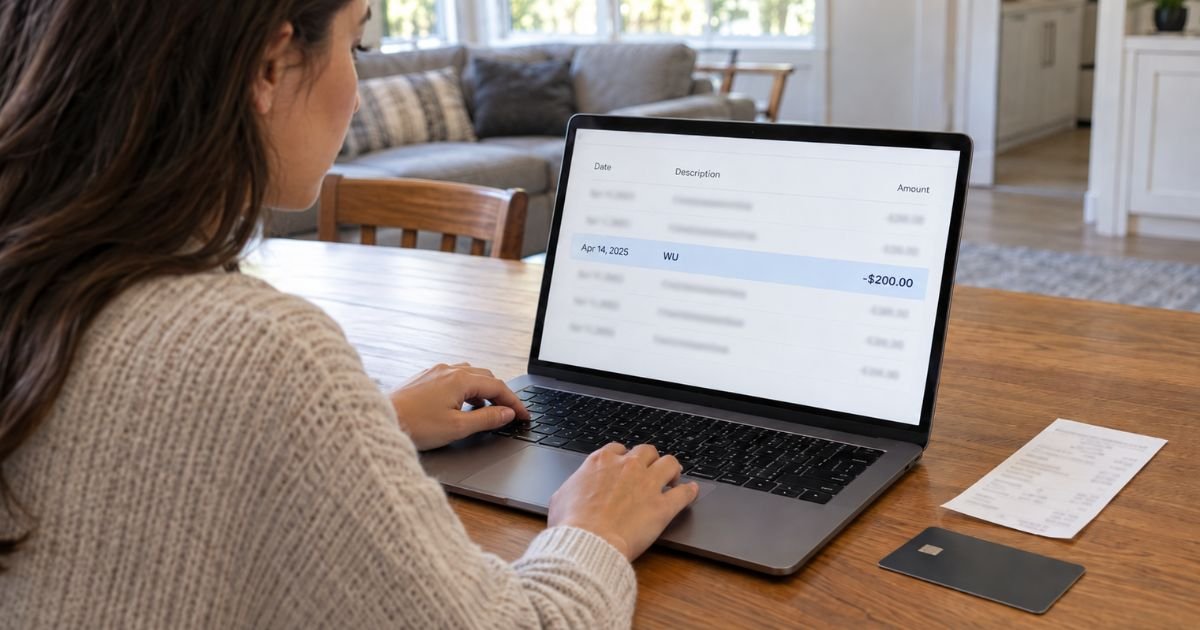
A WU charge on bank statement can feel confusing if you don’t remember paying a company with those initials. In many cases, WU refers to Western Union, the money transfer and bill payment service.
The charge may come from a money transfer, bill payment, transfer fee, or transaction funded from your bank account or card. Here’s how you can identify the payment and what to do if you never authorized it.
Table of Contents
What Is a WU Charge on Bank Statement?
A WU charge on bank statement typically points to Western Union when the transaction also contains words such as Western Union, WU Digital, WUVISA, money transfer, or a Western Union phone number.
Western Union lets customers fund transfers using bank accounts, credit cards, debit cards, and other available payment methods. Its U.S. mobile app also supports payments directly from a bank account, debit or credit card, Apple Pay, or cash at participating agent locations.
The statement description may vary depending on how you sent the money and which bank processed the transaction.
| Statement wording | What it may indicate |
|---|---|
| WU | Possible Western Union transaction |
| WU DIGITAL | Western Union online or app transfer |
| WUVISA | Card-funded Western Union transaction |
| WU DIGITAL AFT | Descriptor reported with digital transfers |
| WESTERN UNION | Direct Western Union payment |
| WU plus phone number | Western Union transaction with contact details |
A descriptor containing only “WU” is not enough to identify a transaction with complete certainty. Ask your bank for the expanded merchant details if nothing else appears.
Why Did Western Union Charge Your Bank Account?
The most common explanation is a money transfer that you initiated.
Western Union says customers can pay the transfer amount plus applicable transfer fees using supported bank cards or ACH bank payments. The total debited can include the amount being sent and Western Union’s applicable fees.
Possible reasons for a WU transaction include:
- Sending money to another person
- Funding an international transfer
- Sending a domestic transfer
- Paying a bill through Western Union
- Using a debit card to fund a transfer
- Using a bank account for an online transfer
- Paying Western Union transfer fees
- A transfer initiated by another authorized account user
Western Union also offers bill payment services. Its U.S. site says customers can pay certain bills with cash or a U.S. bank-issued debit card at participating locations, while some phone payments can use a credit or debit card.
Pro Tip: Search your email for “Western Union,” “WU,” and “MTCN.” Western Union provides a Money Transfer Control Number, or MTCN, for transfers, which can make matching the bank charge much easier.
What Does WU Digital Mean?
WU Digital generally points to Western Union’s online or mobile money-transfer service rather than a payment made at a physical agent location.
Consumer reports show statement descriptions such as WU Digital AFT and WUVISA AFT after Western Union transfers. The precise formatting can vary by bank, so these reports are useful clues rather than universal descriptors.
Western Union officially confirms that customers can create and pay for transfers online and through its mobile app. You can use a bank account or supported card as the funding source.
If you recently used the Western Union app, compare the transfer amount and fee with the amount shown by your bank.
Why Is the WU Charge Higher Than the Amount You Sent?
Western Union charges transfer fees on many transactions.
Its official terms explain that the total charged to your card or bank account can include both the principal amount being sent and the transfer fee. Your bank or card issuer may also apply separate fees.
For example, sending $200 does not necessarily mean your account will show a $200 debit. Your total may be higher after the transfer fee.
Credit card funding can create additional costs. Western Union warns that some card issuers may treat a money transfer as a cash advance, which can result in a separate card fee and interest.
Check your Western Union receipt before treating a higher amount as an error.
How to Verify a WU Charge
Start by signing in to your Western Union account or app.
Compare your recent transfer history with the date and amount on your bank statement. Western Union also lets customers track transfers using the MTCN.
Check:
- The transfer amount
- Western Union fees
- The recipient
- Transfer date
- MTCN
- Funding bank account or card
- Recent bill payments
- Other authorized account users
Your bank may show the charge a day or two later than the date when you initiated the transfer.
If you don’t see a matching transaction, ask your bank for the complete descriptor. It may be able to provide the merchant phone number and additional payment-network information.
Common Mistakes: Don’t compare only the amount sent to the recipient. Western Union fees may be included in the total bank debit, so compare your statement with the total shown on the transfer receipt.
Can You Cancel a Western Union Charge?
Cancellation depends heavily on the status of the transfer.
Western Union’s U.S. remittance disclosure says certain transfers can be canceled for a full refund if you contact Western Union within 30 minutes of payment and the money has not already been picked up or deposited.
Its broader online terms also allow cancellation and refunds in certain circumstances when funds have not yet been collected or deposited. Exact rules depend on the transaction type and applicable law.
If you just sent money to the wrong person, act quickly. Once the recipient receives the funds, recovering the money may become much harder.
What If You See Two Western Union Charges?
Do not automatically assume both transactions are duplicates.
Check whether two different MTCNs appear in your account. Each completed transfer generally has its own tracking number.
BBB complaints include individual reports where consumers alleged that more than one Western Union charge appeared even though they expected only one transfer. Western Union’s responses in those cases show that the company can investigate transactions using its internal transfer records.
If you authorized one transfer but see two posted debits, contact Western Union and your bank. Save your original receipt and MTCN as evidence.
Is a WU Charge Legitimate?
Western Union is a long-established money-transfer company, so WU can be a legitimate bank descriptor.
Consumer feedback about the company is mixed. Trustpilot currently shows Western Union with a 4.3 rating from roughly 170,000 reviews, with many customers mentioning speed and convenience while some report blocked transfers, verification problems, or payment issues.
BBB currently shows hundreds of complaints against Western Union over the previous three years. Most are categorized as product or service issues, while a smaller number involve billing.
These reviews do not prove that your specific WU charge is correct or incorrect.
Reddit users also report both normal Western Union descriptors and unauthorized Western Union transactions. Those posts are anecdotal and should be used only as clues.
What If You Never Used Western Union?
Treat an unexplained charge seriously.
First ask anyone else authorized to use the bank account or card whether they sent money. Also check whether you used Western Union indirectly to pay a bill.
If nobody recognizes the payment, contact Western Union through its official support channels. Western Union’s U.S. error-resolution information currently lists 1-800-325-6000 for transfer problems.
You should also contact your bank promptly.
Ask whether the payment came through your debit card, credit card, or ACH bank account. That distinction can affect how your bank handles the dispute.
What If Your Western Union Account Was Hacked?
Change your Western Union password immediately if you see activity you did not authorize.
Also review the email address, phone number, saved cards, bank accounts, and recipient information connected with the account. Change the password on your email account too if you believe someone gained access to it.
Consumer reports describe cases involving unauthorized Western Union transfers from linked bank accounts and cards. Western Union itself advises affected customers to contact their financial institution about unauthorized charges.
Do not pay anyone who claims they can recover stolen Western Union funds for an upfront fee. That can be a separate recovery scam.
How to Dispute an Unauthorized WU Charge
Call your bank or card issuer as soon as you determine that the payment was not yours.
Give it the exact WU descriptor, amount, date, and any information you obtained from Western Union. Ask whether your card or bank account details need to be replaced.
Also report the transaction to Western Union. Its U.S. error-resolution disclosure asks customers to provide the transfer amount, recipient information when known, and the transaction confirmation number.
Keep your dispute records and case numbers.
FAQs: WU Charge On Bank Statement
Q. What does WU mean on your bank statement?
A. WU typically refers to Western Union when the transaction is associated with a money transfer or bill payment. Check the full descriptor and your transfer history to confirm it.
Q. What is WU Digital on your bank statement?
A. WU Digital generally indicates a Western Union transaction completed through its online or mobile service. Your bank may add other abbreviations to the descriptor.
Q. Why did Western Union debit more than you sent?
A. The withdrawal may include both your transfer amount and Western Union’s transfer fee. Your bank or card issuer may also charge separate fees depending on how you funded the transfer.
Q. What should you do if you never authorized WU?
A. Contact Western Union and your bank promptly. Ask the bank how the payment was processed and follow its procedure for reporting an unauthorized card or account transaction.
Conclusion
A WU charge on bank statement typically relates to Western Union and may come from a money transfer, bill payment, or related transfer fee. Descriptors can include WU Digital, WUVISA, Western Union, or other shortened versions.
Check your Western Union history, MTCN, receipts, transfer fees, and other authorized account users first. If you cannot identify the payment, contact Western Union and your bank promptly to investigate and dispute it when appropriate.
Disclaimer: This article is for informational purposes only and is not financial or legal advice. Transfer rules, refunds, fraud protections, and dispute procedures may vary by transaction and financial institution. Verify account-specific questions with Western Union or your bank.
Meet the Author
