
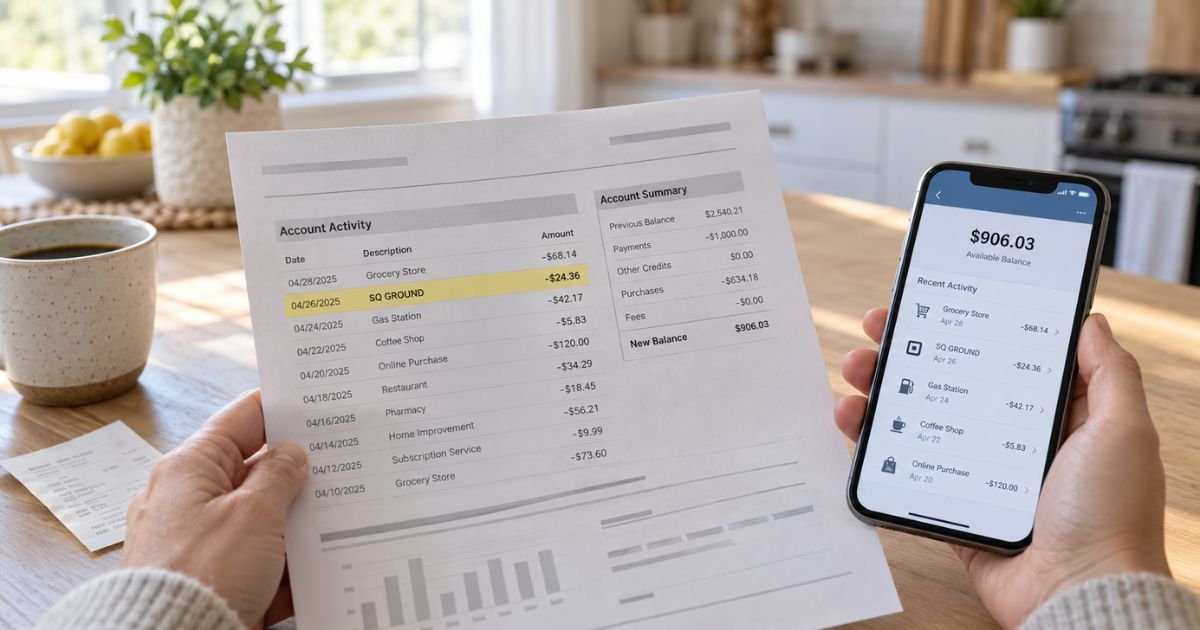
An SQ Ground charge on bank statement is almost always a card payment processed by Square for a business whose registered name starts with “Ground.”
Square is the payment company (part of Block, Inc.) that sits between your bank and the shop. It is not a bank fee, and it is not Square billing you for its own product in most cases.
This article explains how that line is built, how to match it to a real purchase, and what to do if you still do not recognize it.
Table of Contents
What an SQ Ground Charge on a Bank Statement Means
Square sends banks a short descriptor in a set format: SQ * plus the business name from the seller’s Square Dashboard, plus an optional store ID.
After the SQ * prefix, Square itself has only about 20 characters to work with. Your bank may cut that text even more. That is why a full name like “Ground Coffee Roasters” can land on your statement as SQ Ground.
Square’s own receipt tool states the same idea in plain language: Square was not the merchant that charged you. You paid a business that uses Square to accept cards. That includes a Square Reader at a counter, a terminal, an online checkout, or an emailed invoice.
Sellers cannot remove the SQ * prefix. Square keeps it so banks and customers can tell the payment ran through Square if a question comes up later.
How the line can look on your statement
Your bank decides the exact spacing and punctuation. Common variations include:
- SQ *GROUND
- SQ GROUND
- SQ *GROUND COFFEE
- SQ *COMMON GROUND
- GOSQ.COM plus a short business name
- CHECKCARD SQ *GROUND or POS DEBIT SQ *GROUND
GOSQ.COM is another Square label, often used for online or invoice payments. SQ *CASH APP is different. That one is Cash App, which is also under Block, Inc.
Tap the charge in your banking app when you can. The expanded view sometimes shows a city, a longer name, or a phone number that the printed statement hid.
Why “Ground” is there instead of the shop you remember
The word after SQ * is the location business name the seller entered in Square, not always the sign on the door. A coffee shop might trade as The Ground, Grounded, Ground Floor, or Common Ground Games. If the owner left the legal name short, or if the bank ran out of characters, you only see Ground.
Typical places that use Square include cafés, food trucks, farmers markets, salons, boutiques, pop-up vendors, and freelancers who send Square invoices. A one-time visit is more common than a subscription, but some sellers do use Square for recurring memberships.
How to identify the SQ Ground charge
Work through these steps before you call the bank.
- Match the date and the exact dollar amount to a recent purchase, tip, or invoice. Include tax and tip. A $6.50 coffee plus a $1.50 tip can post as $8.00.
- Read every character after SQ. Look for Coffee, Cafe, Games, Kitchen, or a city.
- Search your email and texts for “Square receipt” or “Receipt from” around that date. Many Square sellers text or email a digital receipt if you gave a phone number or email at checkout.
- Use Square’s public receipt lookup at squareup.com/receipts. Enter the card details the tool requests, the transaction date, and the amount. If it finds a match, the receipt usually shows the merchant name and location. Square notes that it was not the merchant. It only processed the payment.
- Think about small vendors from that day: a market stall, a food truck, a pop-up, or a shop that had you sign on a phone or tablet.
- Ask anyone else on the account. An authorized user or family member may have paid a local shop.
The receipt lookup works for card payments Square processed. Cash sales will not appear. You need a close date and amount for a match.
Pending holds versus the final charge
Some SQ Ground lines start as a pending pre-authorization. A café or bar may hold a higher amount, then settle the real total after the tip. The pending line can drop off and a slightly different amount can post a day or two later. That is normal card processing, not a second purchase.
If two similar SQ Ground amounts post, compare times. One may be the sale and one a tip adjustment. If they are true duplicates, keep both receipts and contact the merchant first. Many Square sellers can refund from their dashboard once they see the extra charge.
Is an SQ Ground charge a scam?
In the usual case, no. Square is a widely used U.S. payment processor, and SQ * is its official statement prefix. A confusing name is far more common than fraud.
Treat it as suspicious if:
- You have no matching purchase, receipt, or authorized user activity.
- Several SQ charges appear in a short window at odd hours.
- The amount is far larger than any recent small-business visit.
- You already refunded the purchase in person and the card still posted.
Do not call a phone number printed only on a random text or email that claims to be Square support. Start with your bank app and the official receipt page on squareup.com.
What to do if you still do not recognize it
Contact the merchant if the receipt lookup gives you a name and a way to reach the shop. Ask for an itemized receipt or a refund if the charge is wrong.
If you cannot identify the seller, or the charge is unauthorized, dispute it with the card issuer. Square’s own community guidance for unrecognized SQ charges is to use the receipt tool first, then work with your bank. The bank opens the formal dispute with Square and the merchant.
Credit cards
The Fair Credit Billing Act covers billing errors, including charges you did not make and charges that are not clearly identified.
Send written notice to the billing-error address on your statement within 60 days after the issuer sent the first statement that shows the charge. Keep paying the rest of the bill. You may withhold the disputed amount while the issuer investigates.
The issuer must acknowledge a written billing-error notice within 30 days and resolve it within two billing cycles, and not later than 90 days.
Debit cards and bank account EFTs
Regulation E covers unauthorized electronic transfers. Tell the bank as soon as you see the charge. If a debit card or PIN was lost or stolen, notice within two business days generally limits your loss to $50. You also have 60 days from the statement that first shows the error to trigger the full error-resolution process.
After notice, the bank generally has 10 business days to investigate (20 if the account is new). It may take up to 45 days, or 90 days for some point-of-sale debit charges, if it provisionally credits your account.
When you file, give the full descriptor, date, amount, last four digits of the card, and any receipt-lookup result. Ask the bank to add notes from the expanded merchant record.
If the issuer’s answer is incomplete, you can submit a complaint to the Consumer Financial Protection Bureau at consumerfinance.gov.
How to keep SQ charges easier to read next time
- Turn on transaction alerts in your bank or card app so a $12 SQ Ground line does not wait for the monthly PDF.
- Save Square emails and texts in a folder.
- Glance at the reader or tablet at checkout. Many screens show the business name before you tap.
- Review pending charges every couple of days, not just the posted statement.
- If a shop’s name on the receipt never matches the sign, that is a seller settings issue. You can still use the receipt for your records.
SQ Ground versus other Square-looking lines
Not every SQ line is the same merchant.
| What you see | What it usually is |
|---|---|
| SQ *GROUND or SQ GROUND | A Square seller whose dashboard name starts with Ground |
| SQ *CASH APP | A Cash App payment, also under Block, Inc. |
| GOSQ.COM | Square online, invoice, or e-commerce checkout |
| SQUARE INC | Sometimes Square’s own services or hardware, not a café |
If the line is SQ *CASH APP, use Cash App’s help tools rather than a coffee-shop hunt.
FAQs: SQ Ground charge on a bank statement
Q. Is SQ Ground the same thing as Square?
A. SQ is Square’s prefix. Ground is the merchant name (or the start of it) that followed the prefix after truncation. Square processed the payment. The shop named Ground charged you.
Q. Why does the receipt lookup ask for my card number?
A. Square uses those details to find the matching payment without opening a full support case. Use the official page at squareup.com/receipts and only enter information from your own statement.
Q. Can I stop shops from showing as SQ * on my statement?
A. No. Square does not let sellers drop the SQ * prefix. You can still identify the seller from the name after SQ * and from the digital receipt.
Q. Should I pay a credit card SQ Ground charge I am disputing?
A. Pay any charges you do not dispute. For a timely billing-error claim on a credit card, federal rules let you withhold the disputed amount during the investigation. Debit cards pull cash right away, so report those quickly.
Conclusion
An SQ Ground charge on a bank statement is Square’s label plus a truncated merchant name, not a mystery bank fee. Match the date and amount, open the full descriptor in your app, and run Square’s receipt lookup.
If the purchase is still not yours, dispute it with your issuer on the credit-card or debit-card timeline that applies. The useful next step is to pull the exact date, amount, and last four card digits and search the charge at squareup.com/receipts.
Disclaimer: This article is general educational information for U.S. readers. Statement text varies by bank. Dispute rights depend on whether you used a credit card, debit card, or another transfer method, and on how quickly you report the issue. This is not legal, tax, or banking advice. Review your card agreement and contact your issuer or a qualified professional about your specific charge.
Meet the Author
