
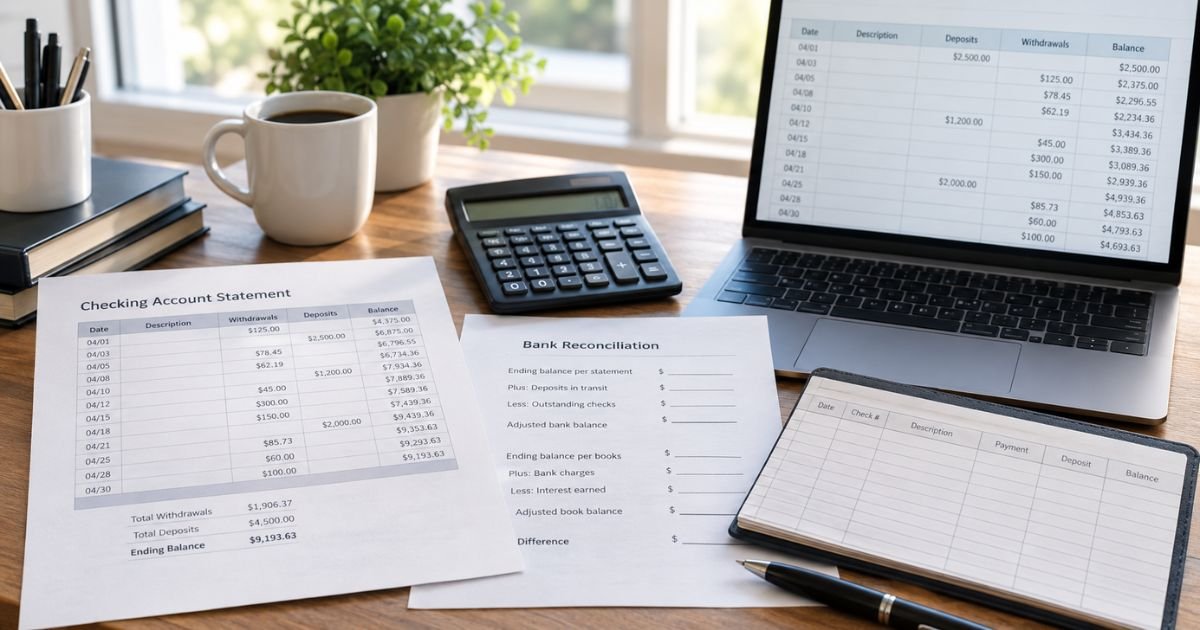
A bank reconciliation statement is the worksheet that explains why the cash balance on your bank statement does not match the cash balance in your books.
Those two numbers almost never start out the same. The bank and your ledger record the same account on different schedules.
This article covers what a bank reconciliation statement includes, why the balances differ, and how to prepare one.
You will also see a worked example, the journal entries that belong in your books, and the mistakes that keep a reconciliation from tying out.
Table of Contents
What Is a Bank Reconciliation Statement?
A bank reconciliation statement is an internal document that compares two records of the same cash account:
- The ending balance on the bank statement (or online activity through the same cutoff date)
- The ending balance in your cash account, usually the general ledger or check register
The statement lists every difference, adjusts each side, and proves that the adjusted bank balance equals the adjusted book balance. That matching figure is the cash amount you should report.
The reconciliation does not change the bank’s records. Timing items such as outstanding checks stay on the bank side until they clear.
Items the bank already posted that you have not recorded, such as a service fee or an NSF check, go on the book side and need a journal entry.
Most U.S. businesses prepare this statement at least monthly. Software can match many lines, but you still need to review unmatched items and keep a record of why the two sides agree.
Why Bank and Book Balances Differ
A difference on the statement date does not automatically mean someone made a mistake. The bank and your books often post the same item on different days.
Common reasons the numbers differ include:
- Deposits in transit. You recorded a deposit. The bank has not posted it yet, often because you deposited late in the day.
- Outstanding checks. You wrote and recorded a check. The payee has not cashed or deposited it.
- Bank service charges. Monthly fees, wire fees, or overdraft charges appear on the statement first.
- Interest earned. Interest the bank added has not been entered in your ledger.
- NSF (nonsufficient funds) checks. A customer check you deposited bounced. The bank reversed the deposit and may add a fee.
- Automatic payments and collections. ACH drafts or notes the bank collected may hit the statement before your books.
- Errors. You may have entered $1,430 as $1,340. The bank may have posted a check for the wrong amount.
Timing differences do not need a journal entry. They should clear later. Bank-only items and book errors do need entries so your ledger matches reality.
Bank Reconciliation Statement Format
U.S. practice usually uses an adjusted-balances format. You work both sides until they meet.
Bank side
Bank statement ending balance
- Deposits in transit
− Outstanding checks
± Bank errors
= Adjusted bank balance
Book side
Book (ledger) ending balance
- Interest earned and other unrecorded bank credits
− Bank fees, NSF checks, and other unrecorded bank debits
± Book errors
= Adjusted book balance
The two adjusted balances must be identical. If they are not, an item is missing, an amount is wrong, or last period’s reconciliation never closed.
Name the account, bank, period-ending date, preparer, and reviewer on the statement. File it with the bank statement, outstanding-check list, deposit-in-transit list, and any journal entries.
How to Prepare a Bank Reconciliation Statement
Follow these steps in order. Skipping the first two is how most “it will not balance” problems start.
1. Gather the right documents
Collect the bank statement, the cash ledger or check register for the same dates, last month’s reconciliation, and support for unusual items. Confirm that this month’s beginning book balance matches last month’s adjusted book balance. If it does not, fix the prior period first.
2. Match every deposit
Tick off each deposit that appears in both places. A deposit in your books that is missing from the statement is a deposit in transit. Add it on the bank side. If the bank shows a deposit you never recorded, find the source and enter it.
Compare amounts, not just dates. A $2,500 deposit recorded as $2,050 is an error, not a timing item.
3. Match every withdrawal
Do the same for checks, ACH payments, debit card charges, and wires. Checks in your register that have not cleared are outstanding checks. Subtract them on the bank side. List the check number, date, payee, and amount. A check that stays outstanding for months may need to be voided.
4. Record bank-only items in your books
Scan the statement for service charges, interest, NSF returns, and automatic drafts you did not enter. These adjust the book side. Then post journal entries so the ledger catches up.
Typical entries look like this:
- Bank fee: debit Bank Service Expense, credit Cash
- Interest earned: debit Cash, credit Interest Income
- NSF customer check: debit Accounts Receivable, credit Cash (plus any NSF fee the bank charged)
5. Investigate leftover differences
If the sides still disagree, look for transposed digits, a duplicate entry, a transfer between your own accounts recorded as income, a bad beginning balance, or a bank error. Report a bank error to the bank and show it on the bank side until the bank corrects it.
Do not force the statement to balance with a plug labeled “miscellaneous.” That hides the problem.
6. Prove the adjusted balances and file the work
When adjusted bank equals adjusted books, save the statement, the unmatched-item lists, and the journal entries. Have a second person review it when you can. Then close the period so later edits cannot break next month’s opening balance.
Worked Example
Here is a simple month-end example for a U.S. checking account.
- Bank statement ending balance: $14,800
- Book cash balance: $14,160
- Deposit made on the last business day, not yet on the statement: $1,200
- Outstanding checks: #2148 for $950 and #2151 for $1,350 (total $2,300)
- Bank service charge not in the books: $25
- Interest earned not in the books: $40
- Customer check returned NSF: $400
- Book error: a utilities check for $210 was recorded as $135 (books are $75 too high)
Bank side
Bank statement balance: $14,800
Add deposit in transit: $1,200
Less outstanding checks: $2,300
Adjusted bank balance: $13,700
Book side
Book balance: $14,160
Add interest earned: $40
Less bank service charge: $25
Less NSF check: $400
Less correction of check recording error: $75
Adjusted book balance: $13,700
Both sides agree at $13,700. That is the cash figure to use. The deposit in transit and outstanding checks do not get journal entries.
The book adjustments still need entries:
- Debit Cash $40, credit Interest Income $40
- Debit Bank Service Expense $25, credit Cash $25
- Debit Accounts Receivable $400, credit Cash $400
- Debit Utilities Expense $75, credit Cash $75
After those entries post, the ledger cash account should also show $13,700.
How Often Should You Reconcile?
Monthly is the standard because that matches the bank statement cycle. If you write many checks, take card payments, or run tight cash, weekly matching through a bank feed keeps month-end shorter.
The IRS does not set a specific reconciliation deadline. It does require records that clearly support income and expenses, and it treats the business checking account as a primary source for those records. A current reconciliation helps you meet that standard.
Waiting several months turns a short task into detective work, because people forget what a deposit was for.
Common Mistakes
These problems show up often:
- Starting with a beginning balance that never matched last month
- Putting outstanding checks on the book side, or bank fees on the bank side
- Treating a transfer between your own accounts as revenue or an expense
- Leaving NSF checks in cash instead of moving the amount back to accounts receivable
- Ignoring small recurring fees
- Editing a closed period and breaking the next opening balance
- Calling a difference “timing” without listing the actual checks or deposits
If a reconciling item is still open after 60 to 90 days, research it. Do not leave it as a permanent plug.
What to Do After the Statement Is Done
Post the book-side journal entries the same day. Follow up with the bank on any bank error. Contact customers on NSF checks.
Review checks that have been outstanding too long. Then use the adjusted cash balance for forecasts, bill payments, and financial statements.
If you use software, save the reconciliation report. That report is the statement.
FAQs: How to Prepare a Bank Reconciliation Statement
Q. How is a bank reconciliation statement different from a bank statement?
A. A bank statement is the bank’s record of your account for a period. A bank reconciliation statement is your internal worksheet that starts with that bank balance, compares it with your books, and explains every difference until both sides show the same adjusted cash figure.
Q. Do outstanding checks require a journal entry?
A. No. You already recorded the check when you wrote it. The bank simply has not paid it yet. List the check as a subtraction on the bank side. Enter a journal entry only if you later void the check or learn the amount was wrong.
Q. What if the bank made the error?
A. Show the error as an adjustment on the bank side and contact the bank with the date, amount, and transaction details. Keep the correspondence with the reconciliation. Do not change your books to match a bank mistake.
Q. Can I skip reconciliation if I use bank feeds?
A. No. A feed copies the bank’s activity into your file. It does not prove that every book entry is complete or correctly classified. You still need to match items, investigate exceptions, and save a reconciliation that ties out to the penny.
Conclusion
A bank reconciliation statement turns two different cash numbers into one figure you can trust. Start with the bank balance and the book balance, add deposits in transit, subtract outstanding checks, record bank fees and NSF items in the books, and stop only when the adjusted amounts match.
Do the work on a set schedule, keep the support with the statement, and fix book errors as soon as you find them. That habit protects cash and gives you a clean cash balance for decisions that depend on it.
Disclaimer: This article is general educational information about U.S. bookkeeping practice. It is not accounting, tax, or legal advice. Bank rules, software workflows, and the journal entries you need can differ by account, entity type, and facts. Review unusual or unresolved items with a qualified accountant.
Meet the Author
