
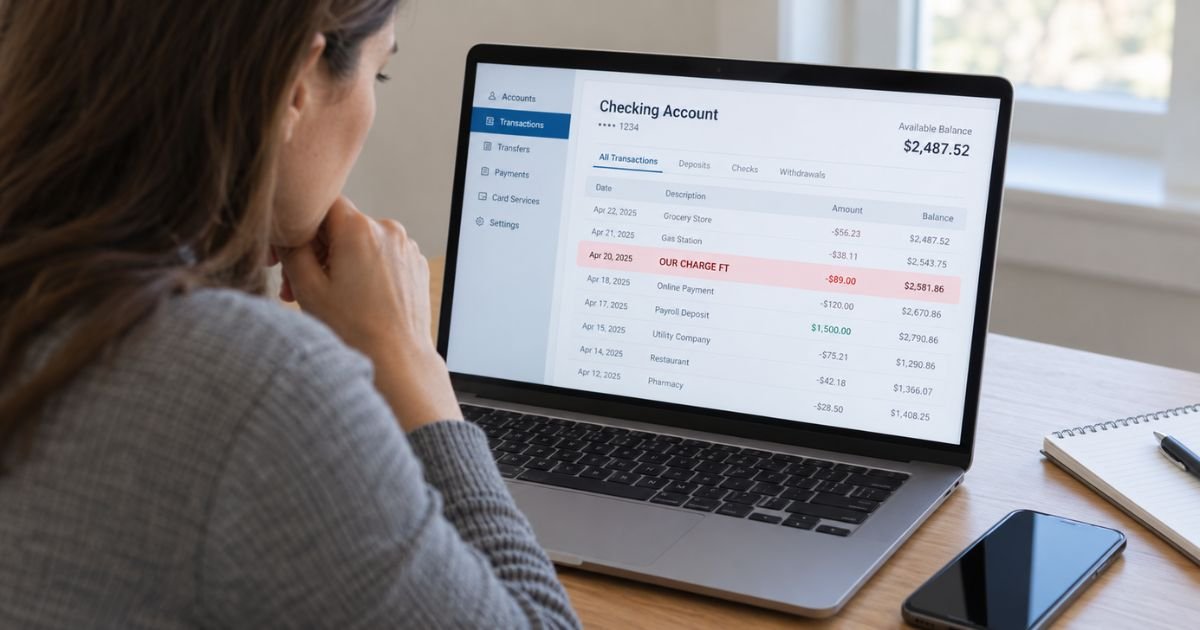
An Our Charge FT on bank statement can feel confusing if you don’t remember paying a company by that name. In many cases, this wording appears to be banking terminology rather than the name of a retail merchant.
The charge may relate to a funds transfer, especially an international bank payment. Here’s how you can identify the fee, understand the term “OUR,” and decide whether you need to contact your bank.
Table of Contents
What Is an Our Charge FT on Bank Statement?
An Our Charge FT on bank statement generally appears to describe a bank-generated charge connected with a transfer. The strongest evidence points toward international or foreign funds transfers rather than an ordinary debit-card purchase.
In international banking, “OUR” has a specific meaning. SWIFT payment standards use OUR, SHA, and BEN to tell banks who should pay transfer charges.
With the OUR option, you as the sender generally agree to pay the transfer charges. The recipient is intended to receive the transferred amount without those fees being deducted from it.
“FT” commonly refers to a funds transfer in banking systems. However, statement abbreviations can vary by financial institution, so you should not assume every bank uses FT in exactly the same way.
What Does “OUR” Mean in a Bank Transfer?
If you make an international wire, your bank may ask how the fees should be divided between you and the person receiving the money.
Three common options are:
| Charge code | Who generally pays the fees? | Effect on recipient |
|---|---|---|
| OUR | Sender | Usually intended to receive the full transfer amount |
| SHA | Sender and recipient share costs | Recipient may pay receiving or intermediary fees |
| BEN | Recipient | Fees may be deducted from the transfer |
| OUR CHARGE | Sender | May appear as a separate transfer-related fee |
SWIFT documentation confirms that OUR, SHA, and BEN are recognized payment-charge options. Newer ISO 20022 messages may use DEBT, SHAR, and CRED as comparable charge-bearer codes.
This makes “Our Charge” different from wording such as “our service charge” in everyday language. In a transfer context, OUR may be a technical payment instruction.
What Does FT Mean on Your Statement?
FT often means “funds transfer” in bank processing systems. Banking software from Oracle, for example, uses FT as an abbreviation when describing funds-transfer contracts and related charges.
However, there is no universal U.S. rule requiring every bank to define FT this way on statements. Your bank may use its own internal abbreviations.
You may therefore see OUR CHARGE FT after:
- An international wire transfer.
- A foreign currency transfer.
- A bank-to-bank payment.
- A business payment sent overseas.
- A transfer where you selected the OUR fee option.
- A transfer involving an intermediary bank.
Pro Tip: Compare the fee date with transfers made one or two business days earlier. A transfer charge may post separately from the amount you actually sent.
Is Our Charge FT a Merchant?
Probably not in most cases. The available evidence points more strongly toward a bank transaction description than a company called “Our Charge FT.”
An exact historical example of “Our Charge Ft” appears in published financial records tied to a Lloyds Bank Business Banking account. Current Lloyds fee information also describes “our charge” when explaining fees for foreign payments.
That does not prove your particular charge came from Lloyds. Other banks also use OUR terminology for international payments.
You should check the name of the financial institution that issued your statement before assuming which bank created the descriptor.
Why Did You Get an Our Charge FT Fee?
A common reason is that you chose, or your transfer instructions used, an OUR charge arrangement.
For example, your bank may charge its normal transfer fee plus an additional amount to cover correspondent-bank or overseas-bank costs.
NatWest currently explains that when a customer chooses its OUR option, the sender pays the bank’s charge plus the applicable agent fee. The receiving party is then intended to receive the full transfer amount.
HSBC India similarly states that choosing OUR for certain outward foreign-currency wire transfers creates an additional fee because the sender is taking responsibility for local and overseas charges.
The exact amount can vary widely. Your bank, destination country, currency, intermediary banks, and transfer method can all affect the final charge.
Is Our Charge FT the Same as a Wire Transfer Fee?
It may be connected with a wire fee, but the two entries are not always identical.
Your bank could charge one fee for sending the wire and another amount for an OUR arrangement. The second fee may cover costs that would otherwise be deducted by intermediary or receiving banks.
You may therefore see several entries around the same transaction.
| Statement activity | Possible explanation |
|---|---|
| Main transfer amount | Money you sent |
| Wire or transfer fee | Your bank’s processing charge |
| OUR CHARGE FT | Additional sender-paid transfer costs |
| FX charge | Currency conversion cost |
| Correspondent bank charge | Fee connected with an intermediary bank |
Your account’s fee schedule is the best source for identifying which charges apply.
How to Verify an Our Charge FT Entry
Start with the full transaction details in online banking. You should look for a transfer reference, recipient information, currency, value date, or related payment number.
Then review transfers around the same date. Check international wires in particular.
You can also:
- Review your wire-transfer receipt.
- Check your bank’s current fee schedule.
- Look for an OUR, SHA, or BEN selection.
- Compare the charge with your transfer confirmation.
- Ask your bank to identify the linked transaction.
When contacting your bank, ask whether OUR CHARGE FT is a bank fee rather than a third-party merchant charge. Your bank should be able to see more processing information than you can see on a normal statement.
BBB, Trustpilot, and Reddit Reports
BBB and Trustpilot searches are generally more useful when a statement charge belongs to a specific company. OUR CHARGE FT does not appear to identify one clear merchant.
Current searches do not provide reliable evidence of a business officially operating under that exact name. Reddit also does not show a strong recurring pattern tied to a specific company using the descriptor.
That lack of merchant evidence fits with the banking explanation. However, it does not prove the reason for your specific charge.
Common Mistakes: Don’t search for a company called “Our Charge FT” and assume a missing company profile means fraud. Start with your bank, because the wording may have been generated by the bank itself.
Can You Get an Our Charge FT Fee Refunded?
Possibly, but there is no universal refund rule.
If you knowingly selected the OUR option, the fee may be valid under your bank’s transfer terms. Your bank generally does not have to waive a properly disclosed fee simply because you did not notice it.
You may have a stronger reason to request a review if:
- You did not make the related transfer.
- The bank charged a different amount than it disclosed.
- You selected another fee arrangement.
- The same fee appeared twice.
- A transfer was canceled but the charge remained.
- A bank employee gave you incorrect fee information.
Ask your bank to explain the fee before requesting a refund. A clear explanation can help you determine whether the issue is a pricing question or a transaction error.
What If You Did Not Make the Transfer?
Treat an unknown transfer differently from a fee you simply do not understand.
If you did not authorize the underlying transaction, contact your bank or credit union promptly. Ask it to identify both the OUR CHARGE FT fee and the transfer associated with it.
For U.S. consumer accounts, federal protections may apply to qualifying unauthorized electronic fund transfers. The CFPB says you should report unauthorized account activity promptly, and certain liability protections depend on how quickly you notify your financial institution.
Do not focus only on disputing the small fee. An unexpected transfer fee could indicate a larger transaction that also needs investigation.
FAQs: Our Charge FT On Bank Statement
Q. What does Our Charge FT mean on a bank statement?
A. It generally appears to be a bank fee associated with a funds transfer. The term OUR commonly means that you, as the sender, agreed to pay the transfer charges.
Q. Does FT definitely mean funds transfer?
A. Funds transfer is a common banking meaning for FT, but statement abbreviations can vary. You should ask your bank to confirm how it defines the code on your account.
Q. Is Our Charge FT a fraudulent transaction?
A. Not necessarily. It may be a legitimate fee associated with an international transfer or wire.
If you did not make any related transfer, contact your bank promptly.
Q. How can you avoid Our Charge FT fees?
A. Review the fee options before sending an international payment. Depending on the transfer, choosing a shared-fee arrangement may reduce your cost, but the recipient may then receive less.
Your bank can explain which options are available before you send the payment.
Conclusion
An Our Charge FT on bank statement most likely refers to a bank-generated fee connected with a funds transfer, particularly an international payment. The word OUR is a recognized banking charge option that generally means you, as the sender, pay the transfer costs.
The exact meaning of FT and the amount charged can vary by bank. Check your transfer records and ask your bank to identify the linked payment if the Our Charge FT on bank statement entry does not look familiar.
Disclaimer: This article is for general informational purposes only and is not financial or legal advice. Bank abbreviations, international transfer fees, refund rules, and dispute rights can vary by issuer and account, so verify account-specific questions with your bank or credit union.
Meet the Author
