
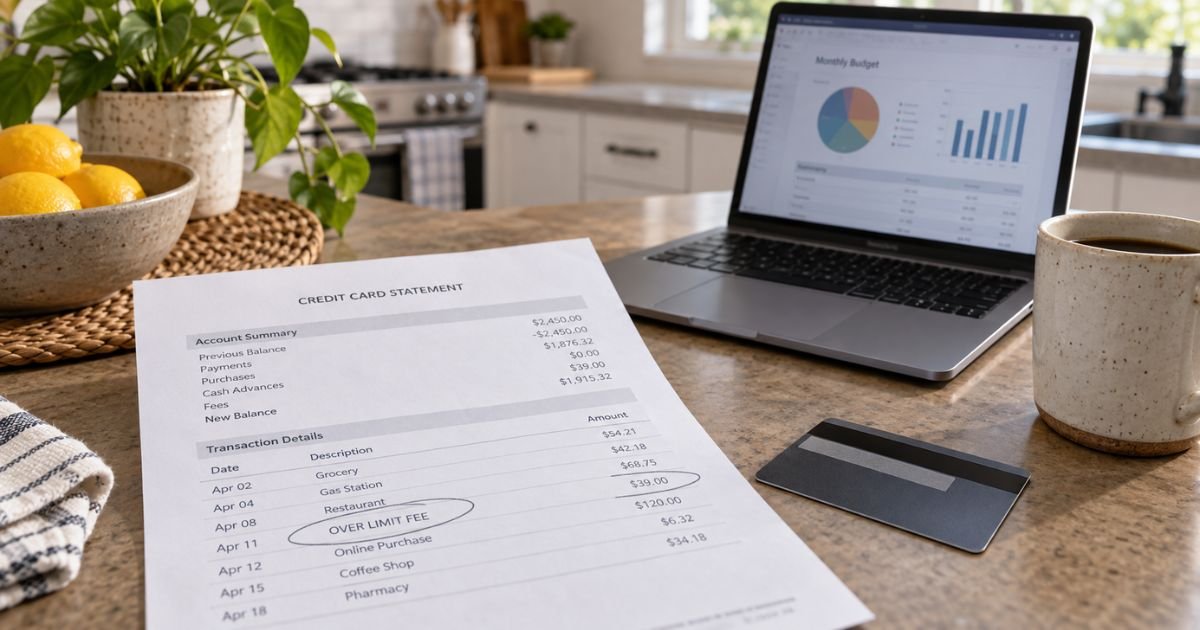
Seeing credit card over limit charges can feel confusing if you don’t recall signing up for anything extra. The line often looks like a penalty you never agreed to. In many cases it is a real issuer fee, but only after you opted in.
This guide explains what that charge usually is, when federal rules allow it, and what to do if the amount looks wrong.
Table of Contents
What credit card over limit charges are
Credit card over limit charges are typically an over-the-limit fee. Your issuer adds that fee when a transaction pushes your balance past the credit limit on that card. The fee is not a store purchase. It is an issuer penalty line.
Federal law changed this fee in a big way. Under the CARD Act rules in Regulation Z, an issuer generally cannot charge an over-the-limit fee unless you first opt in to let over-limit transactions go through.
If you never opted in, the purchase is usually declined instead. The issuer may still pay an over-limit charge without your opt-in. It just cannot add a fee for doing so.
Many large issuers stopped charging this fee after those rules took effect. The CFPB later described overlimit fees as effectively gone as a major cost for most cardholders. Your own card can still be different. Always read the fee box in your card agreement.
How over limit charges appear on your statement
Issuers shorten the wording. You may see OVER LIMIT FEE, OVER-THE-LIMIT FEE, OVERLIMIT FEE, or OTL FEE. The amount is usually a flat dollar figure, not a store name.
Match that line to the same billing cycle where your balance crossed the limit. Interest, a late fee, or a returned-payment fee can also raise the balance. Those are separate lines. They are not the same thing as an over-limit fee.
A declined swipe does not create this fee. If the terminal said “declined,” you generally should not see an over-limit charge for that attempt.
Pro Tip: Check the “Fees” section of your latest statement and the pricing box in your card agreement. If the agreement lists the over-limit fee as $0 or “None,” a posted over-limit fee is worth a written question to the issuer.
When an issuer can charge an over-limit fee
The federal opt-in rule is the starting point. Before a fee is allowed, the issuer generally must:
- Give you a clear notice about the service and the fee amount
- Give you a real chance to say yes
- Get your affirmative opt-in
- Send written or electronic confirmation
- Tell you that you can revoke that consent later
You can opt in or opt out by phone, in writing, or online if the issuer offers those methods. The issuer must let you cancel the same way you signed up. Canceling does not erase a fee already posted for an earlier purchase.
Even after you opt in, extra limits apply:
| Rule | What it generally means for you |
|---|---|
| Opt-in required for a fee | No opt-in, no over-limit fee |
| One fee per billing cycle | Several over-limit purchases in one cycle still mean one fee |
| Same overage is capped | The same leftover overage generally cannot keep drawing a new fee forever |
| Fee cannot beat the overage | If you went $10 over, the fee cannot be more than $10 |
| Interest-only overage | The issuer generally cannot charge the fee if you went over only because it added its own interest or fees that cycle |
The CFPB’s consumer page says that if you did opt in, you generally can be charged a fee of up to $25 the first time you go over, and up to $35 if you go over again within six months. The fee still cannot be larger than the amount you went over. Your agreement lists the exact figure your issuer uses.
Penalty-fee safe harbors in Regulation Z can also change over time, so treat those CFPB numbers as a consumer guide, not a promise on every card.
An issuer does not have to approve an over-limit purchase even if you opted in. Approval is still the bank’s choice.
What else can happen if you go over your limit
The fee is only one possible result. Many people never see a fee and still feel the squeeze.
Your next purchase may be declined until you pay the balance back under the limit. Some issuers raise the minimum payment by the extra amount so you cannot carry that overage for months. Some may place an administrative hold on new spending until the balance drops.
High balances can also affect credit scores when the issuer reports the account. Credit utilization is the share of your limit that you are using. Going over the limit pushes that ratio above 100% on that card.
Scoring models generally treat very high utilization as a risk signal. Paying the balance down typically helps more than arguing with the score itself.
A penalty APR is a separate issue. Some agreements allow a higher rate after certain violations, usually with advance notice. That is not the over-limit fee. Read the penalty-rate section of your agreement before you assume the rate jumped automatically.
Charge cards are a different product. Some have no preset spending limit and review charges case by case. Do not mix those terms with a regular credit card that prints a hard dollar limit.
What to do if you see over limit charges
Start with matching, then decide whether the fee was allowed.
- Confirm the posted fee name and dollar amount on the statement.
- Compare that cycle’s balance to your credit limit in the app.
- Look for an opt-in confirmation you received when you opened the account or later.
- See whether the balance crossed the limit only after interest or issuer fees posted. That pattern is a common reason to ask for a reversal.
- Pay enough to get back under the limit if you can. That stops new declines and can reduce utilization before the next report date.
- Opt out of over-limit coverage if you no longer want purchases approved past the limit.
If you never opted in, or the fee is larger than the overage, treat it as a possible billing error. Call the issuer first. To keep federal billing-error protections, also send a written notice to the billing-inquiries address on your statement.
Do that so it arrives within 60 days after the issuer sent the first statement that showed the fee. Include your name, account number, the fee date and amount, and why you believe it is wrong.
You generally do not have to pay the disputed fee or related finance charges while a valid billing-error review is open. You still need to pay the rest of the bill on time.
If the issuer will not correct a fee that breaks the opt-in rules, you can submit a complaint to the CFPB. Use the complaint tool on consumerfinance.gov.
Common Mistakes: Assuming every over-limit swipe creates a fee. Ignoring the fee because “the purchase went through.” Opting in years ago and forgetting the setting is still on. Waiting until the next statement to pay the overage, then getting declined at the store.
How to avoid going over your limit
Available credit is your limit minus the posted balance minus pending holds. Gas pumps, hotels, and rentals often hold more than the final bill. Those holds can make you look maxed out even when the posted purchases are smaller.
Helpful habits include:
- Turning on issuer alerts when you hit 50%, 70%, or 90% of the limit
- Checking pending authorizations before a large purchase
- Paying mid-cycle if a hold or trip will land near the ceiling
- Asking for a limit increase only if your income and payment history support it
- Keeping a second card or debit card for emergencies instead of opting in to over-limit fees
A limit increase can lower utilization if your spending stays flat. It can also tempt more spending. Request one only if you will keep the balance in a range you can pay.
FAQs: Credit Card Over Limit Charges
Q. Are credit card over limit charges a scam?
A. Usually no. Credit card over limit charges are typically an issuer over-the-limit fee, not a random merchant. The charge is generally allowed only if you opted in and a purchase pushed you past the limit. If you never opted in, or the fee is bigger than the overage, ask the issuer to reverse it.
Q. Can my issuer charge an over-limit fee if I did not opt in?
A. Generally no. Federal rules say the issuer cannot assess that fee unless you affirmatively opted in to over-limit transactions. The issuer may still let a charge through. It just cannot add the fee for paying it. Check your agreement and any old opt-in confirmation.
Q. Why did I go over my limit without making a new purchase?
A. Posted interest, a late fee, or a returned-payment fee can raise the balance after the last swipe. Authorizations that later post higher than the pending amount can do the same. Federal rules generally bar an over-limit fee when the only reason you crossed the line that cycle is the issuer’s own interest or fees.
Q. Will going over my limit hurt my credit score?
A. It can, mainly through utilization. When the issuer reports a balance above the limit, that card’s utilization is over 100%. Scoring models generally treat that as high risk. Paying the balance back under the limit, and ideally much lower, is usually the fastest repair. A single over-limit fee by itself is not the same as a missed payment.
Conclusion
Credit card over limit charges are usually an issuer over-the-limit fee, not a store you forgot. The key federal rule is opt-in. No opt-in generally means no fee, even if a purchase slipped through. If a fee did post, compare it with the overage, your agreement, and whether interest alone pushed you over.
Pay the balance back under the limit if you can, opt out if you no longer want that coverage, and use the 60-day written billing-error path when the fee does not match the rules.
Disclaimer: This article is for general information only. It is not financial, legal, or tax advice. Fee amounts, opt-in settings, and credit-reporting practices vary by issuer and by card. Confirm account-specific questions with your card issuer or the CFPB resources linked to your own agreement.
Meet the Author
