
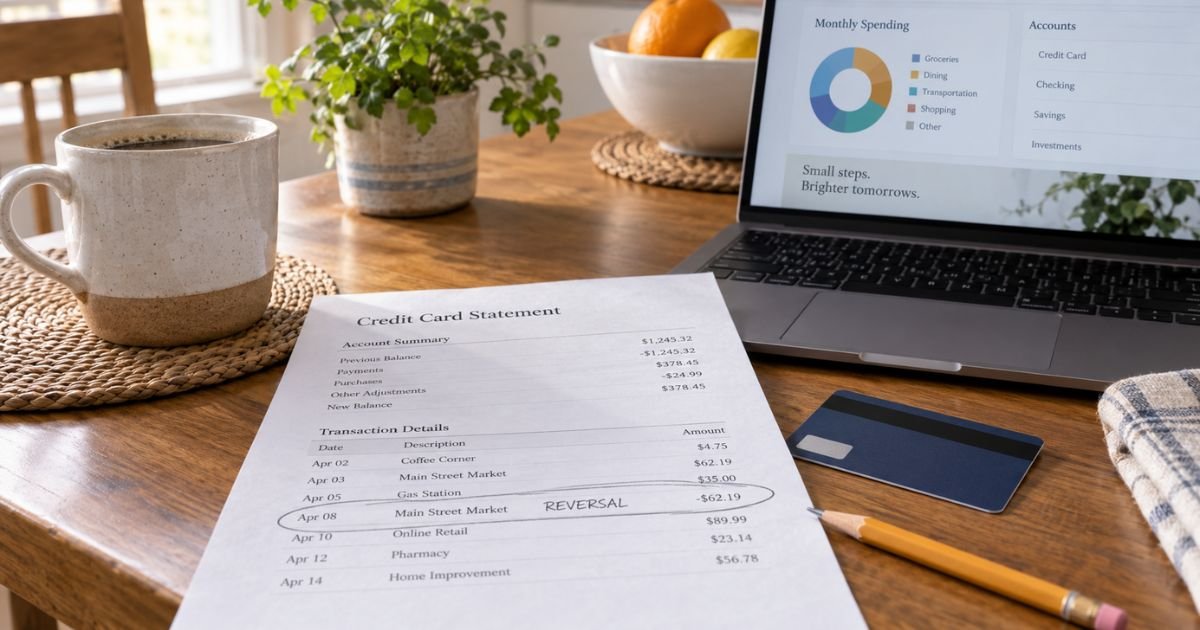
Seeing a reversal charge on a credit card can feel confusing if you don’t recall signing up for anything. The line often looks like a brand-new merchant. In many cases it is simply your bank or a store undoing an earlier transaction.
This guide explains what that label usually means, how it differs from a refund, and what to check if the amount looks wrong.
Table of Contents
What a reversal charge on a credit card is
A reversal charge on a credit card is generally a bank or merchant label for undoing a card transaction. It is typically not a storefront you shopped at.
“Reversal” is an umbrella word. It can cover a canceled pending hold, a posted refund, a dispute result, or the take-back of a temporary credit.
Direction matters. A reversal that lowers your balance is usually money coming back to you. A reversal that raises your balance is often the issuer taking back an earlier credit or a payment that did not clear.
Issuers shorten the wording. You may see REVERSAL, REV, CHARGE REVERSAL, PAYMENT REVERSAL, or REVERSAL OF TEMPORARY CREDIT. Some banks use CB, ADJ, or DISPUTED TRANS next to the original merchant name.
How a reversal charge usually appears on your statement
Look at more than the first word. Match the date and dollar amount to an earlier purchase, refund, payment, or dispute.
Common patterns include:
- The original store name plus REVERSAL or REV
- PAYMENT REVERSAL after you tried to pay the card from a bank account
- REVERSAL OF TEMPORARY CREDIT after a dispute investigation ends
- A pending charge that vanishes, then a posted credit with a similar amount
- A small $1 authorization that posts and then reverses
Pending and posted views can differ. Check both in your issuer’s app. A hold that drops off is often an authorization reversal. A separate credit line next to the original purchase is more often a refund.
Pro Tip: Screenshot the original charge, the reversal, and any email or in-app receipt. Dates and reference numbers make a later call much faster.
Reversal vs. refund vs. chargeback
People use these words as if they mean the same thing. They do not.
| Type | Who usually starts it | When it happens | What you typically see |
|---|---|---|---|
| Authorization reversal (void) | Merchant, processor, or network | Before the sale fully settles | Pending hold disappears; may never post |
| Refund or merchant credit | Merchant | After the sale posts | Separate credit line next to the original charge |
| Chargeback | You, through your card issuer | After the sale posts and you dispute it | Credit or “dispute” tag; may be temporary at first |
| Temporary-credit reversal | Your issuer | After a dispute investigation | Earlier credit is taken back; balance can rise |
A void generally happens the same day or within a short settlement window. A refund is a new credit after money already moved. A chargeback is a formal dispute your issuer runs with the merchant’s bank.
Federal billing-error rules for credit cards sit under the Fair Credit Billing Act. The Consumer Financial Protection Bureau says you should also send a written notice within 60 calendar days after the charge appeared on your statement.
After the issuer gets that notice, it generally has 30 days to confirm receipt, unless it already finished the required steps.
Why you might see a reversal charge
Most reversals have a simple cause. Start with the matching purchase before you assume fraud.
Typical reasons include:
- A cashier voided a duplicate swipe or a wrong amount
- An online order was canceled before it shipped
- A hotel, gas pump, or rental car released a larger hold
- A merchant ran a small card-check authorization, then dropped it
- You returned an item and the store sent a credit
- You filed a dispute and received a temporary credit
- The issuer later decided the original charge was valid and took that credit back
- A card payment from your bank account was returned unpaid
- Rewards or cash-back posted on a purchase that later refunded
A $1 charge and matching reversal is often a card-on-file check. That pattern is common when you add a card to an app.
It can also appear if someone is testing a stolen number. If you did not recently add the card anywhere, call the number on the back of your card.
A PAYMENT REVERSAL is different from a store refund. That line usually means your payment to the card issuer did not stay posted.
Insufficient funds, a closed account, or a mismatched routing number can trigger it. Your card balance generally goes back up by that payment amount.
How long a reversal typically takes
Timing depends on which kind of reversal you have. Issuer apps and merchant processors do not move at the same speed.
Authorization reversals are usually the fastest. If the merchant sends a proper cancel message, the hold often drops within a day.
If nobody sends that message, the hold may linger until it expires. Everyday pending charges commonly clear or drop within a few business days. Hotel, car-rental, and similar estimated holds can last longer.
Refunds generally take several business days after the merchant processes them. You may see the original purchase and the credit on the same statement, or on the next one.
Dispute reversals follow federal clocks for billing errors. After a valid written notice, the issuer generally must acknowledge it within 30 days and finish within two billing cycles, and no later than 90 days.
A reversal of temporary credit usually appears when that investigation ends. If the issuer sides with the merchant, the earlier credit comes off. That can look like a new charge even though it is only the take-back of a placeholder.
What to do if you do not recognize the reversal
Work in order. Most cases resolve with matching, not with a formal fight.
- Open recent activity, not just the mailed statement. Find a purchase, refund, payment, or dispute with the same amount.
- Confirm whether the line is a credit or a debit. Credits lower what you owe. Debits raise it.
- If it matches a store visit or online order, contact that merchant first. A same-day void is often faster than a bank dispute.
- If it says PAYMENT REVERSAL, check the linked bank account for a returned transfer. Then call your card issuer about the payment, not the store.
- If it says REVERSAL OF TEMPORARY CREDIT, look for a closed dispute letter or app message. Ask the issuer what evidence it used.
- If nothing matches and you did not authorize a related purchase, treat it as a possible billing error or unauthorized use.
To keep federal billing-error protections on a credit card, send a written notice to the billing-inquiries address on your statement. Do that so it arrives within 60 days after the issuer sent the first statement that showed the problem.
Include your name, account number, the date and amount, and why you believe the line is wrong. Keep copies. The FTC publishes a sample dispute letter you can adapt.
You generally do not have to pay the disputed amount or related finance charges while a valid billing-error review is open. You still need to pay the rest of the bill on time.
If the issue is unauthorized use, federal law generally caps your credit-card liability at $50. Many major issuers advertise $0 liability policies, but those are issuer rules, not a substitute for reporting the problem quickly.
Common Mistakes: Waiting for the next statement before you match the line. Ignoring a PAYMENT REVERSAL and assuming the card is paid. Treating a vanished pending hold as a finished refund, then being surprised when the final charge posts a few days later. Calling only the merchant when the label is clearly an issuer payment reversal.
FAQs: Reversal Charge on Credit Card
Q. Is a reversal charge on a credit card a scam?
A. Usually no. The words “reversal charge on a credit card” typically describe a void, refund, dispute result, or payment correction. Scams more often hide behind an unfamiliar store name, not the word reversal itself. Still match the amount. If you did not make a related purchase or payment, call your issuer.
Q. Why did a reversal increase what I owe?
A. A reversal that raises your balance is often the issuer taking something back. Common examples are a temporary dispute credit that did not stick, a card payment that bounced, or rewards clawed back after a return. It can look like a new purchase even when it is only an adjustment.
Q. How long does a reversal take to show up?
A. It varies by type. A canceled pending hold may disappear within a day or a few business days. A merchant refund often takes several business days after the store processes it. A dispute-related credit or later take-back can take weeks, because the issuer has up to two billing cycles and no more than 90 days to finish a billing-error review after it receives your written notice.
Q. Can I dispute a reversal charge on a credit card?
A. Yes, if the reversal itself looks wrong. Examples include a temporary credit pulled back without an explanation, a payment reversal when your bank account had the funds, or a “refund reversal” for a return the store already accepted. Start with the issuer or merchant that created the line. Use the 60-day written billing-error path if it is a credit-card statement error.
Conclusion
A reversal charge on a credit card is usually paperwork, not a mystery store. Read the full descriptor, match the dollars to an earlier purchase or payment, and notice whether the line raises or lowers your balance. Most cases are a voided hold, a refund, a dispute update, or a bounced card payment.
If the numbers still do not add up, write to your issuer within the 60-day billing-error window and keep paying the undisputed rest of the bill.
Disclaimer: This article is for general information only. It is not financial, legal, or tax advice. Card-network rules, issuer labels, and refund timelines vary. Confirm account-specific questions with your card issuer, your bank, or the merchant on the original purchase.
Meet the Author
