
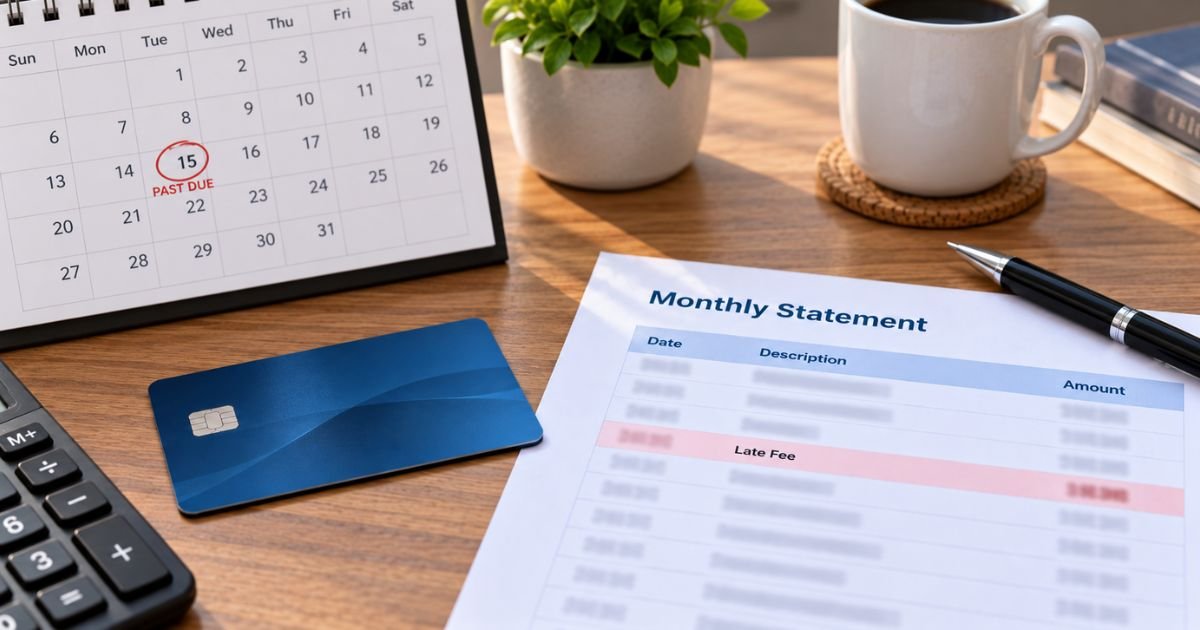
A late charge on a credit card can feel confusing if you thought you paid on time. The line is usually a fee from your issuer, not a store.
That fee can sit next to interest and a higher penalty APR. This guide explains what a late charge on a credit card means, when it posts, and how to stop the next one.
Table of Contents
What Is a Late Charge on a Credit Card?
A late charge on credit card is a late payment fee. Your issuer adds it when it does not receive at least the minimum payment by the due date on your statement.
It is not a merchant. You will not find a shop called Late Charge. The words LATE FEE, LATE PAYMENT FEE, or LATE CHARGE typically appear under fees on the same bill as your purchases.
Federal rules under the CARD Act say penalty fees must be reasonable and proportional. A 2024 CFPB rule tried to set an $8 safe harbor late fee for large issuers. A federal court vacated that cap in 2025.
Consumer reports in 2026 still describe first late fees near $30 and a higher fee if another payment is late within about six billing cycles, often near $41.
Your own amount is the number in your card agreement. Do not treat those examples as your rate.
A late fee is separate from interest. Interest is the finance charge on a carried balance. You can owe a late fee even on a small missed minimum.
You can owe interest even when every payment was on time, if you did not pay the statement in full.
How the Charge May Appear on Your Statement
Read the fees section, not only the purchase list.
| Statement wording you might see | What it often means |
|---|---|
| LATE FEE or LATE PAYMENT FEE | Minimum payment missed the due date |
| LATE CHARGE | Same fee, different issuer label |
| RETURNED PAYMENT FEE | Your payment bounced; this is a different fee |
| PENALTY APR or DEFAULT APR note | Rate hike after serious delinquency |
| FINANCE CHARGE or INTEREST CHARGE | Interest on a balance, not the late fee |
Cutoff time matters. Some issuers treat an online payment as on time only if it arrives by midnight Eastern on the due date. Mail can take days. A payment you sent on the due date can still be late.
What Else Can Follow a Late Payment
A second, higher late fee
If you miss again in the same cycle or in one of the next six cycles, many agreements raise the fee.
Credit reporting
Issuers generally do not report a payment as 30 days late until it is about 30 days past due. A fee on day two is painful. A 30-day mark can follow you on a credit report for years.
Penalty APR
If you go about 60 days past due, the issuer may apply a penalty rate to existing balances after required notice, often 45 days. After six on-time payments, federal rules generally require the issuer to review that penalty rate on the old balance.
Lost grace period
If you usually pay in full and avoid purchase interest, a missed cycle can start interest on new purchases until you catch up under your agreement.
A charge card rule
Some charge cards that require payment in full use a late fee tied to a percent of the unpaid balance after more than one missed cycle. That structure is in Regulation Z. Read that product’s terms.
How to Verify the Late Charge
- Open the statement that shows the fee and find the due date and minimum due.
- Check your bank for a payment dated on or after that due date.
- Confirm the payment method. Autopay can fail if the linked account was short.
- Look for a returned-payment fee on the same bill.
- Read the fee table in your card agreement or Schumer box.
If the issuer changed the payment address and that change delayed your check, Regulation Z generally blocks late fees caused by that change for 60 days. Tell the issuer in writing if that is what happened.
Pro Tip: Autopay the minimum at least. You can add a second payment later for the rest. That single autopay is the simplest way most people stop a late charge on a credit card.
How to Get a Late Fee Taken Off
Pay the missed minimum first. Then call the number on the card.
Ask for a courtesy waiver. Many issuers will drop a first late fee if your history is clean. That waiver is a favor, not a right. Get a confirmation number.
If autopay failed, fix the funding account before the next due date. If mail was slow, switch to the app.
You can change the due date with some issuers so it lands after payday. Ask how many cycles the change takes. Keep paying the old date until the new one starts.
If the fee is a billing error, such as a payment the issuer received on time and failed to credit, use the written billing-error process. Send the letter within 60 days of the statement that first showed the fee.
Common Mistakes: People pay the statement balance two days late and think the fee is interest. It is a penalty for missing the minimum. Others mail a check on the due date and assume it counts.
How to Avoid the Next One
- Turn on due-date alerts in the card app and your email.
- Set autopay for at least the minimum.
- Pay a few days early when the due date falls on a weekend or holiday.
- Keep a small buffer in the account that funds autopay.
- If you cannot pay the full bill, still send the minimum on time.
A hardship program may pause or lower payments if you ask before you are far behind. Terms vary. Ask the issuer. Do not ignore the bill.
Late Charge Versus Other Fees
A late charge is not a cash-advance fee. It is not an over-limit fee. It is not a foreign transaction fee.
A returned payment can stack with a late fee if the bounced payment was your only attempt. Fix the bank account, then send a good payment the same day.
Interest can dwarf one late fee if a penalty APR stays on a large balance. The fee is the first hit. The rate is the long one.
If You Are Already Behind
Bring the account current as soon as you can. One late fee is cheaper than two fees plus a 30-day credit mark plus a penalty APR.
If several cards are late, list due dates and pay each minimum first. Then attack the highest-rate balance.
Nonprofit credit counseling can help you map payments. Watch for for-profit debt-relief ads that charge before they settle anything.
FAQs: Late Charge on Credit Card
Q. Is a late charge on a credit card a fraudulent charge?
A. No. It is typically your issuer’s late payment fee after a missed minimum. Call the number on the card if the due date or payment date looks wrong.
Q. How much is a late charge on a credit card?
A. It depends on your agreement. After the $8 federal safe-harbor cap was vacated in 2025, published first fees near $30 and repeat fees near $41 are common in consumer guides. Check your own terms.
Q. Will one late payment ruin my credit?
A. A fee alone is not a credit-report item. Issuers generally report delinquency at about 30 days past due. Pay before that mark when you can.
Q. Can I get the fee waived?
A. Often yes on a first miss if you ask and then pay. There is no federal rule that forces a waiver. Be polite, pay the minimum, and keep the confirmation.
Conclusion
A late charge on a credit card is your issuer’s fee for missing the minimum by the due date. It is not a store. The dollar amount lives in your card agreement, not in a single national price.
Pay the minimum on time, ask for a one-time waiver if you slipped, and use autopay so the next statement stays clean.
Disclaimer: This article is for general information only. It is not financial or legal advice. Late fee amounts, penalty APRs, and courtesy waivers vary by issuer and by card. Confirm the fee and your options with your card company.
Meet the Author
