
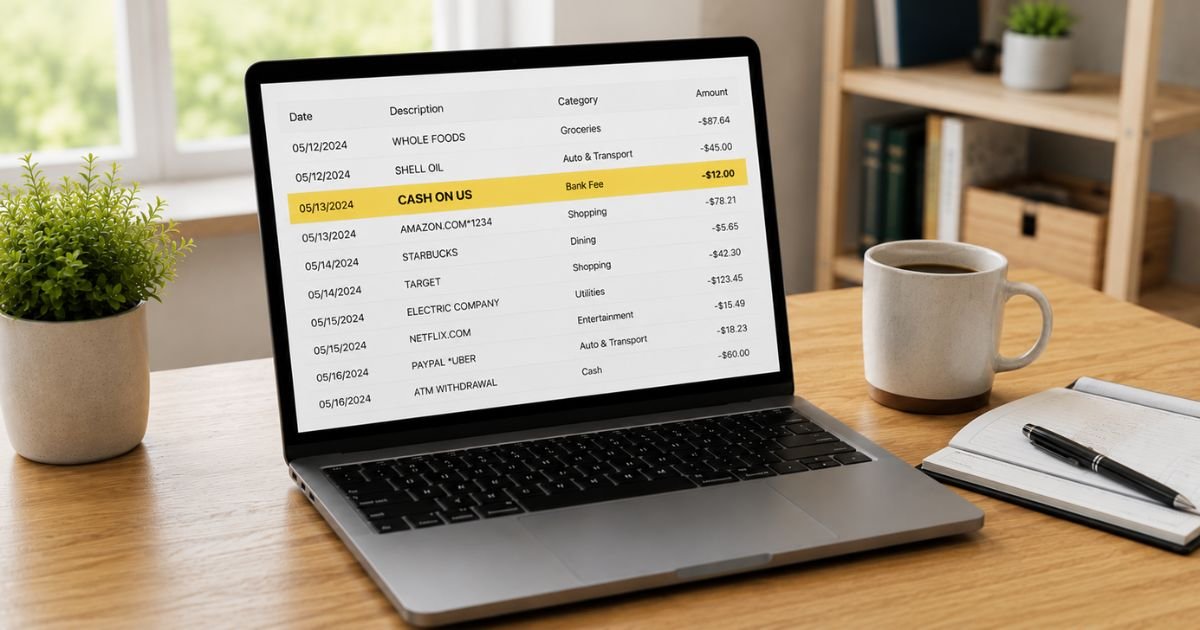
Seeing a Cash On Us charge on bank statement can be puzzling if you don’t recognize the wording. You’re not alone. Many people notice this entry and want a clear explanation right away.
This guide explains what the charge means, why it appears, how to confirm it, and practical steps if you have questions or want to avoid similar fees in the future.
Table of Contents
What Is a Cash On Us Charge?
“Cash On Us” (sometimes shown as Cash On-Us, CASH ON US, or similar) refers to a fee some banks and credit unions charge when a non-customer cashes a check drawn on an account at that same institution.
In banking terms, an “on-us” check is one written on an account at the bank where the check is being presented.
Because both the check writer’s account and the cashing location are at the same bank, the transaction does not have to travel through the broader check-clearing system.
Many banks allow non-customers to cash these checks but charge a convenience or processing fee for doing so. The fee compensates the bank for the teller time, risk, and immediate availability of funds.
The amount typically ranges from a few dollars to around $8 or more, depending on the institution’s fee schedule.
The charge may appear on the account holder’s statement or be deducted from the amount paid to the person cashing the check, depending on how the bank processes it.
Why Did This Charge Appear?
Common reasons include:
- Someone cashed a check you wrote at the same bank (an on-us check) and the bank assessed its non-customer check-cashing fee.
- You cashed a check drawn on your own bank as a non-account holder at a different branch or under a non-customer policy.
- The bank’s fee schedule lists a specific “Cash On-Us” or “Cash On-Us Checks (non-member)” fee that was applied.
- A related internal processing fee for handling an on-us item posted to the account.
These fees are disclosed in most banks’ and credit unions’ fee schedules. They are more common when the person cashing the check does not have an account at that institution.
How to Verify the Charge
Use this checklist:
- Note the exact amount, date, and full description on your statement.
- Review your recent check register or online check images for any checks that may have been cashed around that date.
- Log into your online banking or mobile app and look for more details or images related to the transaction.
- Check your bank’s or credit union’s current fee schedule (usually available on their website under “Fees” or “Disclosures”) for any “Cash On-Us,” “On-Us Check,” or non-customer check-cashing fees.
- Contact your bank’s customer service and ask them to explain the specific entry using the date and amount.
- If someone else cashed a check you wrote, ask them whether they paid a fee at the teller window.
Matching the date and amount to a cashed check or a published fee usually confirms the charge is expected.
Is It Legitimate or Fraud?
Legitimate scenarios
Most Cash On Us charges are standard bank fees for handling on-us checks presented by non-customers.
Banks are generally allowed to charge these fees, and many do so as part of their published fee schedules.
The CFPB has noted that banks can charge non-customers a fee to cash checks drawn on accounts at that bank.
Warning signs
- The amount is unusually large or appears repeatedly without corresponding check activity.
- You have no record of writing or cashing any related checks.
- The description does not match anything in your bank’s fee schedule.
- You receive no explanation when you ask the bank about it.
If the charge does not make sense after reviewing your records and the fee schedule, contact your bank promptly for clarification or to dispute it.
How to Avoid or Stop These Charges
Because this is typically a one-time fee tied to a specific check-cashing event, there is usually nothing ongoing to cancel. To avoid future charges:
- Encourage people you write checks to to deposit them at their own bank instead of cashing them at yours.
- If you need to cash a check drawn on another bank, consider depositing it into your own account rather than cashing it as a non-customer elsewhere.
- Review your bank’s fee schedule and ask whether any on-us check fees can be waived for certain situations.
- Use electronic payments, Zelle, or other transfer methods when possible to reduce paper checks.
- If you are a non-customer frequently cashing checks at a particular bank, opening an account there may eliminate the fee.
Contact your bank’s customer service for the most accurate guidance on their specific policy.
Can You Get a Refund?
Refunds for Cash On Us fees are uncommon once the fee has been properly assessed according to the bank’s published schedule. However:
- If the fee was applied in error (for example, the person cashing the check was actually an account holder), the bank may reverse it.
- Contact customer service with the date, amount, and any supporting details (such as the check number) and request a review.
- If you believe the charge is incorrect or unauthorized, you can formally dispute it with your bank. Keep records of all communications.
Unauthorized or erroneous fees are generally handled under the bank’s error-resolution procedures.
What to Do If the Charge Is Unauthorized or Incorrect
- Contact your bank or credit union right away and ask for a detailed explanation of the charge.
- Provide the date, amount, and any related check information.
- Request a copy of the fee schedule entry that applies.
- If the fee was assessed in error, ask for a reversal and written confirmation.
- Document every conversation with dates, names, and reference numbers.
- Monitor your account for any follow-up activity.
- If you are not satisfied with the response, you can escalate through the bank’s formal complaint process or contact the Consumer Financial Protection Bureau (CFPB).
Acting promptly makes resolution easier.
Prevention Tips
- Review your bank’s full fee schedule at least once a year.
- Limit the number of paper checks you write when electronic options are available.
- Encourage payees to deposit checks rather than cash them at the issuing bank.
- Keep clear records of checks you write, including dates and amounts.
- Set up account alerts for fees or unusual transactions.
- Ask your bank whether they waive on-us check fees for certain customers or situations.
- Consider switching to a bank or credit union with more favorable check-cashing policies if you frequently deal with these fees.
- Use mobile deposit or ATM deposit for checks whenever possible.
Common Related Fee Descriptions
| Descriptor or Fee Name | Typical Meaning |
|---|---|
| Cash On Us / Cash On-Us | Fee for cashing an on-us check (often non-customer) |
| On-Us Check Fee | Same type of check-cashing fee |
| Non-Member Check Cashing | Fee charged to non-account holders |
| Check Cashing Fee | General fee that may include on-us items |
Typical Next Steps Timeline
| Action | Usual Timeframe |
|---|---|
| Bank explanation of the fee | Same day to a few days |
| Fee reversal (if error) | A few days after approval |
| Formal dispute resolution | Varies; often 10–45 days |
FAQs: Cash On Us Charge on Bank Statement
Q. Why do banks charge a Cash On Us fee?
A. Banks charge the fee to cover the cost and risk of making cash immediately available to someone who is not their customer. The check is drawn on their institution, but processing it still requires teller time and fraud safeguards.
Q. Is a Cash On Us charge the same as an ATM fee?
A. No. It is specifically related to cashing a paper check drawn on the same bank. ATM fees are separate and usually involve withdrawals from another bank’s machine.
Q. Can I avoid the fee if I have an account at the bank?
A. In most cases yes. Account holders typically do not pay the non-customer on-us check cashing fee. Policies vary, so confirm with your bank.
Q. What if I never wrote or cashed a check but still see the charge?
A. Contact your bank immediately for an explanation. Provide the date and amount and ask them to investigate. Keep records of the conversation.
Conclusion
A Cash On Us charge on bank statement is most often a standard bank fee for cashing an on-us check, typically when a non-customer presents a check drawn on that bank.
Review your recent checks and the bank’s fee schedule, contact customer service for clarification if needed, and consider electronic payments to reduce future paper-check fees.
Understanding your bank’s policies makes these charges easier to recognize and manage.
Disclaimer: This article is for informational purposes only and is not financial or legal advice. Fee policies vary by bank and credit union and can change. Always verify details directly with your financial institution or a qualified professional before taking action.
Meet the Author
