
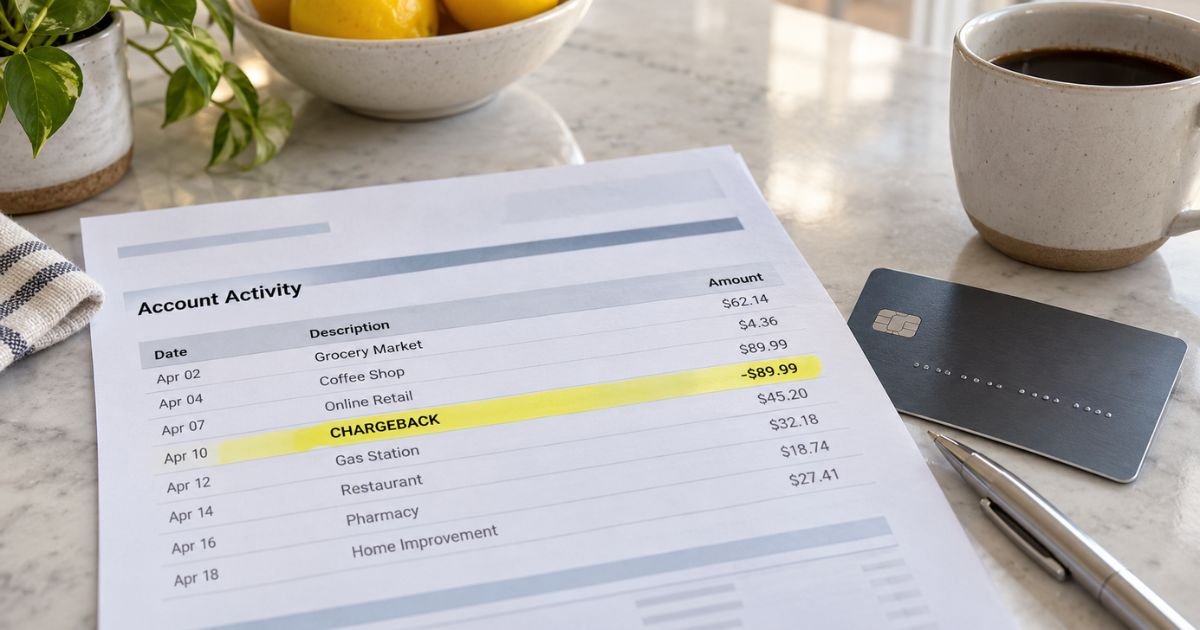
A charge back on a bank statement can feel confusing if you don’t recall starting a dispute. It is usually not a store you shopped at. It is typically a credit or adjustment after a card payment was challenged.
Unfamiliar lines like this are often legitimate. This guide explains what a chargeback is, how it usually looks, and what to do next.
Table of Contents
What Is a Chargeback on a Bank Statement?
A chargeback is a reversal of a card payment that your bank or card issuer runs after a dispute. The Consumer Financial Protection Bureau says a card company can sometimes reverse a charge this way when a refund from the seller does not fix the problem.
It is a process, not a merchant name. You generally start it by telling your issuer about fraud, a billing error, or goods you never received. Your issuer then works with the merchant’s bank and the card network.
A chargeback is different from a store refund. The seller issues a refund. Your issuer starts a chargeback. The first credit you see may be temporary while the case is reviewed.
How a Chargeback Typically Appears
Banks do not use one official phrase. You may see CHARGEBACK, CHARGE BACK, DISPUTE, DISPUTE CREDIT, ADJUSTMENT, ADJ, REV, or REVERSAL. Some statements tag the original merchant name and add a credit next to it.
The dollar amount often matches the purchase you disputed. It may also match only part of that purchase if you challenged a fee or one item in a larger order. Dates can lag the day you called, because the network and both banks have to move the money.
A related label on a checking account is different. Some banks print “return item chargeback” when a deposited check bounces and the bank takes the credit back. That is not the same as a card-network dispute.
Pro Tip: Screenshot the original debit, the chargeback credit, and any case or reference number. Those details make a later call much faster.
Chargeback vs. Refund vs. Reversal
People use these words as if they mean the same thing. They do not.
| Type | Who usually starts it | When it typically happens | What you often see |
|---|---|---|---|
| Authorization void / reversal | Merchant or processor | Before the sale fully settles | A pending hold disappears |
| Merchant refund | The seller | After the sale posts | A separate credit from the store |
| Chargeback | You, through your issuer | After the sale posts and you dispute it | A credit or “dispute” tag, often temporary at first |
| Temporary-credit reversal | Your issuer | After the investigation | An earlier credit is taken back |
A void generally happens in a short settlement window. A refund is a new credit after money already moved. A chargeback is a formal case your issuer runs with the merchant’s bank.
If you already received a store refund and then win a chargeback on the same sale, the issuer may later reverse the extra credit. That is why matching dates and amounts matters.
Why You Might See One
Common reasons include:
- An unauthorized or fraudulent charge
- A wrong amount or a duplicate post
- Goods or services you did not receive
- A credit or payment that never showed on the bill
- A seller that would not issue a refund
Issuers are generally most open to cases involving fraud or clear billing mistakes. Buyer’s remorse after a purchase you authorized is typically not a strong claim. Policies vary by issuer and by card network.
If someone else in your household used the card, the charge may be valid even if you do not remember it. Check shared logins, saved wallets, and authorized users before you file.
Credit Cards and Debit Cards Follow Different Rules
On a credit card, federal billing-error rules sit under the Fair Credit Billing Act. The CFPB says you should call the card company right away. To protect those rights, you must also send a written billing-error notice within 60 calendar days after the charge appeared on your statement.
After the issuer gets that notice, it generally has 30 days to confirm receipt unless it already finished the case. It then generally has two billing cycles, and no more than 90 days, to resolve the error.
During a proper billing-error case, the issuer generally should not treat the disputed amount as late or report it as delinquent just because you disputed it. You should still pay any amount you do not dispute.
For unauthorized credit card use, federal law generally caps your liability at $50. Many large issuers go further with $0 liability policies. Those extra policies are company rules, not a substitute for the written FCBA notice.
On a debit card or other electronic transfer, Regulation E applies. If a debit card is lost or stolen, notifying the bank within two business days generally limits your loss to $50. Waiting longer can raise that to $500.
You should also report an unauthorized transfer within 60 days after the bank sent the statement that first showed it. Waiting past that window can leave you responsible for later transfers the bank shows it could have stopped.
The CFPB says a bank generally has 10 business days to investigate an unauthorized electronic transfer after you notify it (20 business days if the account is very new).
If the review needs more time, the bank generally must give a temporary credit, minus as much as $50, and finish within 45 days. Some cases, including many point-of-sale debit purchases or foreign transfers, can take up to 90 days.
How the Chargeback Process Usually Works
You contact your issuer by phone, app, or mail and identify the charge. Many issuers start a review from that call. For credit card billing-error rights, follow up in writing to the billing-inquiries address on your statement. That address may differ from the payment address.
Your written notice should include your name, account number, the dollar amount, and why the charge is wrong. Keep copies. Note the dates of every call.
The issuer may post a temporary credit while it investigates. That credit can later stay if you win. It can also come back off your account if the issuer decides the charge was valid.
The merchant’s bank typically gets a chance to respond. You may be asked for receipts, tracking pages, cancellation emails, or screenshots of chat with the seller. Send what you have. Do not delay the written notice while you hunt for extra files.
If the issuer agrees with you, the charge should come off the bill. If it does not, the CFPB says the company must tell you why in writing and say how much you owe and when it is due.
You can still dispute a charge you already paid. The CFPB notes you probably will not see the money back until the company decides you were right.
What You Should Do If You See a Charge Back
- Match the credit to the original purchase. Confirm the amount, date, and merchant name.
- Check whether you, a family member, or an authorized user started a dispute.
- Look for a matching store refund so you do not treat the same money as missing twice.
- Call the issuer if the credit is a surprise or if a temporary credit later disappears.
- For a new problem you have not disputed yet, try the merchant first when the purchase is real and only the outcome is wrong.
- File with the issuer if the seller will not help, or if the charge looks like fraud.
- Send the credit card written notice within 60 days of the statement that first showed the error.
If the issuer mishandles the process, you can submit a complaint to the CFPB at consumerfinance.gov or by calling (855) 411-2372. The Bureau generally forwards the complaint to the company for a response.
Common Mistakes: Waiting for a phone case to “count” as your only FCBA notice. Skipping the merchant on a delivery problem you could have fixed in one email. Treating a bounced-check “return item chargeback” like a card dispute. Spending a temporary credit before the case is closed.
FAQs: What is a Charge back on a Bank Statement
Q. Is a charge back on a bank statement a company I paid?
A. Usually no. A chargeback is typically a credit or adjustment from your bank or card issuer after a dispute. The original store name may still appear next to it. A checking-account “return item chargeback” is a different event, often a deposited check that did not clear.
Q. How long does a chargeback take?
A. It varies. Credit card billing-error cases generally must be acknowledged within 30 days and resolved within two billing cycles, with a 90-day cap, after the issuer gets your written notice. Debit investigations often start with a 10-business-day review and can run 45 or 90 days if a temporary credit is issued. Network reviews can also take weeks.
Q. Can the chargeback credit disappear later?
A. Yes. Many first credits are temporary. If the issuer later sides with the merchant, it may reverse that credit and the balance can rise. Keep records until you get a final written result.
Q. Should I ask the store for a refund instead of filing a chargeback?
A. Often yes, when you recognize the purchase and only need a return or a missing item fixed. A merchant refund is usually simpler. Use a chargeback when the seller will not help, the charge looks unauthorized, or a clear billing error remains. Do not file both and then ignore a double credit.
Conclusion
A charge back on a bank statement is typically your issuer moving money after a dispute, not a new bill from a mystery shop.
Match it to the original sale, watch for a temporary credit, and use the written credit card timeline when you need federal billing-error rights. Acting early keeps your options open.
Disclaimer: This article is for general information only. It is not financial, legal, or tax advice. Dispute rights, statement labels, and timelines vary by bank, card type, and card network. Confirm account-specific questions with your issuer or the merchant that billed you.
Meet the Author
