
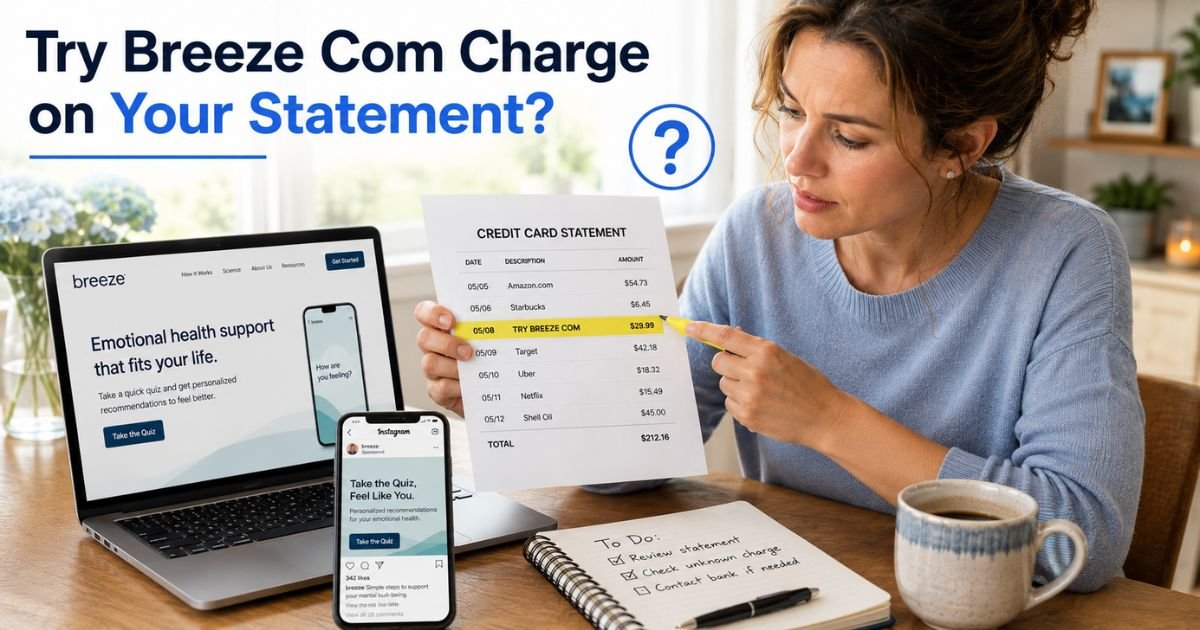
You open your credit card app and spot it right away: Try Breeze Com for $29.99. Your heart skips a beat. You do not remember signing up for anything. Did you click on one of those mental health quiz ads? Is this a scam?
You are not alone. Hundreds of people every month see this exact charge and feel the same confusion. The good news is the Try Breeze Com charge on credit card is almost always tied to a real app. It is the Breeze Wellbeing mental health and self-discovery service.
You will learn exactly what the Try Breeze Com charge means, how it usually starts with a low-cost trial, and the quick steps you can take today to verify it, cancel the subscription, or dispute the fee if it is not yours.
Table of Contents
What Is the Try Breeze Com Charge on Credit Card?
The Try Breeze Com charge comes from try-breeze.com, the website for the Breeze Wellbeing app (also called Breeze on app stores). This is a self-care and mental health toolkit that offers mood tracking, guided reflections, personalized insights, and practical tools.
On your statement it shows up as TRY BREEZE COM, TRYBREEZE.COM, VSA_TRY-BREEZE.COM, or similar short codes because the company uses a payment processor that shortens the name.
The company is linked to Basenji Apps and uses support@bsnj.co for customer service. They run heavy online ads, often with quizzes about trauma, CPTSD, or personal growth.
You pay a small $1 fee for a 7-day trial, and then it automatically rolls into a $29.99 monthly subscription unless you cancel.
The charge usually hits every 30 days and can feel mysterious because the app never clearly reminds you about the renewal.
How the Charge Usually Starts
Most people first see an Instagram or Facebook ad promising a quick personality or mental health analysis. You take a short quiz, enter your email or card details for the $1 trial, and think that is all. The fine print about the monthly renewal is easy to miss. Once the trial ends the full charge begins.
Take Jessica, a 35-year-old teacher from Phoenix. She clicked on a “Discover Your Inner Strength” quiz ad during a stressful week. She paid the $1 trial fee and forgot about it.
A month later the Try Breeze Com charge appeared on her statement. After checking her email she found the confirmation she had skimmed past. Jessica canceled right away and received a partial refund.
Why So Many People See This Try Breeze Com Charge
The Breeze Wellbeing app uses aggressive marketing that makes the trial sound like a one-time thing. The onboarding feels helpful, but the auto-renewal is buried. Uninstalling the app does not stop the billing. You must cancel through their website or your app store.
Banks display only the short descriptor to keep statements clean. That is why Try Breeze Com looks so vague even when it is your own subscription.
Pro Tip: Take a screenshot of every trial signup page before you hit confirm. Keep it in a folder named by month. You will have the exact details handy when a charge like Try Breeze Com shows up and you need to cancel or dispute it.
Is the Try Breeze Com Charge Legit or Fraud?
In most cases the charge is legitimate from a real company. However, many users report feeling tricked by the signup flow and say cancellation is harder than it should be. Plenty of complaints on Reddit and Trustpilot call the billing practices deceptive.
Here is a quick checklist:
- Did you take any mental health or self-discovery quiz online in the last few weeks?
- Did you pay a $1 trial fee for an app?
- Has the same amount been charging on or around the same date each month?
If you answer yes to any of these, it is probably your subscription. If none of it rings a bell, treat it as suspicious and dispute it immediately.
Common Mistake: Assuming the charge is small so you can just let it slide. Those $29.99 fees add up fast. Many banks only give you 60 days from the statement date to dispute a charge, so waiting reduces your chances of getting your money back.
How to Stop or Dispute the Try Breeze Com Charge
You have two clear paths that usually work fast.
First, cancel directly with the company. Go to https://breeze-wellbeing.com/cancel-subscription/login/. Enter the email you used to sign up and follow the magic link they send. Cancel at least 24 hours before the next renewal. Keep the confirmation email.
If you cannot find your account or the process fails, contact your card issuer. Call the number on the back of your card and file a dispute. Say you did not authorize the recurring charge. Most banks will reverse it while they investigate.
Bottom line: Acting the same day you spot the Try Breeze Com charge almost always stops the next billing cycle.
Step-by-Step Guide to Handle the Charge
Follow these steps and you will have the situation under control quickly.
- Log into your credit card account online and note the exact date and amount.
- Search your email for “breeze-wellbeing,” “try-breeze,” or any order confirmation using the charge date.
- Visit https://breeze-wellbeing.com/cancel-subscription/login/ and cancel with your signup email.
- If you signed up through Apple or Google, also cancel in your phone’s app store subscriptions section.
- If nothing matches or you never signed up, call your bank the same day and start a dispute.
Common Try Breeze Com Charges
Here is a handy breakdown of what people typically see and what it usually means.
| Charge Amount | What It Usually Covers | How It Often Starts | Best First Action |
|---|---|---|---|
| $1.00 | 7-day trial access | Instagram quiz ad | Cancel immediately after trial |
| $29.99 | Monthly full subscription | Auto-renew after trial | Use cancel link at breeze-wellbeing.com |
| $29.99 | Renewal after previous month | Ongoing auto-billing | Dispute with bank if unwanted |
| Varies | One-time or test charge | App store or website checkout | Check email for confirmation |
Source: User reports from Reddit, Trustpilot, and company terms.
Other Names This Charge Might Appear As
You might also see slight variations such as:
- VSA_TRY-BREEZE.COM
- TRYBREEZE.COM
- BREEZE WELLBEING
All of them point to the same mental health app service. Use the same cancellation steps no matter which version shows up.
FAQs: Try Breeze Com Charge on Credit Card
Q. Why does Try Breeze Com keep charging my credit card every month?
A. It usually means you started the 7-day $1 trial for the Breeze Wellbeing app and it auto-renews at $29.99. The company requires you to cancel at least 24 hours before the next billing date through their website. Uninstalling the app does not stop the charges.
Q. Can I get my money back for a Try Breeze Com charge I did not authorize?
A. Yes in most cases. First try canceling at breeze-wellbeing.com/cancel-subscription/login/ or email support@bsnj.co. If you never signed up or the process fails, dispute the charge with your bank right away. Banks generally side with customers on unrecognized recurring fees.
Q. How do I stop Try Breeze Com from appearing on my bank statement again?
A. Cancel the subscription immediately through the link above or your phone’s app store subscriptions section. You can also ask your bank to block future charges from Try Breeze Com. Turn on alerts for any charge over $10 so you catch new ones the same day they post.
Conclusion
The Try Breeze Com charge on credit card is almost always tied to the Breeze Wellbeing mental health app subscription. It usually starts with a tempting online quiz ad that quietly rolls into monthly billing after the $1 trial.
The fix is straightforward: check your email for the confirmation, cancel through their website, or dispute it with your bank if needed.
Take those steps today and you will stop the fees and protect your account moving forward. Small habits like reviewing statements weekly and using alerts make a huge difference.
If another mystery charge pops up on your statement, head back to ExplainCharges.com. We have straightforward guides for dozens of the most confusing entries people see every month. You have got this.
Disclaimer: The content on ExplainCharges.com is for informational and educational purposes only and does not constitute financial, legal, or professional advice. We are not affiliated with any companies or services mentioned. The information provided may not apply to your specific situation. If you suspect unauthorized charges or fraud, contact your bank or credit card issuer immediately. Always verify details directly with the source and consult a qualified professional if needed.
Meet the Author
