
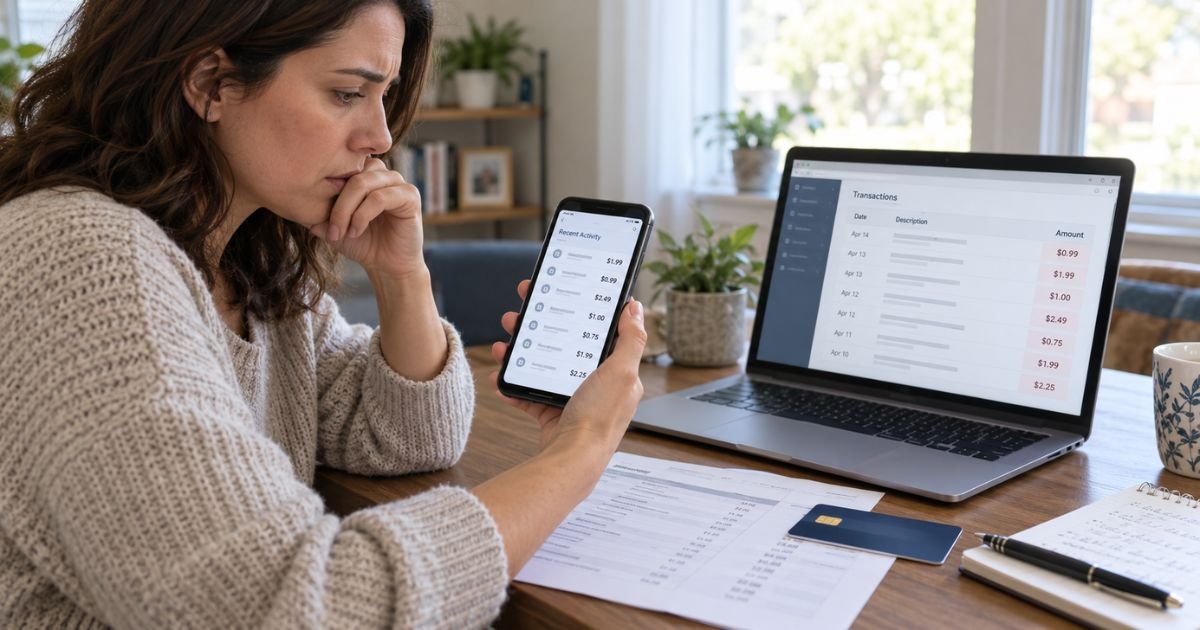
Small unauthorized credit card charges can be easy to ignore because the amount may be only a few cents or a few dollars. An unfamiliar low-dollar charge is often harmless, but it may also be an early sign that someone is testing whether your card still works.
You should first check whether the charge is a temporary authorization, a merchant name you do not recognize, or a transaction you truly did not approve. This guide explains how to tell the difference and what to do next.
Table of Contents
What Are Small Unauthorized Credit Card Charges?
Small unauthorized credit card charges are low-dollar transactions that appear even though you did not make or approve them. They may be under $1, a few dollars, or another amount small enough to escape notice.
The CFPB warns that thieves sometimes process a small charge first and return for more if it succeeds. That makes even a tiny unfamiliar posted charge worth checking promptly.
Not every small transaction is fraud. Merchants may also use temporary authorizations to confirm that your card is valid.
Fraud Charge vs. Temporary Authorization
You should look at the transaction status, merchant, and timing before assuming fraud.
| What you see | What it may mean | What to do |
|---|---|---|
| $0 verification | Card validation | Check recent card setup |
| Small pending amount | Temporary authorization | Verify merchant and monitor |
| Small posted unknown charge | Possible fraud | Contact issuer promptly |
| Several tiny unknown charges | Possible card testing | Lock and replace card |
| Familiar merchant, odd name | Different billing descriptor | Check receipts |
Visa confirms that $0 account verification is used to check whether an account is valid and open. Capital One also notes that merchants may place small temporary holds to validate payment methods.
Why Fraudsters May Start With a Small Charge
A fraudster may use a tiny purchase to see whether stolen card details are active. A small amount may also be less likely to catch your attention.
The CFPB specifically warns that thieves may run a small charge and then return for larger transactions if it works. You should not assume a $1 or $2 unauthorized charge is too small to matter.
Pro Tip: Turn on alerts for every card transaction if your issuer offers them. You may spot a test charge within minutes instead of finding it on your next statement.
When a $0 or $1 Charge May Be Legitimate
A $0 or $1 transaction can sometimes be a normal verification rather than a real purchase. You may see one after adding your card to a subscription, digital wallet, travel service, or online account.
Visa supports zero-dollar verification requests. Some merchants also use small authorizations that later disappear instead of becoming final charges.
You should still recognize the merchant or recent activity. A verification charge from a company you never used should not automatically be treated as harmless.
What to Do When You Find an Unauthorized Charge
Once you determine that the transaction was not yours, you should generally act right away.
- Lock the card in your issuer’s app if available.
- Call the number on the back of your card.
- Report the transaction as unauthorized.
- Ask whether your card number should be replaced.
- Review other pending and posted transactions.
- Change your account password if compromise is possible.
- Save the fraud claim or dispute number.
The FTC recommends reporting unauthorized credit card use immediately through the issuer’s official number, website, or app.
Common Mistakes: Do not wait for a larger charge before reporting a tiny transaction you know is unauthorized. A small test charge may be the first visible sign that your payment details were compromised.
Should You Wait for a Pending Charge to Post?
If you recognize the merchant but question the amount, a pending authorization may change or disappear. Capital One says pending transactions can adjust or fall off before they become final.
If you did not authorize the pending transaction at all, you should generally notify your issuer promptly. Some issuers can start the fraud process before the charge posts, while the formal transaction dispute may follow later.
Your card company may also replace your card immediately to prevent more attempts.
How Credit Card Fraud Liability Works
Federal law generally limits your liability for unauthorized credit card use to no more than $50 when the physical card is lost or stolen and used before you notify the issuer. Many issuers provide stronger zero-liability policies.
If someone steals only your account number while you still have the physical card, the CFPB says you generally have no liability for unauthorized use.
You should still report the problem quickly. Fast reporting can help stop additional charges and secure the account.
How to Dispute a Posted Small Charge
Call your issuer and report the posted transaction as unauthorized. The issuer may close the compromised card number and send a replacement.
To preserve federal billing-error rights, the CFPB says you should generally send a written billing-error notice within 60 calendar days after the issuer sent the statement showing the charge. Your statement should list the correct dispute address.
Keep copies of your notice and any supporting records. Continue paying the undisputed part of your bill on time.
If the issuer finds that the charge was unauthorized, it should generally correct your account. If it decides the charge was valid, it must generally explain the result under applicable billing-error procedures.
What Consumer Reports Show
Reddit users regularly describe tiny unfamiliar charges before or alongside other suspected fraud. Some report amounts under $1 that led them to replace their cards. These stories are anecdotal, but they are consistent with the CFPB’s warning about small test charges.
BBB complaint records for major U.S. issuers also include disputes over unauthorized transactions and fraud investigations. These complaints do not show how every case will be handled.
Trustpilot evidence is limited for this narrow issue because reviews usually discuss fraud handling broadly.
How to Reduce Future Unauthorized Charges
Use transaction alerts and review your card activity regularly. Remove stored card details from websites you no longer use, and use unique passwords for financial accounts.
Do not give card numbers, security codes, passwords, or one-time codes to unexpected callers. If someone claims to be your bank, contact the issuer through the number on your card.
FAQs: Small Unauthorized Credit Card Charges
Q. Why would someone steal only $1 from your credit card?
A. A fraudster may use a small charge to test whether stolen card details work before trying a larger transaction. The CFPB specifically warns that thieves sometimes make a small charge first.
Q. Is a $0 credit card charge always fraud?
A. No. A $0 authorization may be a legitimate verification used to confirm that your account is valid. You should still investigate it if you do not recognize the merchant.
Q. Should you replace your card over a small unauthorized charge?
A. You should generally report the charge immediately and follow your issuer’s fraud instructions. Your issuer may recommend replacing the card number to prevent additional attempts.
Q. Are you responsible for small fraudulent credit card charges?
A. Federal law generally limits liability for unauthorized credit card use to no more than $50, and you generally have no liability when only your account number was stolen. Many issuers provide stronger protections.
Conclusion
Small unauthorized credit card charges should generally be checked even when they involve only a few cents or dollars. They may be legitimate verification holds, but they can also signal that someone is testing stolen payment information.
Confirm the merchant, check whether the transaction is pending or posted, and report anything you know you did not authorize. Acting quickly can help your issuer secure the account before small unauthorized credit card charges turn into larger fraudulent purchases.
Disclaimer: This article is for general informational purposes only and is not financial or legal advice. Fraud protections, dispute procedures, issuer policies, and card-network rules may vary, so verify account-specific questions with your credit card issuer.
Meet the Author
