
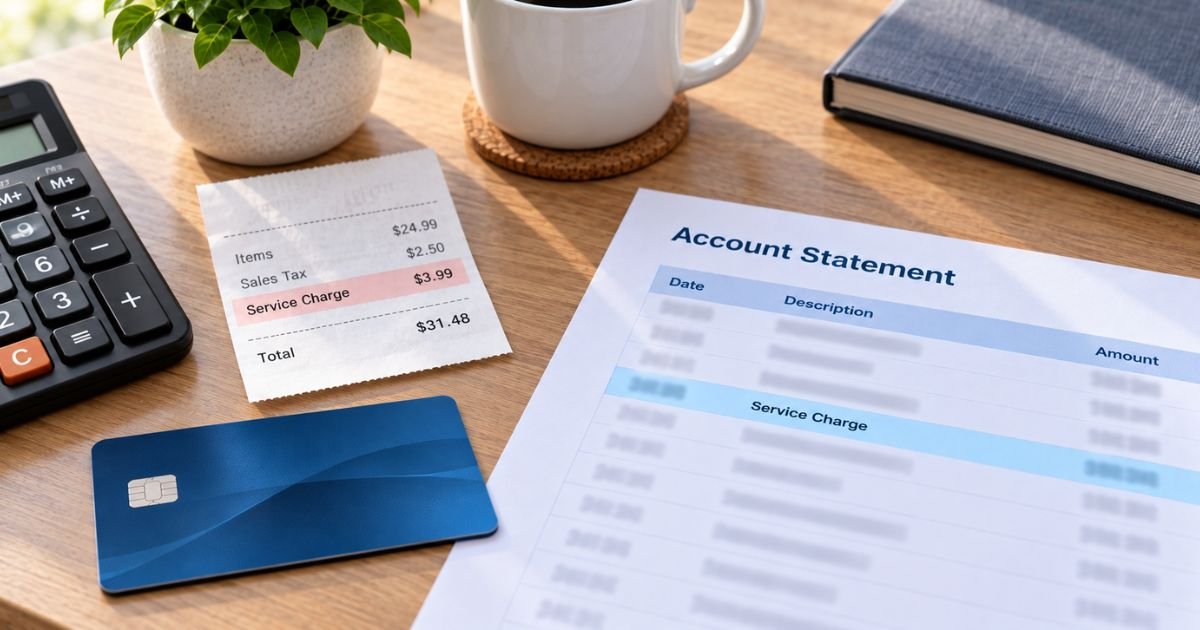
A service charge on a credit card can feel confusing if you don’t recall adding a fee at checkout. The words are generic. Banks use them for more than one thing.
The line may be your issuer’s monthly or annual fee. It may be a store’s card surcharge. It may be a bill-pay convenience fee.
This guide shows you how to tell those apart and what to do next.
Table of Contents
What Is a Service Charge on a Credit Card?
A service charge on credit card is a fee line that does not name a product. It can come from your card company or from a merchant that took the card.
Your issuer may call an annual fee, a monthly membership fee, or a plan fee a service charge.
Regulation Z treats many service, transaction, and carrying charges as part of the cost of credit when the issuer imposes them.
Those fees belong in the fees section of your statement and in the Schumer box you got when you opened the card.
A merchant may add a “card service charge,” “non-cash service fee,” or “service fee” when you pay with plastic. That extra amount is usually a surcharge or a convenience fee, not interest.
Card networks generally limit credit surcharges and do not allow the same surcharge on debit.
Some states ban merchant surcharges. Connecticut, Massachusetts, and Maine are commonly listed among those bans. Confirm your state’s current rule.
A third use is a bill you meant to pay. Utilities, schools, courts, and tax sites often add a service fee to take a card.
Restaurants sometimes add an automatic service charge instead of a tip line.
Service Finance Company can also print SERVICE FINANCE on a loan draft. Read the rest of the descriptor.
How the Charge May Appear on Your Statement
Match the section of the bill, the amount, and whether it repeats.
| Statement wording you might see | What it often means |
|---|---|
| SERVICE CHARGE or MONTHLY SERVICE FEE | Issuer account fee or merchant add-on |
| ANNUAL FEE or MEMBERSHIP FEE | Yearly cost of keeping the card |
| CARD SURCHARGE or NON-CASH SVC FEE | Extra percent for paying with credit |
| CONVENIENCE FEE | Extra cost for phone or online pay |
| SVC FEE plus a city or agency | Utility, tax, or government card payment |
| SERVICE CHARGE on a restaurant line | Auto-gratuity or table fee |
| SERVICE FINANCE | Home-improvement or similar loan payment |
A flat $1 to $10 next to a ticket or bill-pay site is often a convenience fee.
A percent of the ticket, such as about 3%, is more often a surcharge. Your receipt should show the add-on before you tap.
Likely Sources of the Charge
Your card issuer
Look at the fees box, not the purchase list. An annual fee posts once a year. A monthly service fee posts every cycle. An installment plan fee can post each month on a purchase you split.
A store surcharge
The cashier or checkout page added a card fee on top of the price. Networks generally cap how large that percent can be and require notice. Cash or debit may cost less at that register.
A convenience or government service fee
You paid rent, a ticket, taxes, or a utility online or by phone. The portal charged extra for that channel. FTC junk-fee guidance says businesses should show unavoidable fees in the total price and disclose optional ones before you pay.
A restaurant service charge
Some dining rooms add a set percent for large parties or as house policy. That is not a tip you chose. Ask the receipt if gratuity was included.
A loan or contractor bill
SERVICE FINANCE and similar names are lenders, not a mystery fee. Match the amount to an HVAC or solar coupon book.
How to Verify the Charge
- See whether the line sits under Fees or under Transactions.
- Compare the date with a restaurant, utility, or checkout you remember.
- Open the paper or email receipt and look for surcharge or service-fee text.
- Read your card agreement for an annual or monthly fee.
- Search the extra words after SERVICE CHARGE, such as a city or company.
- Ask anyone who shares the card if they paid a bill online that day.
If the amount matches your annual fee, the charge is typically legitimate. If it matches a 3% add-on you saw on a store sign, it is typically the merchant fee. If nothing matches, treat it as an unknown merchant and call the number on the card.
Pro Tip: Sort the statement by fees first. Issuer service charges cluster there. Merchant service charges sit on the same line as the store name.
How to Avoid or Stop Extra Service Charges
For an issuer fee, you cancel or downgrade the card if you no longer want that product. Ask whether a product-change removes the annual fee.
A 30-day or 60-day window after the fee posts is common on many agreements. Get the rule in writing.
For a store surcharge, pay with debit, cash, or a method the sign says is fee-free when that works for you. You can still use the credit card if the extra cost is worth the rewards. Do the math on that purchase.
For bill-pay portals, look for ACH or e-check. Those options often skip the card service fee. Save the confirmation.
For a restaurant auto-gratuity, tell the server before you pay if the party size or the printed policy does not apply. Do not tip twice on top of a service charge unless you mean to.
Watch the next cycle. If a new service charge on a credit card posts after you canceled the fee or the plan, call the issuer.
Common Mistakes: People dispute an annual fee as fraud. It is in the account contract. Others pay a utility by card every month and forget the portal adds a service fee each time.
If You Do Not Recognize It
Work through this list before you file a dispute.
- Confirm no annual fee month landed.
- Check utility and tax emails for a card convenience fee.
- Look at rideshare, ticketing, and government apps.
- Change passwords if the merchant is a store you never used.
- Send a written billing-error notice within 60 days of the statement if you want the federal process.
A disclosed surcharge you agreed to at the register is usually not fraud. An extra fee that never appeared until after you tapped may be a billing error. Say which one you have when you call.
Service Charge Versus Similar Fees
A service charge is not automatically interest. Interest is the finance charge on a carried balance.
It is not a late fee. A late fee follows a missed minimum.
It is not a cash-advance fee. That fee hits ATM and cash-like pulls.
It is not foreign transaction interest. A foreign fee is usually a percent of an overseas purchase.
FAQs: Service Charge on Credit Card
Q. Is a service charge on a credit card a scam?
A. Not automatically. Many lines are annual fees, store surcharges, or bill-pay convenience fees. A charge can still be unauthorized if you never used that merchant.
Match the fees box and your receipts first.
Q. Can a store add a service charge when I use a credit card?
A. In most states, a disclosed credit surcharge is allowed within network caps. Some states ban that extra percent. Debit generally cannot take the same surcharge.
Ask to see the fee before you pay.
Q. How do I stop future service charges on a credit card?
A. Cancel or change the card product if the fee is your issuer’s. Use a no-fee pay method if the fee is the merchant’s.
Then watch the next statement.
Q. Can I get the service charge refunded?
A. Issuer annual fees follow the card agreement. Merchant fees follow the receipt and state or network rules. Ask the merchant or issuer in writing.
If you never agreed to the add-on, use your issuer’s dispute process. Do not count on a refund until someone confirms it.
Conclusion
A service charge on a credit card is a catch-all label. It may be your issuer’s periodic fee, a store’s card surcharge, a bill-pay convenience fee, or a restaurant add-on.
Read the fees section and the receipt. Pay a different way if you want to skip the extra cost, and use the number on the card if no fee or purchase matches.
Disclaimer: This article is for general information only. It is not financial or legal advice. Fee names, surcharge rules, and cancel windows vary by issuer, merchant, and state. Confirm the charge with your card company or the seller.
Meet the Author
