
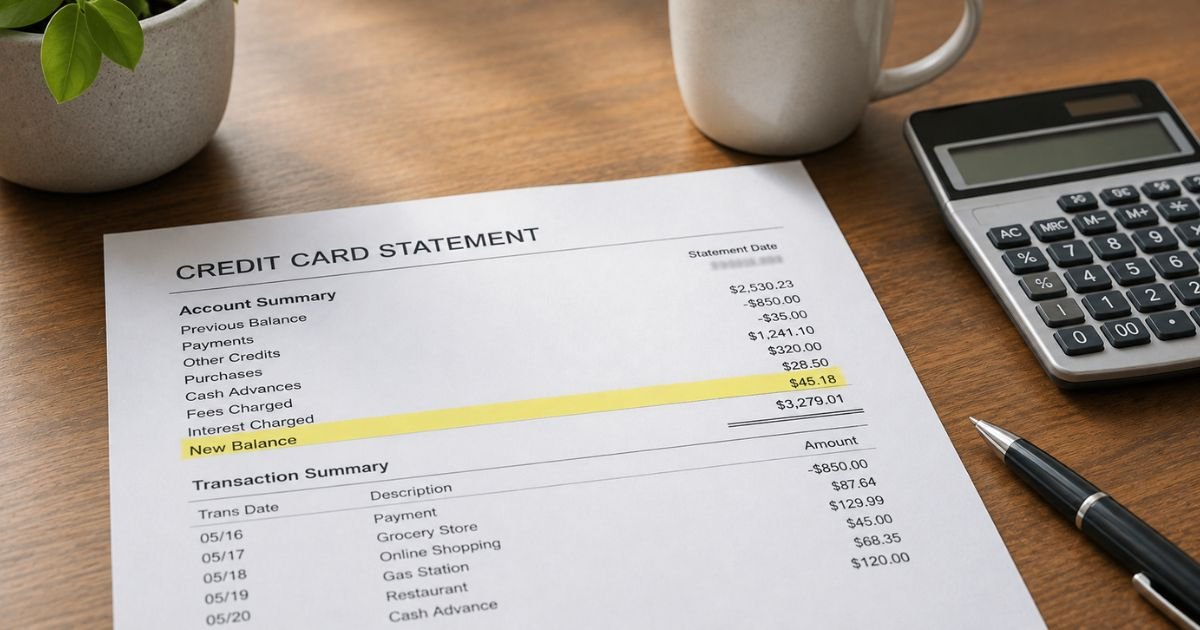
An interest charge on credit card can feel frustrating if you thought you paid enough or expected a zero-interest month. These charges are common when a balance carries over from one billing cycle to the next.
This guide explains what the interest charge means, how issuers typically calculate it, and practical steps you can take.
Table of Contents
What Is an Interest Charge on Your Credit Card?
An interest charge (sometimes labeled finance charge or interest charge purchase) is the cost your card issuer adds when you do not pay your full statement balance by the due date. It is the price of borrowing money from the issuer.
Most cards give you a grace period on new purchases. If you pay the entire statement balance in full by the due date, you typically pay no interest on those purchases. Once any portion of the balance rolls into the next cycle, interest generally begins to apply.
Interest rates appear as an annual percentage rate, or APR. The national average for accounts that carry a balance has hovered around 19–22% in recent periods, though your exact rate depends on your card and credit profile. Rates can differ for purchases, cash advances, and balance transfers.
How Credit Card Interest Is Typically Calculated
Issuers usually calculate interest using your average daily balance and a daily periodic rate. Here is the common process:
- Divide your APR by 365 (or sometimes 360) to get the daily rate.
- Add up your balance at the end of each day in the billing cycle and divide by the number of days. That gives the average daily balance.
- Multiply the average daily balance by the daily rate, then by the number of days in the cycle.
The result is the interest charge that appears on your next statement. Interest typically compounds daily, so you can end up paying interest on previously accrued interest if the balance continues.
A simple example helps. Suppose your purchase APR is 20% and your average daily balance is $1,000 over a 30-day cycle.
The daily rate is roughly 0.0548%. Interest for the cycle would be about $16.44. Exact numbers depend on your issuer’s method and any mid-cycle transactions.
Your statement usually shows the APR, the average daily balance subject to interest, and the resulting interest charge broken out by type (purchases, cash advances, etc.).
When Does Interest Start and Stop?
Most cards offer a grace period of at least 21 days from the statement closing date to the payment due date. Federal rules require this minimum when a grace period is offered. During that window, new purchases generally do not accrue interest if you pay the previous balance in full.
If you carry any balance past the due date, the grace period for new purchases can end. Interest then applies to the unpaid amount and often to new purchases until you pay the full statement balance for two consecutive cycles (policies vary by issuer).
Cash advances and most balance transfers usually have no grace period. Interest on those typically starts the day the transaction posts and uses a higher APR.
Why You Might See an Unexpected Interest Charge
Common reasons include:
- Paying only the minimum or a partial amount
- Making a payment after the due date
- Carrying a balance from a previous cycle even if you paid the newest statement in full
- Using the card for a cash advance or convenience check
- Losing the grace period after revolving a balance
A payment that posts after the due date, even by one day, can trigger interest on the prior balance. Some issuers also charge interest if a payment is still processing on the due date.
Here is a quick comparison of common balance types:
| Balance Type | Typical Grace Period | Usual APR Level | Interest Starts |
|---|---|---|---|
| New purchases | Yes (if paid in full) | Standard purchase | After grace period ends |
| Carried balance | No | Standard purchase | Immediately on unpaid amount |
| Cash advance | Usually none | Higher | Day of transaction |
| Balance transfer | Often none (or promo) | Promo or standard | Day of transfer (or after promo) |
How to Avoid or Reduce Interest Charges
The most reliable way is to pay your statement balance in full by the due date every month. Set up autopay for the full amount if your cash flow allows it. Pay early in the cycle when possible so the average daily balance stays lower.
If you already carry a balance, pay more than the minimum whenever you can. Even small extra payments reduce the average daily balance and the interest that compounds. Consider a lower-rate balance transfer or a personal loan only after comparing total costs and fees.
Review your statement each month. Look for the “Interest Charged” section and the explanation of how it was calculated. Contact your issuer if the number does not match what you expect.
Pro Tip: Pay at least a few days before the due date. This gives the payment time to post and protects your grace period even if processing is delayed.
What to Do If the Interest Charge Looks Wrong
First check the statement details: the average daily balance, the APR used, and the number of days in the cycle. Compare those against your own records of payments and purchases.
If something still seems incorrect, call the number on the back of your card. Ask the representative to walk through the calculation with you. Have recent statements ready. Most issuers can adjust an error once it is confirmed.
For ongoing high interest, ask whether a temporary rate reduction or hardship program is available. Document every conversation.
Common Mistakes: Paying only the minimum for months while assuming interest stays small. Ignoring the difference between the statement balance and the current balance. Waiting until the last day to pay and then seeing a late post that triggers interest.
FAQs: Interest Charge on Credit Card
Q. Why did I get an interest charge even though I paid my bill?
A. Interest typically appears when any part of the previous balance remained unpaid past the due date. Paying the newest statement in full does not always erase interest that already accrued on the carried amount. Check whether a prior balance or late payment affected the calculation.
Q. How can I stop interest charges going forward?
A. Pay the full statement balance by the due date each cycle. Once you do that for consecutive cycles, most cards restore the grace period on new purchases. Avoid cash advances, which usually start accruing interest immediately.
Q. Does the interest charge hurt my credit score?
A. The interest charge itself does not appear on your credit report. What matters is your payment history and credit utilization. Paying late or carrying high balances relative to your limit can lower your score over time.
Q. Can I negotiate or get the interest charge removed?
A. Some issuers will waive a one-time interest charge as a courtesy, especially for long-time customers with good payment history. Call and ask politely. Success is not guaranteed and depends on the issuer’s policies.
Conclusion
An interest charge on credit card is the cost of carrying a balance past the due date. Issuers generally calculate it from your average daily balance and daily periodic rate based on the APR.
Most people can avoid these charges simply by paying the statement balance in full each month and protecting the grace period. Review your statements, pay on time, and contact your issuer if a charge looks incorrect.
Understanding how interest works helps you keep more of your money and stay in control of your card.
Disclaimer: This article is for informational purposes only and is not financial, legal, or professional advice. Interest calculation methods, grace periods, APRs, and policies vary by issuer and account. Always check your specific cardholder agreement and contact your card issuer for details that apply to your account.
Meet the Author
