
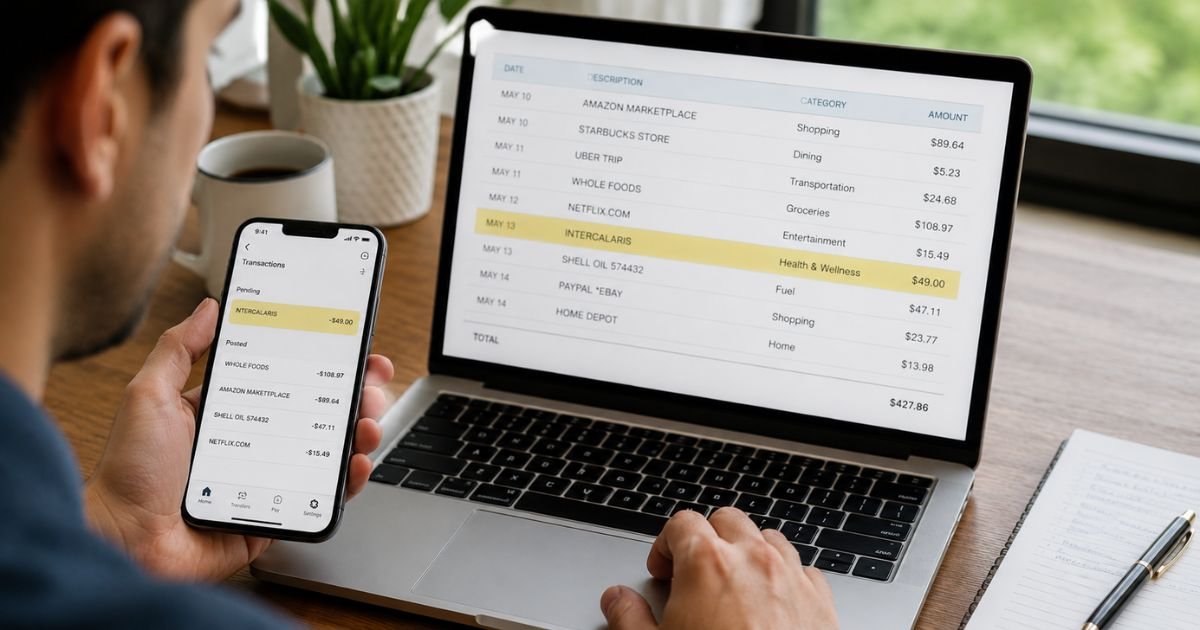
Seeing an Intercalaris charge on credit card can feel unsettling because the name does not clearly match a well-known company or service.
This guide walks you through how to investigate it, what to do next, and how to protect your account.
Table of Contents
What Is the Intercalaris Charge?
An INTERCALARIS (or Intercalaris) entry on a credit card, debit card, or bank statement is currently an unidentified merchant descriptor.
Public records and consumer reports do not connect it to a specific modern company, product, app, or service.
Possible statement variations include:
- INTERCALARIS
- INTERCALARIS.COM
- INTERCALARIS LLC or INC
- CHECKCARD INTERCALARIS
- RECURRING INTERCALARIS
- PENDING INTERCALARIS
The name may be a shortened legal business name, a payment-processor account name, an international merchant code, or a formatting variation used by the card network.
The historical Latin meaning of “intercalaris” (an extra month in the old Roman calendar) does not explain a modern credit-card charge.
Why Did This Charge Appear?
Because the merchant is unidentified, several possibilities exist:
- A one-time online purchase or trial you or someone else authorized.
- A recurring subscription or membership that uses this descriptor.
- A family member or authorized user made the purchase.
- A pending authorization hold that later posted.
- A duplicate, retry, or failed-payment attempt.
- An unauthorized or fraudulent transaction.
Without the full merchant details from your card issuer, it is not possible to know which explanation applies.
How to Verify the Charge
Start with these practical steps:
- Copy the exact descriptor, amount, date, and whether the charge is pending or posted.
- Call the number on the back of your credit card and ask for expanded merchant information. Request the complete merchant name, city or country, phone number if available, merchant category code, and whether the transaction is marked recurring or card-on-file.
- Search your email (including spam and trash) for the exact amount, the word “Intercalaris,” or related terms such as “order,” “receipt,” “subscription,” or “membership.”
- Review browser history, app subscriptions, digital wallets (Apple Pay, Google Pay, PayPal), and recent online purchases.
- Ask every person who has access to the card whether they recognize the charge.
- Look back through the last several statements for similar amounts or name variations.
The most useful information usually comes from your card issuer’s merchant lookup.
Is It Legitimate or Fraud?
It is possible the charge is legitimate even if the name looks unfamiliar. Merchants sometimes use coded or shortened descriptors that do not match their public brand.
Treat the charge as potentially unauthorized if:
- No one in the household recognizes it.
- Expanded merchant details from the bank are missing, incomplete, or unusable.
- Multiple similar charges appear in a short time.
- You never authorized any matching purchase or trial.
- The bank cannot provide a clear merchant identity.
Do not assume fraud without checking, but do not ignore an unrecognized charge either.
How to Cancel
No public cancellation portal or verified merchant contact for Intercalaris is currently available.
If you later identify the underlying service:
- Use any receipt or confirmation email to locate account login or cancellation instructions.
- Cancel future billing and request written confirmation.
- Save screenshots and email replies.
- Monitor the next billing cycle.
If the merchant remains unidentified, contact your card issuer and ask them to block future merchant-initiated payments from this descriptor if possible.
Replacing the card may also stop tokenized charges, though it does not automatically cancel an underlying subscription.
Can You Get a Refund?
A refund is only realistic after the merchant is identified.
- Contact the merchant (once known) with the transaction date, amount, and reason for the request.
- Ask for written confirmation and a timeline.
- If the merchant does not respond or the charge was unauthorized, file a dispute with your credit card issuer.
Credit cards generally offer strong dispute rights for unauthorized or incorrect charges when you report them promptly. Keep all records of statements, emails, and phone calls.
What to Do If the Charge Is Unauthorized
- Call your credit card issuer right away using the number on the back of the card and report the charge as unauthorized.
- Ask them to open a dispute or fraud claim and request a temporary credit if available.
- Request that future charges from this merchant descriptor be blocked if the bank can do so.
- Consider freezing or replacing the card if you suspect the number has been compromised.
- Document the date, time, and reference number of every conversation.
- Monitor the account closely for additional activity.
- You may also report suspected fraud to the Federal Trade Commission at ReportFraud.FTC.gov, though this does not reverse the charge itself.
Act quickly. Most credit-card dispute protections work best when you report within 60 days of the statement date.
Prevention Tips
- Enable real-time transaction alerts on every credit card.
- Review pending and posted charges at least once a week.
- Keep a simple list or note of active subscriptions and trials.
- Use virtual card numbers or single-use cards for online trials when available.
- Avoid saving card details on sites you use only once.
- Immediately cancel free trials you do not intend to continue.
- Ask authorized users to notify you of any purchases they make.
- Periodically search your email for words like “subscription,” “trial,” or “membership.”
Common Situations and Next Steps
| Situation | What It May Mean | Best First Action |
|---|---|---|
| Single unrecognized charge | Forgotten purchase or unknown merchant | Request expanded merchant details |
| Multiple similar charges | Possible recurring billing or fraud | Check for pattern + contact issuer |
| Pending then posted | Authorization hold that completed | Confirm final amount with bank |
| No matching email or account | Higher chance of unauthorized activity | Dispute as unauthorized promptly |
FAQs: Intercalaris Charge on Credit Card
Q. What is Intercalaris on my credit card statement?
A. It is currently an unidentified merchant descriptor. No verified company or service is publicly linked to the exact name. Your card issuer can provide more details.
Q. Is Intercalaris a scam?
A. It is not possible to confirm from public information alone. Many unfamiliar descriptors turn out to be legitimate but poorly labeled merchants. Verify with your bank before deciding.
Q. How do I stop future Intercalaris charges?
A. Contact your credit card issuer, ask whether the transaction is recurring, and request a block on future payments from that merchant if available. Replacing the card can also help stop tokenized charges.
Q. Can I dispute an Intercalaris charge?
A. Yes. If you do not recognize the charge after checking with authorized users and requesting merchant details, report it to your card issuer as unauthorized or incorrect and open a formal dispute.
Conclusion
An Intercalaris charge on credit card is an unidentified descriptor that requires investigation.
Start by asking your card issuer for the full merchant information, then cross-check emails, accounts, and authorized users.
If the charge remains unexplained, report it promptly as unauthorized.
Staying current with your statements and using transaction alerts are the most effective ways to catch and resolve unfamiliar charges quickly.
Disclaimer: This article is for informational purposes only and is not financial or legal advice. Merchant descriptors and policies can change. Always confirm details directly with your credit card issuer.
Meet the Author
