
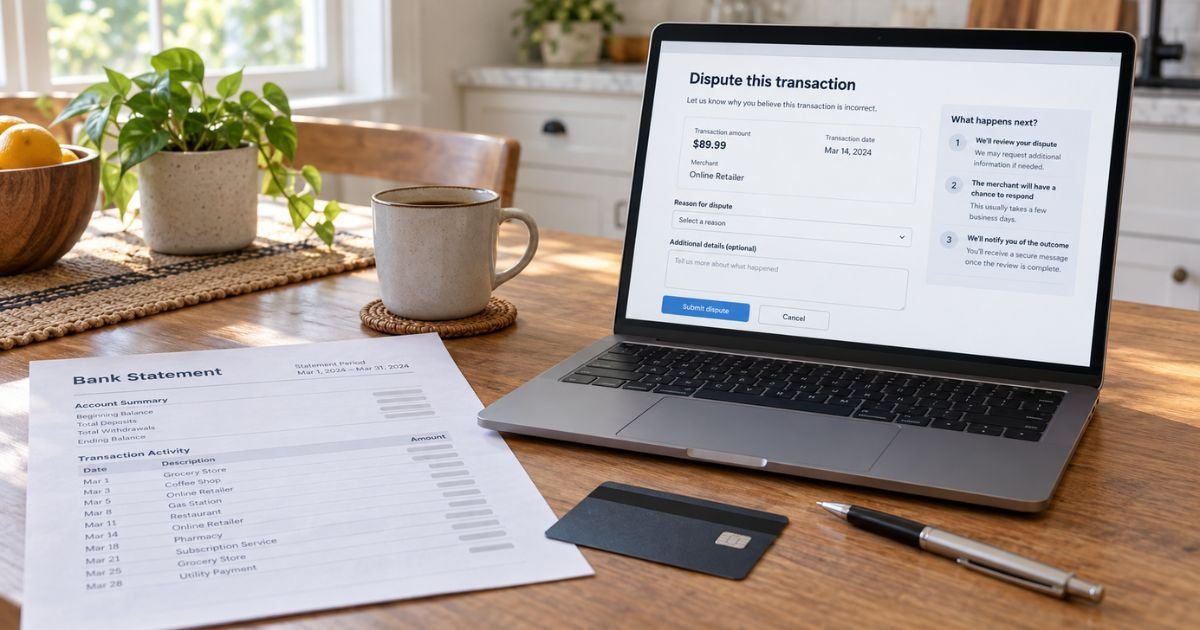
Figuring out how to do a chargeback with your bank can feel confusing if you do not recall the purchase or you already asked the merchant for help.
Many unfamiliar lines are still real sales, authorizations, or refunds that have not posted yet. This guide walks through what a chargeback is, how credit and debit rules differ, and the steps federal agencies describe.
Table of Contents
What a chargeback with your bank actually is
A chargeback is not a store name on your statement. It is the process your bank or card issuer uses to pull a card payment back from the merchant’s bank. You usually start that process by filing a dispute. Your bank may then send a network claim to the other side.
The word on your statement may say “chargeback,” “dispute,” “provisional credit,” or “reversal.” Those labels are not interchangeable.
A merchant refund is the seller putting money back. A pending void is the merchant releasing a hold that never posted. A chargeback is the card network path after you ask your bank to step in.
Federal billing-error rules sit on top of that network process. For most credit cards, the Fair Credit Billing Act and Regulation Z set the consumer steps. For most debit cards and other electronic transfers, Regulation E applies instead.
Chargeback vs refund vs billing-error dispute
Start with the merchant when you recognize the seller. The Consumer Financial Protection Bureau says to contact the company that sold the product or service first and ask it to undo the charge. Many problems end there.
A billing-error dispute is the federal notice you send your issuer. The CFPB says you should call and also send a written billing-error notice. The Federal Trade Commission publishes a sample letter and says the same.
A chargeback is what the issuer may file with Visa, Mastercard, American Express, or Discover after it takes your claim. You do not file that network form yourself. You file with your bank.
Pro Tip: Save the statement line, the exact dollar amount, the posted date, and any receipt or chat with the seller. Copies travel better than originals.
When a chargeback usually makes sense
A dispute is typically a better fit when:
- You did not authorize the charge.
- The amount or date is wrong.
- You were billed twice for the same sale.
- You never received what you ordered, or you refused delivery.
- A credit you were promised never posted.
- A canceled subscription kept billing after a confirmed cancel.
Quality complaints are different. If the item arrived but you dislike it, the issuer may still want proof you tried the seller first.
Separate “claims and defenses” rules can apply when you used a credit card, the price was more than $50, the purchase was in your home state or within 100 miles of home, you tried in good faith to fix it with the seller, and you have not fully paid.
Those extra conditions come from CFPB guidance. They do not replace the 60-day billing-error clock.
Do not use a chargeback as a first step for a purchase you simply regret. Banks can close a claim if the merchant shows a valid sale.
Credit card vs debit card rules
The steps look similar in an app. The legal clocks are not the same.
| Topic | Credit card (FCBA / Reg Z) | Debit card or EFT (Reg E) |
|---|---|---|
| Your notice clock | Written notice generally must arrive within 60 days after the issuer sent the statement that first showed the error | Error notice generally within 60 days after the statement with the error was sent |
| Bank timeline | 30-day written acknowledgment unless resolved sooner; resolve within two billing cycles, no later than 90 days | Often 10 business days; many cases extend to 45 days, or up to 90 days for some POS, new-account, or foreign items |
| During review | You may withhold the disputed amount and related finance charges | The bank may post provisional credit after 10 business days if it needs more time |
| Unauthorized use | Federal cap generally $50; many issuers advertise $0 liability | Lost-device tiers can be $50, $500, or more, depending on how fast you report |
Call the number on the card for fraud the same day you see it. That oral notice can limit later charges. It does not always replace the written billing-error letter on a credit card.
How to do a chargeback with your bank, step by step
1. Match the line first.
Open the statement or app. Confirm the merchant text, amount, and date. Check email receipts, subscriptions, family cards, and pending holds. A hold can look like a second charge until it drops.
2. Contact the merchant if you recognize the seller.
Ask for a refund or a void. Keep the date, the name of the person you reached, and any case number.
3. File with your bank.
Most issuers let you tap the posted charge and choose Dispute or Report a problem. You can also call the number on the back of the card. Say you are filing a dispute. Ask for a reference number.
4. Send written notice for credit-card billing errors.
The CFPB says you must also send a written billing-error notice within 60 calendar days after the charge appeared on your statement. Use the billing-inquiries address on the statement, not the payment address.
An in-app dispute may count as writing if your issuer accepts it that way. A mailed follow-up still gives you a paper trail.
5. Pay the rest of the bill.
On a credit card, you generally may withhold only the disputed amount and related finance charges. Pay the undisputed minimum so the account does not fall behind.
6. Watch the decision.
If the issuer agrees, it should remove the charge. If it disagrees, it must explain in writing, say how much you owe, and say when payment is due.
What to put in your written notice
The FTC sample letter asks you to include:
- Your name and account number
- The dollar amount
- The date of the charge
- Why you think the line is wrong
- Copies of receipts, cancel emails, or tracking pages
Send copies. Keep the originals. Certified mail with a return receipt is optional, but it proves when the letter arrived. Ask the issuer to correct the error and any related finance charges.
Regulation Z says a billing-error notice must let the creditor identify you and the account. It should also state, as far as you can, why you believe an error exists and the type, date, and amount.
What happens after you file
On a credit card, the issuer generally has 30 days to acknowledge a proper written notice unless it already finished the case. It then has two complete billing cycles, and no more than 90 days from receipt, to resolve it.
While the review is open, the issuer generally may not collect the disputed amount or treat that slice as late.
On a debit card, the bank generally investigates within 10 business days. If it needs more time, it may take up to 45 days in many cases, or up to 90 days for some point-of-sale, new-account, or foreign transfers.
To use that extra time, it generally posts provisional credit within the first 10 business days and tells you the amount and date. If it later finds no error, it can take that temporary credit back after notice.
A “win” on your statement can still reverse if the merchant later proves the sale. Read any letter that says the credit is temporary.
If the bank says no
The issuer must tell you why in writing if it keeps the charge. The FTC says you can write back that you still dispute the bill. Send that follow-up within 10 days or the payment window the issuer gave you, whichever is later, if you want to keep fighting the finding.
You can also ask for the documents the issuer used. File a complaint with the CFPB at consumerfinance.gov/complaint or call (855) 411-2372. The Bureau says most companies respond within 15 days. Some send a final answer in up to 60 days.
A CFPB complaint does not guarantee a refund. It does put the file in front of the company again.
Common Mistakes: Waiting past the 60-day statement clock. Writing only to the payment address. Disputing a charge you authorized because you changed your mind. Ignoring the undisputed balance. Treating a pending authorization as a finished sale.
FAQs: How to Do a Chargeback with Your Bank
Q. How long do I have to request a chargeback at my bank?
A. For credit-card billing errors, your written notice generally must arrive within 60 days after the issuer sent the statement that first showed the error. Debit and other electronic errors also use a 60-day statement clock for the formal error process. Report lost-card fraud even faster. Debit liability can rise if you wait.
Q. Can I do a chargeback by phone only?
A. Call first so the bank can flag the account. For credit-card billing errors, the CFPB still tells you to send a written notice to protect your rights. Many apps now accept a digital dispute. Follow with a letter if you want a dated copy at the billing-inquiries address.
Q. Do I have to pay the charge while the bank investigates?
A. On a credit card, you generally may withhold the disputed amount and related finance charges. Pay everything else. On a debit card, the money often left your account already. The bank may add provisional credit while it investigates. You can still dispute a charge you already paid.
Q. What if I already got a refund from the merchant?
A. Tell the bank right away. A second credit from a chargeback plus a seller refund can look like a duplicate return. The issuer may reverse one of those credits. Keep the refund email so the file stays clean.
Conclusion
A chargeback with your bank is a formal request, not a magic undo button. Match the line, try the merchant when you know the seller, then file the dispute and the written notice on time.
Credit cards follow the FCBA 60-day, 30-day, and 90-day clocks. Debit cards follow Regulation E and often move faster on the first review.
Keep copies, pay the undisputed amount, and use the CFPB complaint path if the written decision still looks wrong.
Disclaimer: This article is for general information only. It is not financial, legal, or tax advice. Chargeback and dispute rules vary by card network, account type, and issuer. Confirm deadlines, addresses, and outcomes with your bank or card company and with current CFPB or FTC materials.
Meet the Author
