
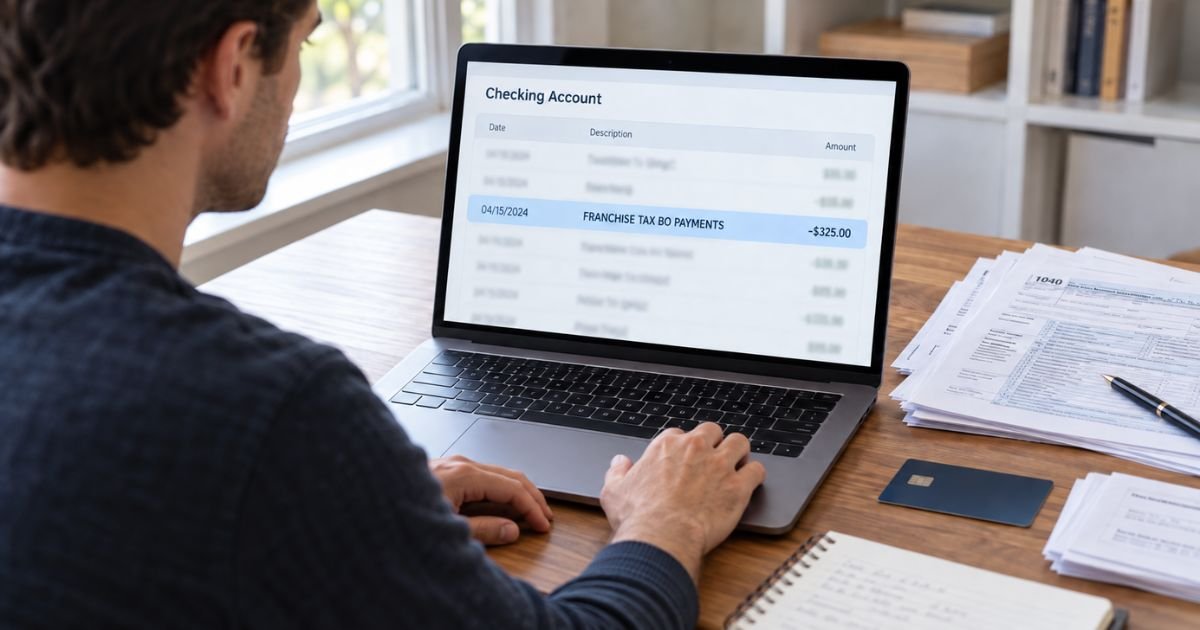
A Franchise Tax BO Payments entry on your bank statement can feel confusing if you do not remember paying a company with that name. In most cases, it points to an electronic payment sent to the California Franchise Tax Board, or FTB.
The FTB handles California personal income tax and many business taxes. Here is how you can identify the debit, confirm why it happened, and respond if you never authorized it.
Table of Contents
What Are Franchise Tax BO Payments on a Bank Statement?
Franchise Tax BO Payments generally means money was withdrawn from your checking or savings account for a payment to the California Franchise Tax Board. The wording is consistent with ACH bank debits used for California state tax payments.
The “BO” portion appears to be a shortened version of “Board.” Banks and ACH systems can shorten agency names, so “Franchise Tax Board” may show as “FRANCHISE TAX BO.”
California lets individuals and businesses pay directly from a bank account through FTB Web Pay. It also supports electronic funds withdrawals connected with tax returns and other approved payments.
| Statement wording | What it may mean |
|---|---|
| FRANCHISE TAX BO PAYMENTS | California FTB electronic tax payment |
| FRANCHISE TAX BO DES PAYMENT | FTB debit with additional bank coding |
| FTB WEB PAY | Payment made through Web Pay |
| Repeating FTB debit | Possible scheduled payment |
| $800 business payment | Possible California LLC annual tax |
| Unknown FTB debit | Verify through MyFTB and your bank |
Why Did Franchise Tax BO Payments Appear?
The most common explanation is that you or someone acting for you scheduled a California tax payment.
FTB Web Pay accepts payments for tax returns, estimated taxes, bills, extensions, amended returns, proposed assessments, and other balances. Businesses can also pay annual taxes and fees electronically.
Common reasons include:
- A balance due with your California return
- A quarterly estimated tax payment
- An extension payment
- A payment on an FTB notice
- A scheduled or installment payment
- A California business tax or fee
- A payment submitted through tax software
- A payment arranged by your tax preparer
This descriptor does not mean you own a franchise. The California Franchise Tax Board also administers personal income taxes.
Pro Tip: Review the tax return you recently filed. Many tax programs let you authorize a future electronic withdrawal while e-filing, so you may have scheduled the payment weeks earlier.
Could Your Tax Preparer Have Scheduled It?
Yes. A preparer or tax program may have set up the debit when your return was filed.
Check your final tax package for an electronic payment authorization, payment voucher, or filing summary. Compare the payment amount and date with your bank statement.
If you used a tax professional, ask whether an FTB payment was transmitted with your return. Do not assume the state independently withdrew the money simply because you forgot approving it.
What Does a $800 Franchise Tax BO Payment Mean?
If you own a California LLC, an $800 debit may be the annual LLC tax.
California currently requires many LLCs doing business or organized in the state to pay an $800 annual tax. FTB says that payment can be made through Web Pay or other approved methods.
If you closed an LLC, check that the required cancellation filings were completed. FTB says an LLC can remain subject to annual tax until the appropriate cancellation documents are filed.
How to Verify the Payment
Start with MyFTB. The online account lets you check payment history, account details, and notices.
Compare the bank debit with:
- Your California return
- Estimated tax records
- FTB notices
- Tax preparer documents
- Business tax filings
- Web Pay confirmations
- Scheduled payment records
If the debit is recent, allow for processing time. FTB currently says personal Web Pay payments generally process in about five days, while some business payments can take longer.
What If You Do Not Owe California Tax?
First, check whether you made an estimated payment, paid a prior-year balance, or approved a withdrawal through tax software.
Also ask whether a spouse, business partner, or authorized preparer used the same bank account. A payment may be legitimate even if it does not immediately appear familiar.
Common Mistakes: Do not assume “Franchise Tax” applies only to businesses. Also, do not block a scheduled tax payment before checking whether stopping it could leave an unpaid balance, penalties, or interest.
Can You Cancel a Franchise Tax BO Payment?
A future Web Pay request may be cancelable if you act early enough.
FTB says you can generally cancel a Web Pay request up to two business days before the scheduled payment date. To change a payment, you normally need to cancel it and submit a new request.
Once the payment has been processed and sent to your bank, it may no longer be cancelable through Web Pay. Contact FTB if the amount, payment type, or tax year appears wrong.
What If the Payment Is Unauthorized?
If you never approved the payment and cannot match it to your tax records, contact both FTB and your bank.
Ask your bank whether the transaction was an ACH debit. Request the complete company name, trace details, and any other information available.
You can also contact the California Franchise Tax Board at 800-852-5711. FTB currently lists general assistance on weekdays from 8 a.m. to 5 p.m.
Give the representative the date and amount. Avoid sending your Social Security number, full bank account number, or tax documents through unverified email or social media.
Can You Get a Refund?
You may be able to request a refund if you overpaid or paid an amount you did not owe.
FTB has a formal claim-for-refund process. Depending on the situation, a claim may involve an amended return, written request, or specific form. Refund deadlines vary, so act promptly.
If the issue is an unauthorized ACH debit rather than a tax overpayment, also contact your bank. A bank dispute and an FTB tax refund claim are separate processes.
Is Franchise Tax BO Payments Legitimate?
The California Franchise Tax Board is a real state government tax agency. A debit using this descriptor can therefore be legitimate.
However, you should still verify the payment through MyFTB or official FTB contact information. Scammers can impersonate government agencies, and account-number errors can also occur.
Public complaint and review evidence is limited because FTB is a government agency, not a conventional merchant. Consumer posts can show common confusion, but they do not verify your individual debit.
FAQs: Franchise Tax BO Payments
Q. What does Franchise Tax BO Payments mean?
A. It generally means an electronic payment went from your bank account to the California Franchise Tax Board. It may relate to personal income tax, estimated tax, a business payment, or another California tax balance.
Q. Why did California FTB take money from my account?
A. You, your tax software, or your tax preparer may have scheduled an electronic withdrawal. Check MyFTB, your filed return, and any payment confirmation before treating it as unauthorized.
Q. Is Franchise Tax BO Payments only for businesses?
A. No. The California Franchise Tax Board also administers personal income taxes, so individuals can see this descriptor after paying California state taxes.
Q. How do I dispute an unknown Franchise Tax BO payment?
A. Contact FTB and your bank if you cannot match the debit to an authorized payment. Ask your bank for the complete ACH details and ask FTB whether the amount appears on your tax account.
Conclusion
Franchise Tax BO Payments on a bank statement generally points to an electronic payment to the California Franchise Tax Board. It may come from a filed return, estimated tax, an FTB bill, a scheduled withdrawal, or a California business tax obligation.
Check MyFTB, your tax documents, and your preparer’s records first. If nothing matches, contact the FTB and your bank promptly so you can identify the payment and determine the correct refund or dispute process.
Disclaimer: This article is for informational purposes only and is not financial, tax, or legal advice. Tax obligations, refund rights, ACH dispute procedures, and bank policies may vary. Verify account-specific questions with the California Franchise Tax Board, a qualified tax professional, or your financial institution.
Meet the Author
