
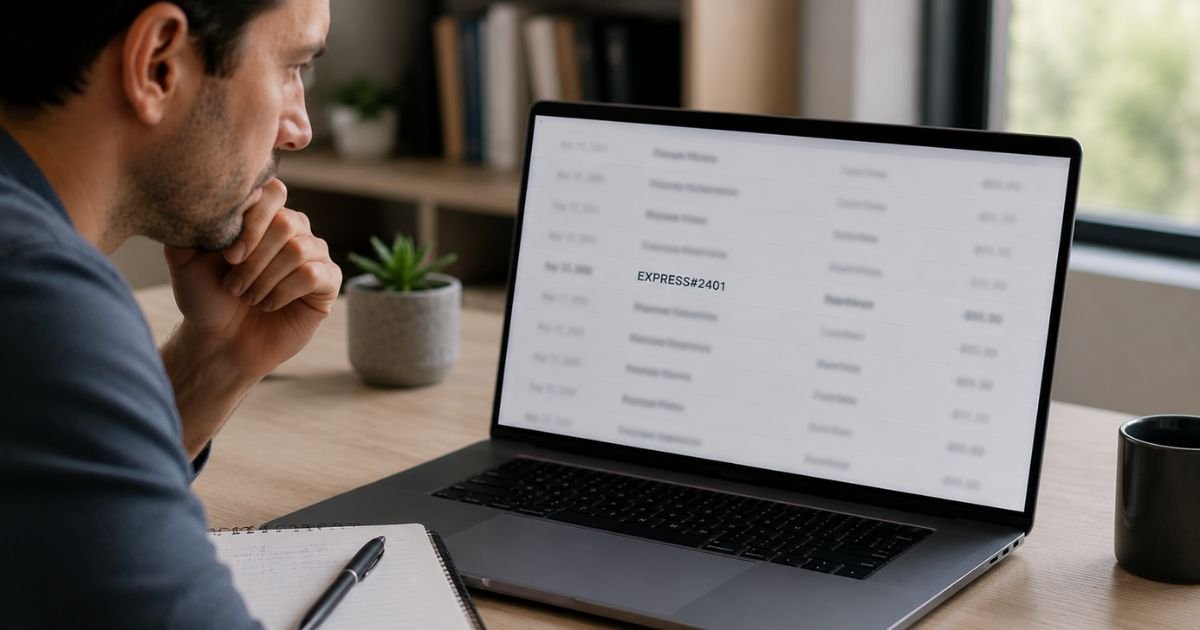
Seeing an Express#2401 charge on bank statement can be alarming, especially if you have never shopped at a store by that name or been in Columbus, Ohio. Many people notice this exact descriptor and immediately wonder whether it is legitimate.
This guide explains what the charge typically is, why it shows up, how to verify it, and the clear steps you should take right away.
Table of Contents
What Is the Express#2401 Charge?
Express#2401 is a billing descriptor that frequently appears on U.S. bank and credit card statements. It is most often listed with a location of Columbus, OH.
Unlike well-known retailers, there is no widely recognized legitimate store or service that customers report knowingly using under this exact name.
Across multiple years of consumer reports on forums, social media, and complaint sites, the descriptor is overwhelmingly associated with unauthorized or fraudulent card activity.
Common amounts in reports range from small “test” charges (around $10–$30) to larger sums. The charge is usually card-not-present, meaning it did not require the physical card to be swiped at a store.
Why Did This Charge Appear?
The most frequent explanations from people who have seen this charge include:
- Unauthorized use of card details that were obtained through skimming, a data breach, or phishing.
- A small initial charge used to test whether the card is active, sometimes followed by larger attempts.
- Fraudulent activity that appears after a legitimate purchase at an unrelated merchant (possible point-of-sale compromise).
- In a smaller number of cases, a pending or declined authorization that later posts.
Because the descriptor does not match a known consumer-facing business that most people recognize, it is treated by many banks and cardholders as suspicious by default.
How to Verify the Charge
Use this quick checklist:
- Note the exact date, amount, and full descriptor (including any city or state shown).
- Think carefully about whether you or any authorized user on the account was in Columbus, Ohio, or shopped at any store called Express around that date.
- Check whether other unfamiliar charges appeared on the same day or in the days that followed.
- Review recent legitimate purchases to see if the card may have been used at a compromised terminal.
- Log into your bank or card account and look at the transaction details for any additional information (such as “card not present”).
If you have no memory of the transaction and were not in the listed location, treat it as unauthorized.
Is It Legitimate or Fraud?
Legitimate scenarios are rare for this specific descriptor. Most documented cases involve people who:
- Have never visited Columbus, Ohio.
- Do not recognize any “Express #2401” merchant.
- See the charge appear without their knowledge or consent.
Warning signs that this is likely unauthorized:
- The charge posts from a city you have not visited.
- Small amounts appear first, followed by larger attempts.
- Multiple Express#2401 charges show up in a short period.
- You receive fraud alerts from your bank about the same merchant.
Because of the consistent pattern of consumer reports, most cardholders and many bank fraud departments treat Express#2401 as a high-risk descriptor.
How to Stop Future Charges
There is no customer service number or cancellation process for a legitimate “Express#2401” business that the public can reliably contact. The practical steps are:
- Contact your bank or credit card issuer immediately and report the charge as unauthorized.
- Ask them to block the merchant descriptor if possible.
- Request a new card number right away. Explicitly tell the issuer not to transfer any existing recurring payments to the new card.
- Monitor the old card number for any additional attempts until it is fully deactivated.
Acting quickly limits further exposure.
Can You Get a Refund?
Yes. Unauthorized charges are generally eligible for dispute and provisional credit under federal rules (especially for credit cards).
- Report the charge to your bank or card issuer as soon as you notice it.
- Provide the date, amount, and descriptor.
- Credit cards usually offer stronger zero-liability protections than debit cards.
- Most issuers have time limits (often 60 days from the statement date), so do not delay.
Your bank will investigate. In the majority of clear unauthorized cases, the charge is reversed.
What to Do If the Charge Is Unauthorized
- Call your bank or card issuer’s fraud department immediately (use the number on the back of your card or in your app).
- Report every Express#2401 charge and any other unfamiliar transactions.
- Request a new card and ask that the old number be canceled.
- Document the conversation (date, time, representative name or reference number).
- Review recent statements and set up real-time transaction alerts if you have not already.
- Consider placing a fraud alert on your credit reports if you see signs of broader account compromise.
- File a report with the Federal Trade Commission at ReportFraud.ftc.gov.
Do not attempt to contact any phone number that may appear alongside the charge unless it is the official number provided by your own bank.
Prevention Tips
- Turn on real-time transaction alerts for every debit and credit card.
- Use your bank’s app or website to review activity several times a week.
- Prefer credit cards over debit cards for everyday purchases when possible (stronger fraud protections).
- Avoid using the same card at unfamiliar ATMs or unattended payment terminals.
- Consider virtual card numbers for online shopping.
- Regularly check that no unexpected recurring payments are linked to your cards.
- If you receive a fraud alert, respond through the official bank app or phone number, never through a link in a text or email.
- Keep a simple list of your active cards and review statements promptly each month.
Common Descriptor Variations
| Statement Text | Typical Context |
|---|---|
| EXPRESS#2401 | Most common form |
| EXPRESS 2401 COLUMBUS OH | Frequently includes city and state |
| EXPRESS#2401 + small amount | Often a test charge |
| Similar “Express” + number | Related unauthorized activity |
FAQs: Express#2401 Charge on Bank Statement
Q. Is Express#2401 a real store in Columbus, Ohio?
A. No widely recognized legitimate retail location operates under this exact descriptor that matches the volume of fraud reports. Most people who see the charge have never been to the listed location.
Q. Why do the amounts sometimes start small?
A. Fraudsters often place small “test” charges to confirm a card is active before attempting larger purchases.
Q. Will my bank automatically catch this?
A. Many banks flag it, but not always. You are still responsible for reviewing your statements and reporting unauthorized activity promptly.
Q. Should I call a phone number shown with the charge?
A. No. Only contact your own bank or card issuer using the official number on your card or in your banking app.
Conclusion
An Express#2401 charge on bank statement is a commonly reported unauthorized transaction descriptor, often linked to Columbus, Ohio, and appearing without the cardholder’s knowledge.
The safest and fastest response is to contact your bank or card issuer immediately, report the charge as fraud, request a new card, and monitor your accounts.
Setting up real-time alerts and reviewing statements regularly remain the most effective ways to catch similar activity early.
Disclaimer: This article is for informational purposes only and is not financial, legal, or professional advice. Always verify current procedures directly with your bank or card issuer.
Meet the Author
