
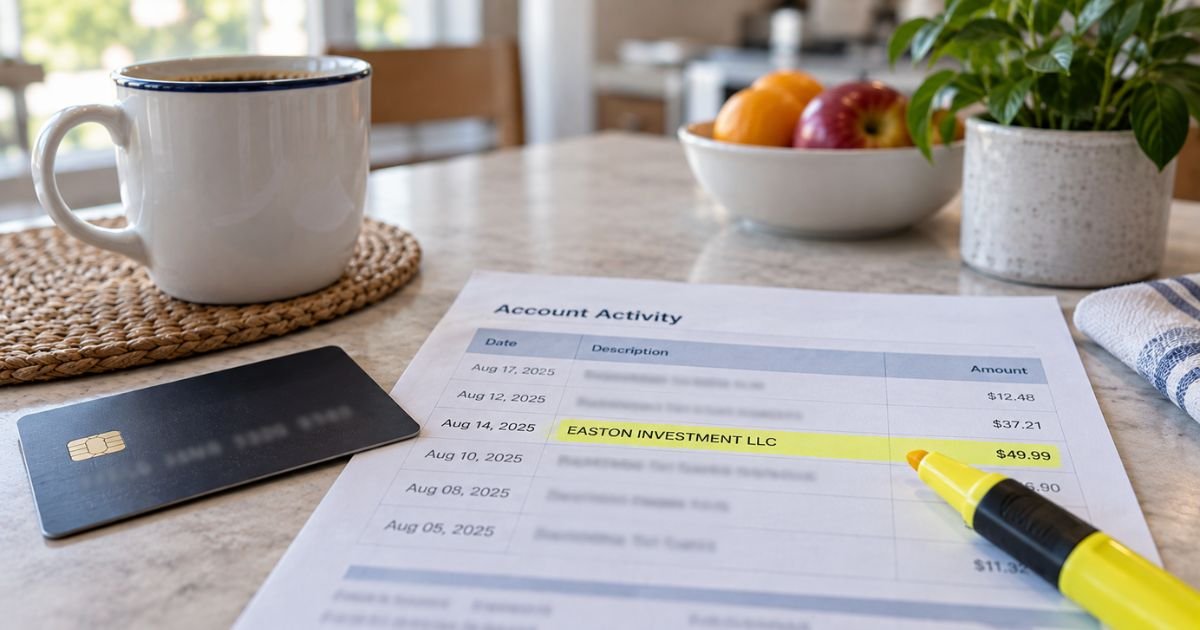
An Easton Investment LLC charge on credit card can feel confusing if you don’t recall signing up for anything. Unfamiliar legal names show up on statements all the time, and some of them are still tied to a real bill.
This guide explains what that wording usually tells you, what it does not prove, and how to check the charge safely.
Table of Contents
What Is an Easton Investment LLC Charge on Credit Card?
An Easton Investment LLC charge on credit card is a merchant descriptor. It is the short name your card network prints for whoever ran the payment. It is not, by itself, proof of a stock trade, a brokerage account, or a scam.
Public records show several different businesses with similar names. None of them publish a clear consumer help page that says, “Yes, we bill cards as Easton Investment LLC.” So the exact company behind your line is often uncertain until you match the date, amount, and city on the statement.
Consumer write-ups from 2024 onward often describe the line as EASTON INVESTMENT LLC or EASTON INVESTMENT LLC MESA AZUS. Mesa is a city in Arizona.
AZUS is a common statement tag that simply means Arizona, United States. That location code is useful. It is not the same thing as a storefront you can walk into.
| What you may see | What it typically tells you |
|---|---|
| EASTON INVESTMENT LLC | Legal billing name, not a product name |
| EASTON INVESTMENT LLC MESA AZ | Processor or merchant tied that charge to Mesa, AZ |
| EASTON INVESTMENT LLC MESA AZUS | Same idea, with a country code added |
| A pending line that later posts | Authorization first, final amount later |
Your bank app may add words like POS, CHECKCARD, or RECURRING. Those labels come from the issuer. They do not identify the product.
Names That Sound Alike but May Not Be Yours
Do not assume every “Easton” company is the same merchant. These are separate records, and most have no official link to a consumer card descriptor:
- Easton Investment Services, LLC in Merrillville, Indiana, once appeared in FINRA BrokerCheck. That firm’s brokerage registration later ended. A closed broker file is not proof your current charge came from that firm.
- Easton Commercial Investments LLC has appeared in Arizona business records as a foreign LLC with a Costa Mesa, California office.
- Easton West Investments LLC has appeared in Arizona records with a Buckeye address, not Mesa.
- Other “Easton” brands sell sports gear, buy houses, or manage property under different legal names.
A statement almost never prints the full state filing number. That is why a web search for the company name can pull up the wrong business.
Pro Tip: Copy the exact statement text, including city and state. Search that full string plus the dollar amount and date. A clipped name alone will mix this charge up with unrelated Easton companies.
Why This Charge Shows Up
Because no official consumer FAQ confirms one product, treat these as possible explanations, not facts about your account.
A real bill under a legal name
Landlords, small property firms, and local investment LLCs sometimes bill under the entity on their merchant account instead of a friendly DBA.
If you paid rent, a deposit, a management fee, or a real-estate related invoice, the legal name can look like “investment” even when you thought you paid “the apartment office.”
A card-not-present payment
Online forms, emailed invoices, and stored cards often print the LLC name on file with the processor. You may have typed your card on a site that never showed “Easton” in big letters.
A look-alike or reused name
“Investment LLC” is a generic style of company name. Different states can have different Easton-named LLCs. A Mesa tag on the charge does not automatically match a Washington, Indiana, or California firm with a similar title.
An unauthorized charge
Consumer posts and charge- explainer pages have described people who did not recognize any Easton relationship at all. That pattern does not prove every line is fraud. It does mean you should not ignore a charge you cannot place.
There is no verified public price list, membership tier, or cancel portal for “Easton Investment LLC” as a national subscription brand.
If a website promises huge returns and then this name hits your card, pause before sending more money.
How to Match the Charge to Something Real
Work from your records first. Do not start by wiring anyone extra funds to “verify” the account.
- Write down the exact descriptor, date, amount, and any city or phone fragment.
- Check email and texts from that week for invoices, rent receipts, or “pay this link” messages.
- Ask anyone else on the card. A partner or adult child may have paid a local bill.
- Think about Arizona ties. A trip to Mesa, a rental there, or an online seller using an Arizona processor can explain the city code.
- Open your issuer app and tap the transaction. Some banks show a merchant category, partial address, or map pin that the paper statement hides.
If the amount matches a rent portal, HOA portal, or property invoice, contact that office with the date and last four of the card.
Ask what legal name sits on their merchant account. Many small firms do not realize their processor prints the LLC name.
If nothing matches, do not keep hunting for a customer-service number from a random blog. Unverified phone numbers are a common follow-on scam after a strange charge.
Is It a Subscription?
It can be recurring if the merchant stored your card. It is not a well-documented national software club like Adobe or Amazon Prime.
Look at your last two or three statements. One lone charge looks more like a one-time invoice or a one-off card use. The same name and similar amount each month looks like a stored-card billing.
In that case you still need the underlying business to cancel. There is no confirmed official “Easton Investment LLC” unsubscribe page for consumers.
If someone asked you to “invest,” “unlock a transfer,” or “pay a small verification fee,” treat that as a warning sign.
Real brokerages and registered advisers do not usually collect random card charges under a vague LLC line with no account login you already use.
What To Do If You Do Not Recognize It
Stay calm and move in order.
- Lock or freeze the card in your issuer’s app if the charge is clearly not yours.
- Ask the issuer for any extra merchant detail. Note the case or reference number.
- File a dispute for unauthorized use or a billing error.
- Watch the next few days for more attempts from the same name.
For credit cards, the Fair Credit Billing Act generally gives you 60 days after the statement was sent to give written notice of a billing error.
Issuers often acknowledge that notice within 30 days and aim to resolve it within two billing cycles, not to exceed 90 days.
Many issuers cap your loss on true unauthorized credit-card use at $50, and many advertise $0 liability if you report promptly.
Debit cards follow a different clock, so act faster if the money left checking.
Replace the card if you dispute unauthorized charges. A new number stops later attempts that reuse the old card data.
You can also log a report at ReportFraud.ftc.gov. That does not pull the money back by itself. It creates a record if the same descriptor shows up for other people.
Common Mistakes: Calling the first phone number a search result shows. Paying a second “refund processing” fee. Assuming every Arizona LLC with Easton in the name is your merchant. Waiting until the next statement because the amount looks small.
Small test charges can precede larger ones. Report the first unrecognized line even if it is only a few dollars.
How to Talk to Your Bank
Keep the story short and specific.
- “I do not recognize Easton Investment LLC.”
- Give the posted date and exact amount.
- Say whether anyone in your household traveled to Arizona or paid a property bill.
- Ask whether the merchant category is rent, professional services, or something else.
- Request a written or in-app confirmation of the dispute.
If the issuer asks you to contact the merchant first, say you cannot find a verified official contact for that exact descriptor. That is an accurate statement based on public information available today.
Do not send copies of your full card number, Social Security number, or one-time passcodes to anyone who emails you after you search this charge.
FAQs: Easton Investment LLC Charge on Credit Card
Q. Is an Easton Investment LLC charge on credit card always fraud?
A. No. Some people may have a real local or online bill that prints this legal name. Public evidence is limited, and consumer reports also describe charges nobody in the household recognizes. Match the date and amount first. Dispute the line if you still cannot place it.
Q. Why does the statement say Mesa, AZ?
A. Card descriptors often include the city tied to the merchant account or processor. Consumer reports have included Mesa, Arizona, plus AZUS. That points to where the payment was coded, not necessarily where you live or shopped in person.
Q. Can I cancel this like a normal subscription?
A. Only if you find the actual business that stored your card. There is no confirmed official consumer cancel page under this exact name. If you cannot identify the merchant, stopping future charges usually means locking the card and filing a dispute with your issuer.
Q. Should I pay someone who offers to “clear” the charge?
A. No. Recovery or refund services that ask for another payment, remote access, or gift cards are a common second scam. Use your card issuer and, if needed, official government complaint sites.
Conclusion
An Easton Investment LLC charge on credit card is a vague legal-name descriptor, sometimes coded to Mesa, Arizona, not a well-documented national product page. Similar company names exist in public records, but they may not be the merchant on your statement.
Match any rent, invoice, or household purchase you can prove. If you cannot, treat the charge as unrecognized and use your issuer’s dispute process.
Disclaimer: This article is for general information only. It is not financial, legal, or tax advice. Merchant names, locations, and policies vary, and public details on this descriptor are limited. Verify account-specific questions with your card issuer or a confirmed business you already know.
Meet the Author
