
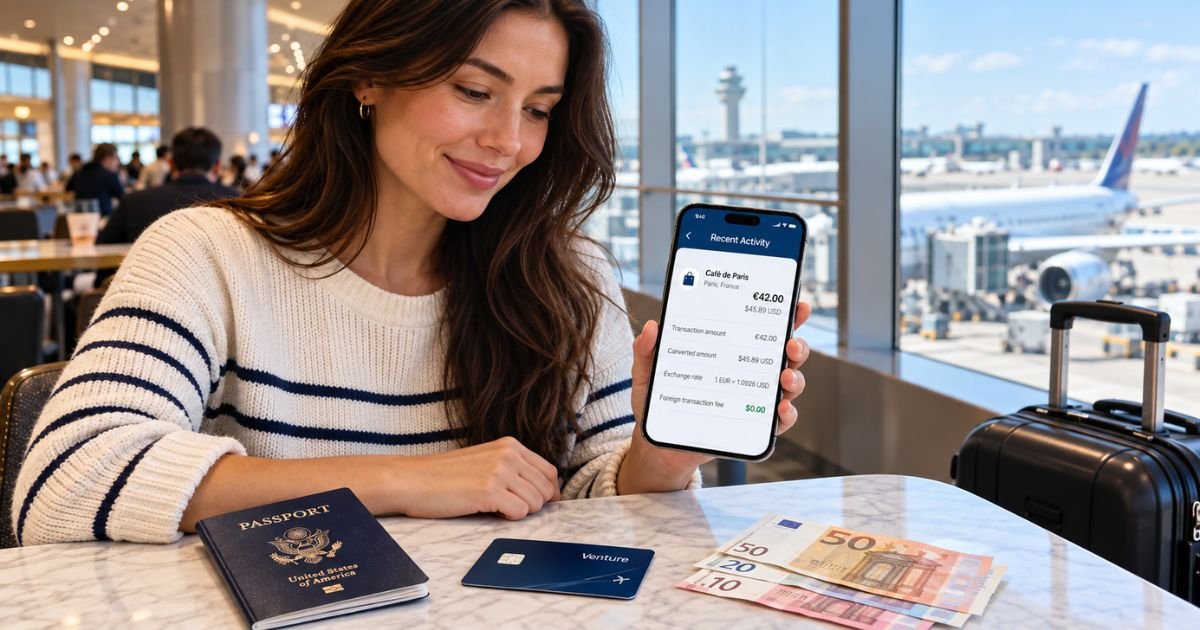
If you’re wondering does Capital One have foreign transaction fees, the answer is generally good news for U.S. credit card customers. Capital One currently says none of its U.S.-issued credit cards charge a foreign transaction fee.
Debit cards and international ATM withdrawals need a little more explanation. This guide covers credit cards, Capital One 360 debit cards, currency conversion, overseas ATMs, and costs you may still encounter.
Table of Contents
Does Capital One Have Foreign Transaction Fees?
Capital One currently charges no foreign transaction fee on any of its U.S.-issued credit cards. This applies across its travel, cash-back, student, and other consumer credit card categories.
That means you generally won’t pay an extra Capital One percentage fee simply because you use an eligible Capital One credit card outside the United States. You can also generally avoid this fee when buying online from a foreign merchant.
Many competing cards that do charge a foreign transaction fee generally add around 1% to 3% of the purchase amount.
Capital One Foreign Fees at a Glance
| Transaction | Typical Capital One fee |
|---|---|
| U.S.-issued Capital One credit card purchase abroad | $0 foreign transaction fee |
| Foreign online purchase with Capital One credit card | $0 foreign transaction fee |
| Capital One 360 Checking debit card purchase abroad | No additional Capital One foreign transaction fee |
| 360 Checking international ATM withdrawal | No additional Capital One foreign transaction fee |
| Non-360 international ATM withdrawal | May be $2 plus 3% |
| Foreign ATM operator fee | May apply |
| Dynamic currency conversion | Merchant or ATM may add conversion cost |
Capital One’s current help information says 360 Checking and MONEY Checking customers are not charged additional Capital One fees for foreign debit card transactions. Older non-360 products may follow different international ATM rules.
Which Capital One Credit Cards Have No Foreign Transaction Fee?
You do not generally need a premium Capital One travel card to avoid foreign transaction fees.
Capital One states that all of its U.S.-issued credit cards have no foreign transaction fee. That includes cards from several product families.
Examples include cards in the:
- Venture family
- Quicksilver family
- Savor family
- Student card lineup
- Business card lineup, depending on the specific U.S.-issued product
You should still review your own card agreement, especially if you have an older, converted, or unusual account.
The important point is that a Capital One card does not need “travel” in its name to avoid the fee.
Pro Tip: Check the rates and disclosures for your exact card before traveling. Capital One’s current U.S. credit card policy is broad, but your cardholder agreement is generally the best source for your individual account.
How Much Could No Foreign Transaction Fee Save You?
Suppose you spend the equivalent of $2,000 during an international trip.
A card charging a 3% foreign transaction fee could add about $60 in fees. With a U.S.-issued Capital One credit card, Capital One currently would not add that foreign transaction fee.
That does not mean every international purchase will cost exactly what you expect.
Currency conversion rates, hotel deposits, merchant surcharges, and dynamic currency conversion can still affect the final amount.
Does Capital One Charge Currency Conversion Fees?
Capital One says it does not charge a separate currency conversion fee when it converts an eligible foreign credit card transaction into U.S. dollars.
The exchange rate used when your purchase is processed may differ from the rate you saw when you made the transaction.
For example, you may buy something for €100 on Monday, but the transaction might process later. Exchange rates can move during that period.
The difference between the two dollar amounts does not automatically mean you were charged a foreign transaction fee.
Should You Pay in U.S. Dollars or Local Currency?
When a store, hotel, restaurant, or ATM abroad asks whether you want to pay in U.S. dollars or the local currency, choosing the local currency is generally worth considering.
Paying in dollars may trigger dynamic currency conversion, commonly called DCC. The merchant or ATM provider handles the conversion and may use its own rate or add a conversion cost.
For example, a restaurant in France might offer to bill you in dollars instead of euros. That can sound convenient, but the merchant’s exchange rate may be less favorable.
Capital One’s lack of a foreign transaction fee does not protect you from a merchant’s DCC markup.
Common Mistakes: Don’t choose U.S. dollars automatically just because the payment terminal offers the option. You may avoid Capital One foreign transaction fees either way, but the merchant’s conversion rate can still make the purchase more expensive.
Does Capital One Charge Foreign Transaction Fees on Debit Cards?
Capital One’s current guidance says it does not charge additional foreign transaction fees for debit card transactions on 360 Checking and MONEY Checking accounts.
This can make a Capital One 360 debit card useful when you need to make a debit purchase while traveling.
However, debit cards come directly from your checking account. If your card is lost or used without permission, the process and legal protections can differ from those for credit cards.
You may therefore prefer using a credit card for most purchases while keeping your debit card for cash access.
Does Capital One Charge International ATM Fees?
The answer depends on your account.
Capital One says 360 Checking and MONEY Checking customers generally do not pay additional Capital One fees simply because an ATM transaction takes place abroad. However, the ATM owner may impose its own fee.
For certain older non-360 accounts, Capital One says it may charge $2 plus 3% of the transaction amount for an international ATM withdrawal.
Before withdrawing cash, read the ATM screen carefully. The machine may disclose an operator fee or offer its own currency conversion.
Can the Foreign ATM Still Charge You?
Yes.
A $0 Capital One fee does not guarantee a free withdrawal. An overseas ATM operator may impose a separate access fee.
For example, Capital One might charge you $0 while the foreign bank operating the ATM charges you the equivalent of $4.
You should see the ATM owner’s charge before confirming the withdrawal in many cases. Cancel the transaction if the cost seems excessive and another ATM is available.
What About Using a Capital One Credit Card at an ATM?
Using your credit card at an ATM is different from making a normal purchase.
A credit card cash withdrawal may be treated as a cash advance. Cash advances can carry separate fees and may begin accruing interest under the terms of your account.
The lack of a foreign transaction fee does not mean a credit card cash advance is free.
Use your cardholder agreement to check the cash advance fee and APR before withdrawing money with a credit card.
Do You Need to Tell Capital One Before Traveling Abroad?
Capital One currently says you generally do not need to submit a travel notification before using your card abroad.
You should still make sure your phone number and email address are current. Capital One may need to contact you if its security systems detect unusual activity.
You can also use the Capital One mobile app to monitor purchases, receive alerts, and lock a card if necessary.
Can You Use Capital One for Foreign Online Purchases?
Yes, your physical location generally does not determine whether a foreign transaction can occur.
You might buy airline tickets from a foreign carrier, book an overseas hotel, or order from a European website while sitting at home in the United States.
Capital One says its U.S.-issued credit cards do not charge foreign transaction fees, including when you shop with foreign merchants.
The merchant may still charge in a foreign currency, so your purchase may need to be converted to dollars.
What Do Consumer Reports Say?
BBB currently lists Capital One Financial Corporation as an accredited business with an A+ rating. Its profile also contains thousands of complaints across billing, service, products, and other banking issues. Those complaints cover Capital One broadly and do not mean its published foreign transaction fee policy is incorrect.
Trustpilot currently shows a low consumer rating for Capital One US, with many recent complaints focusing on customer service, account restrictions, payments, and other issues. Trustpilot also warns that reviews may not represent all customers.
Reddit discussions frequently mention Capital One cards as no-foreign-transaction-fee options. These posts are personal experiences, so you should rely on Capital One’s official terms for your actual account.
How to Avoid Extra Costs When Using Capital One Abroad
Even with no Capital One foreign transaction fee, you can take a few steps to reduce other costs:
- Pay in the local currency when appropriate.
- Review DCC offers carefully.
- Check ATM operator fees before withdrawing.
- Avoid credit card cash advances unless necessary.
- Carry a backup card.
- Keep your contact information updated.
- Enable transaction alerts.
- Review your account during your trip.
Capital One also recommends carrying another payment method because card acceptance can vary by destination.
FAQs: Does Capital One Have Foreign Transaction Fees?
Q. Does Capital One charge a 3% foreign transaction fee?
A. No, Capital One currently says none of its U.S.-issued credit cards charge foreign transaction fees. Other international costs, such as ATM or merchant conversion fees, may still apply.
Q. Does Capital One 360 charge foreign transaction fees?
A. Capital One currently says 360 Checking and MONEY Checking customers are not charged additional Capital One fees for foreign debit card transactions. An overseas ATM operator may still charge you.
Q. Can you use a Capital One card internationally?
A. Yes. You can generally use your card anywhere its payment network is accepted. Capital One also says you usually do not need to notify it before international travel.
Q. Should you choose local currency when using Capital One abroad?
A. Generally, yes. Choosing local currency can help you avoid a merchant’s dynamic currency conversion, which may use a less favorable exchange rate or include additional costs.
Conclusion
So, does Capital One have foreign transaction fees? For U.S.-issued Capital One credit cards, the current answer is no. Capital One says all of its U.S. credit cards have a $0 foreign transaction fee.
Capital One 360 Checking customers also generally do not pay additional Capital One fees on foreign debit card transactions. You should still watch for ATM operator fees, cash advance charges, exchange-rate differences, and dynamic currency conversion when spending abroad.
Disclaimer: This article is for informational purposes only and is not financial or legal advice. Capital One fees, exchange-rate practices, account terms, and ATM policies may change, so verify account-specific questions with Capital One before making financial decisions.
Meet the Author
