
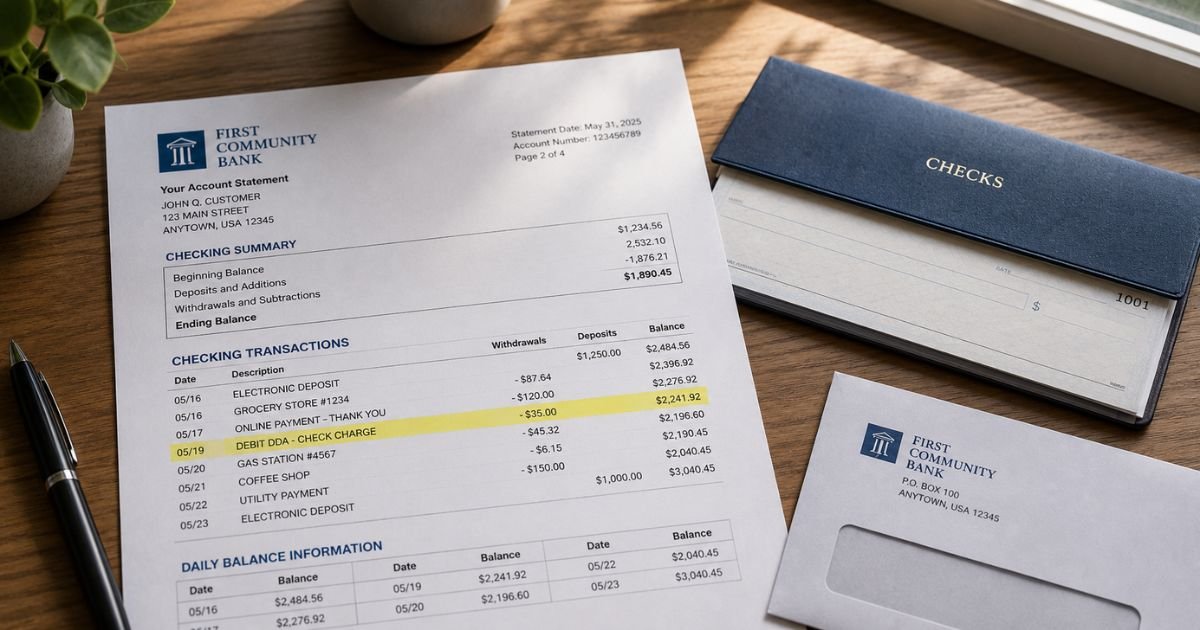
You check your bank statement or recent activity and see a line that says “Debit DDA Check Charge,” “DEBIT DDA – CHECK CHARGE,” or something very similar. The amount is often large, sometimes matching your entire remaining balance, and it can leave you worried.
This entry is usually not a fee from an outside company. In most cases it is an internal bank transaction tied to your checking account. Still, you should verify exactly what happened.
This guide explains what the charge on bank statement means, the most common reasons it appears, how to confirm it, and the practical steps to take next.
Table of Contents
What Is a Debit DDA Check Charge?
DDA stands for Demand Deposit Account. That is the formal name for a standard checking account (and sometimes certain savings accounts) where you can withdraw money on demand.
A “Debit DDA Check Charge” is the bank’s way of recording that it has removed funds from your Demand Deposit Account and is handling them by issuing a check.
Common statement variations include:
- Debit DDA – Check Charge
- DEBIT DDA CHECK CHARGE
- Debit DDA Check
- DDA Check Charge
These descriptors appear most often with large banks such as Chase, though other institutions may use similar wording. The charge is typically for the exact remaining balance in the account.
It is not a merchant purchase, subscription, or standard overdraft fee. It is an internal bank movement of your own money.
Why Did This Charge Appear?
Here are the most frequent reasons people see this entry:
- The bank closed your checking account and is sending you the remaining balance by official check or cashier’s check.
- Your account was restricted or frozen (often after a deposited check raised questions) and the bank later closed it.
- A large deposited check was returned or flagged, leading the bank to reverse funds and close the account.
- The bank is returning funds related to a government seizure, suspected fraud investigation, or other compliance issue.
- In less common cases, it may reflect an electronic conversion of a paper check or a pending internal transfer that later posts under this label.
When the charge equals your full remaining balance and the account shows zero afterward, the bank has almost certainly closed the account and prepared a check for you.
How to Verify the Charge
Follow these steps:
- Look at the exact amount, date, and full description on your statement or online activity.
- Check whether your account balance is now zero and whether online access still works.
- Search your mail (including any recent change-of-address notices) for a letter or official check from the bank.
- Log into online banking or the bank’s app and review any messages, alerts, or account-status notices.
- Call the bank using the number on the back of your debit card or from their official website and ask for an explanation of the “Debit DDA Check Charge.”
- Ask specifically whether a closing check was mailed and to what address.
Have your account number and recent statement ready when you call.
Is It Legitimate or Fraud?
Common legitimate scenarios
- Routine or involuntary account closure with the balance paid out by check
- Bank action after a deposited check was returned unpaid
- Compliance-related account closure where remaining funds are returned to you
Warning signs that need attention
- You never received a closure notice or a check
- The amount does not match your last known balance
- Multiple unexplained DDA charges appear
- You believe the account was closed without proper notice
If the charge matches a closed account and the bank confirms a check was issued, it is almost always legitimate.
If you cannot locate the check or the bank cannot explain the entry, treat it as a problem that needs quick follow-up.
How to Cancel or Resolve
You cannot “cancel” this charge the way you cancel a subscription, because it is usually the bank moving your own remaining funds.
Instead:
- Contact the bank and confirm the status of the account and the check.
- Ask for the check number, mailing date, and address used.
- If the check has not arrived after a reasonable time (often 7–14 business days), request a stop-payment and reissue.
- If the account was closed in error or without proper notice, ask to speak with a supervisor or the bank’s executive office / escalation team.
- Keep written records of every call, including dates, names, and reference numbers.
If the bank will not resolve it, you can file a complaint with the Consumer Financial Protection Bureau (consumerfinance.gov) or your state’s banking regulator.
Can You Get a Refund?
In most cases a “refund” is not needed because the money is still yours. The bank has simply removed it from the account to issue a check.
- If the check arrives, deposit or cash it.
- If the check is lost, the bank can usually reissue it after a waiting period and possible stop-payment fee.
- If the bank incorrectly took funds that should have stayed in the account, request an immediate credit and written confirmation.
Disputes with the bank itself are handled through their internal process rather than a standard credit-card chargeback. Act promptly and document everything.
What to Do If the Charge Is Unauthorized or Unexpected
- Call the bank the same day using the official customer-service number.
- Ask whether the account is closed, whether a check was mailed, and the exact reason for the debit.
- Request a written explanation and the tracking or check details.
- Monitor your credit reports and other accounts for related activity.
- If funds were seized by a government agency, the bank or the agency will usually send a separate notice with instructions.
- Consider consulting a consumer attorney if the amount is large and the bank will not return the funds promptly.
Prevention Tips
- Keep your contact information and mailing address current with the bank.
- Avoid depositing large or unusual checks without confirming they will clear.
- Review account activity frequently so freezes or restrictions are noticed early.
- Maintain a second account at a different bank for emergencies.
- Respond quickly to any bank letters or messages about account status.
- When closing an account yourself, request the final balance by official check and confirm the mailing address.
- Use mobile deposit only for checks you trust will not be returned.
- Ask the bank in advance about their policy for large check deposits.
Common Meanings of Debit DDA Check Charge
| Situation | What the Charge Usually Represents | Next Step |
|---|---|---|
| Account closed by bank | Remaining balance paid out by check | Look for mailed check |
| Account restricted then closed | Funds removed after investigation | Call bank for status and check info |
| Returned deposited check | Reversal plus account action | Confirm with bank |
| Government seizure | Funds held or sent to agency | Follow agency notice |
Typical Timeline After Seeing the Charge
| Action | Usual Time Frame |
|---|---|
| Bank mails closing check | 3–10 business days after closure |
| Check arrives by mail | 7–14 days after mailing |
| Request stop-payment and reissue | Immediately after confirming lost |
| Escalate unresolved balance | After 14–30 days of no response |
FAQs: Debit DDA Check Charge on Bank Statement
Q. What does DDA stand for on a bank statement?
A. DDA means Demand Deposit Account. It is the technical term for a regular checking account that allows withdrawals on demand.
Q. Why is the Debit DDA Check Charge the exact amount of my old balance?
A. The bank is debiting the full remaining funds so it can issue you a check for that amount and close the account at zero.
Q. Will I get my money back if I see this charge?
A. In nearly all cases the money is still yours. The bank has simply moved it into a check. Contact the bank to confirm the check was mailed and to request a reissue if it never arrives.
Q. Can this charge be fraud?
A. It is rarely fraud by an outside party. It is almost always an internal bank entry. The real risk is delay or loss of the closing check, which is why you should contact the bank promptly.
Conclusion
A Debit DDA Check Charge on bank statement almost always means the bank has closed your Demand Deposit Account and is sending the remaining balance to you by check. It is not a merchant fee or random withdrawal.
Verify the charge by checking your mail, reviewing account notices, and calling the bank. Confirm whether a closing check was issued and to what address.
If the check is missing or the explanation is unclear, escalate with the bank and keep detailed records.
Understanding this descriptor helps you move quickly from confusion to resolution and get your funds back under your control.
Disclaimer: This article is for informational purposes only and is not financial or legal advice. Bank policies and procedures vary. Always confirm details directly with your bank and, when appropriate, with regulators or legal counsel.
Meet the Author
