
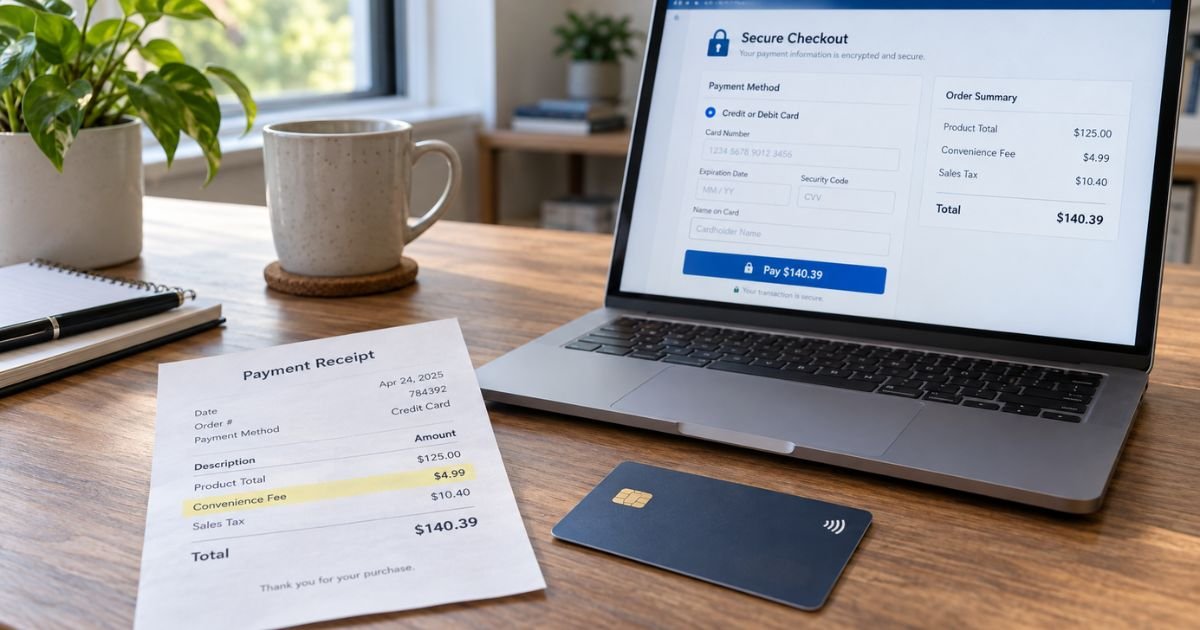
Seeing a credit card convenience charge on your receipt or bank statement can feel confusing, especially if you don’t remember agreeing to an extra fee. Fortunately, these charges are often legitimate costs associated with certain payment methods.
However, not every convenience fee is allowed. Understanding why businesses charge these fees can help you avoid unnecessary expenses and recognize questionable charges.
Table of Contents
What Is a Credit Card Convenience Charge?
A credit card convenience charge is an additional fee that a business may collect when you use an alternative payment method or channel, such as paying a bill online instead of in person.
Businesses generally charge these fees to cover payment-related costs or provide access to an optional payment channel.
For example, a utility company might normally accept payments by mail. If you choose an eligible online payment option, it may add a convenience fee.
However, convenience fees aren’t the same as credit card surcharges. Each has different requirements under card-network rules.
Visa generally requires qualifying convenience fees to be fixed amounts, clearly disclosed, and associated with an alternative payment channel.
The amount and eligibility depend on the payment network, business type, and applicable regulations.
Why Do Businesses Charge Credit Card Convenience Fees?
Businesses typically pay processing costs when customers use credit cards. Some companies recover certain expenses through separately disclosed fees.
Common reasons include:
- Payment processing expenses: Businesses may pay transaction fees to payment processors.
- Alternative payment channels: Some companies offer optional online or telephone payment services.
- Third-party payment platforms: External service providers may process payments for government agencies or other organizations.
- Administrative expenses: Certain payment arrangements involve additional operating costs.
- Customer convenience: Businesses may offer payment options outside their standard collection process.
However, labeling a fee as a convenience charge doesn’t automatically make it permissible.
The charge must comply with applicable laws and payment-network requirements.
How Does a Credit Card Convenience Charge Appear on Your Statement?
A convenience fee may appear as part of the original transaction or under a separate payment-related description.
Common descriptions include:
| Statement Description | Possible Meaning |
|---|---|
| CONVENIENCE FEE | Additional payment-channel fee |
| CC CONV FEE | Credit card convenience fee |
| PAYMENT PROCESSING | Payment service charge |
| ONLINE PAYMENT FEE | Fee for an online payment |
| SERVICE FEE | Payment-related service charge |
| CARD PROCESSING FEE | Fee associated with card acceptance |
| THIRD PARTY PAYMENT | Payment processed by an outside provider |
These descriptions are examples, not standardized merchant identifiers.
Your bank statement may show only the merchant’s name and the combined transaction amount.
If you cannot identify the fee, compare your statement with the original receipt.
Credit Card Convenience Fee vs. Credit Card Surcharge
Although people sometimes use these terms interchangeably, they generally describe different charges.
A convenience fee relates to using an alternative payment channel. A surcharge applies specifically because you choose a credit card instead of another payment method.
Here’s a comparison:
| Feature | Convenience Fee | Credit Card Surcharge |
|---|---|---|
| Main purpose | Alternative payment channel | Credit card acceptance |
| Fee structure | Generally fixed under Visa rules | Usually percentage-based |
| Payment method | May cover multiple methods | Credit cards |
| Disclosure | Required | Required |
| Legal restrictions | Network and state rules | Network and state rules |
For example, a business that adds a fee solely because you use a credit card may be imposing a surcharge rather than a true convenience fee.
Mastercard permits certain credit card surcharges under specific conditions. Its rules prohibit surcharges on Mastercard debit and prepaid cards.
Are Credit Card Convenience Charges Legal?
Credit card convenience charges can be legal in the United States. However, businesses cannot simply add any fee they want.
The rules depend on your state, the card network, and the type of transaction.
For example, Visa generally requires qualifying convenience fees to:
- Apply to an eligible alternative payment channel.
- Be disclosed before completing the transaction.
- Use a fixed amount rather than a percentage.
- Allow customers to cancel before paying.
- Follow applicable payment-network restrictions.
Certain government and educational payments may follow separate service-fee rules.
State laws can also restrict credit card fees and how businesses advertise prices.
The Federal Trade Commission also has rules addressing misleading mandatory fees in covered ticketing and short-term lodging transactions.
These requirements do not mean every convenience fee is illegal. They mean businesses must follow the applicable disclosure and pricing rules.
How Much Is a Credit Card Convenience Charge?
There isn’t one universal convenience fee amount.
Certain pay-to-pay fees can range from a few dollars to $15 or more. Actual charges depend on the payment arrangement.
Consider this illustrative example:
| Payment Detail | Amount |
|---|---|
| Original bill | $100.00 |
| Convenience fee | $3.00 |
| Total payment | $103.00 |
In this example, you pay $3 more for the selected payment channel.
This isn’t a standard fee or recommended amount. Your actual payment provider may charge differently.
Always review the final amount before authorizing your credit card payment.
How to Avoid Credit Card Convenience Charges
You can sometimes avoid convenience fees by choosing another payment method or channel.
However, available alternatives depend on the business.
Consider these options:
1. Pay directly from your bank account
Some billers accept ACH transfers without additional charges. Check whether your provider offers this option.
2. Use a standard payment channel
A company may accept mailed checks or in-person payments without a convenience fee.
3. Compare payment options
Look at all available methods before selecting credit card payment.
4. Review automatic payment settings
Some businesses offer different fees for scheduled payments. Verify the terms before enrolling.
5. Compare fees against credit card rewards
A rewards card isn’t always the cheapest option.
For example, earning 2% cash back while paying a 3% card fee generally leaves you paying more overall.
Pro Tip: Before paying a large bill, compare the credit card fee with your expected rewards. Choosing a fee-free payment method may save more than the rewards you earn.
Can You Dispute a Credit Card Convenience Charge?
You may be able to dispute a convenience fee if it was unauthorized, incorrectly calculated, or not properly disclosed.
Start by contacting the merchant and requesting an explanation.
Follow these steps:
- Review your receipt and payment confirmation.
- Check whether the convenience fee appeared before checkout.
- Contact the merchant through its official support channel.
- Request a correction or refund if the fee was charged incorrectly.
- Save your receipt, screenshots, and correspondence.
- Contact your credit card issuer if the issue remains unresolved.
For qualifying billing errors, federal law generally requires you to send written notice within 60 days after your card issuer sent the first statement showing the error.
Your issuer typically has 30 days to acknowledge your written dispute and up to two billing cycles, but no more than 90 days, to resolve it.
A dispute does not guarantee reimbursement. Your issuer will generally review the circumstances before making a decision.
When Should You Be Concerned About a Convenience Fee?
Most convenience charges are ordinary payment-related expenses. However, certain situations deserve further investigation.
Watch for these warning signs:
- A fee appears without any payment explanation.
- You notice duplicate convenience charges.
- The amount differs from the checkout disclosure.
- A merchant refuses to explain the fee.
- You receive a separate charge from an unknown payment processor.
- You didn’t authorize the underlying transaction.
These warning signs don’t automatically establish fraud.
Consumer discussions sometimes describe frustration with utility payment fees. However, individual reports cannot establish whether a particular fee violates the law.
Likewise, BBB and Trustpilot reviews may help you research a specific merchant, but they cannot verify a generic convenience charge.
Common Mistakes: Don’t assume every processing fee is illegal or that every disclosed charge is valid. The payment channel, fee structure, and applicable rules determine whether a charge is allowed.
FAQs: Credit Card Convenience Charge
Q. Is a credit card convenience charge the same as interest?
A. No. A convenience fee is generally charged by a merchant or payment provider for a qualifying payment arrangement.
Credit card interest is usually charged by your card issuer when you carry a balance under your account terms.
Q. Can a merchant charge a convenience fee on a debit card?
A. Sometimes. Certain qualifying convenience fees apply to an alternative payment channel regardless of which accepted payment method you use.
However, ordinary credit card surcharges generally cannot be imposed on debit cards under major card-network rules.
Q. Can I get a refund for a credit card convenience charge?
A. You may qualify for a refund if the fee was charged incorrectly or violated applicable requirements.
Refund decisions depend on the circumstances, merchant terms, and your card issuer’s investigation.
Q. Are credit card convenience fees charged every month?
A. Not necessarily. Convenience fees generally depend on the payment channel used for a particular transaction.
You might encounter them repeatedly when paying recurring bills. However, recurring billing has additional card-network restrictions, so the exact fee arrangement matters.
Conclusion
A credit card convenience charge is typically an additional payment-related fee associated with using an alternative payment channel. These fees may be legitimate, but businesses must follow applicable disclosure requirements and payment rules.
Before paying, review the total transaction amount and compare available payment options. If a fee seems incorrect or unauthorized, contact the merchant or your credit card issuer promptly.
Understanding these charges can help you control payment costs, avoid unnecessary fees, and recognize suspicious transactions.
Disclaimer: This article is for informational purposes only and does not provide financial or legal advice. Convenience fee rules, dispute procedures, and banking policies may vary by issuer, card network, and state. Verify account-specific questions with the company involved or your bank.
Meet the Author
