
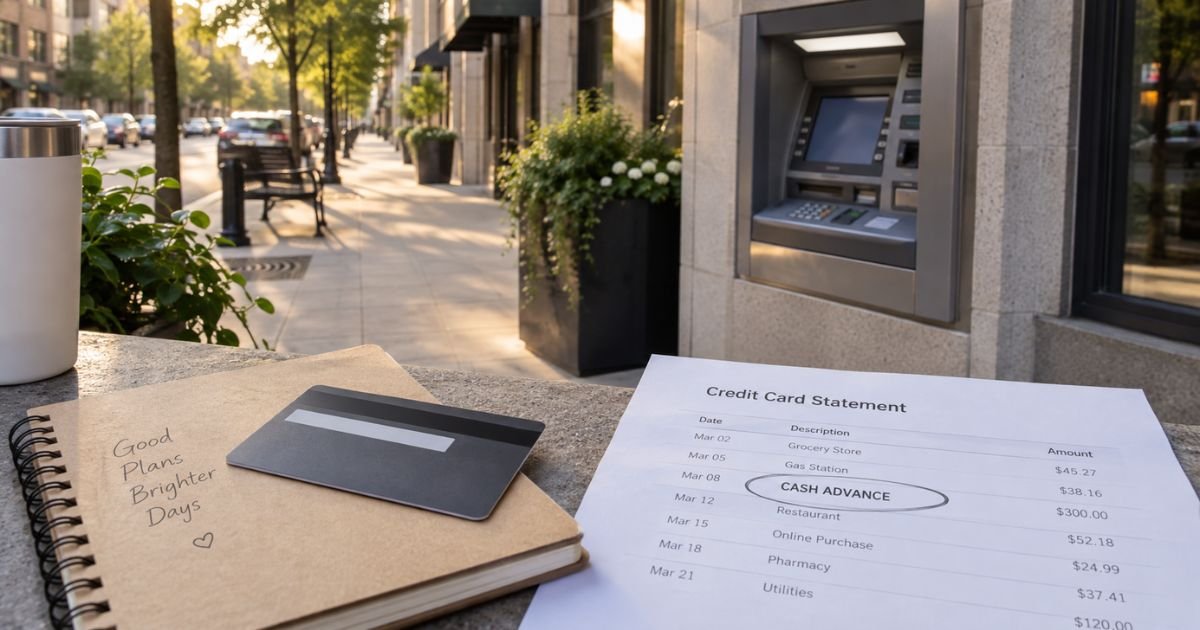
Seeing credit card cash withdrawal charges can feel confusing if you don’t recall taking a loan. The line often looks like an ATM trip, not a store. In most cases it is a cash advance from your credit line. That is usually more expensive than a regular purchase.
This guide explains what those charges are, how the fees stack, and what to do if the amount looks wrong.
Table of Contents
What credit card cash withdrawal charges are
Credit card cash withdrawal charges are the extra costs of taking cash from a credit card. The Consumer Financial Protection Bureau says you can withdraw cash with a credit card at an ATM, but it is expensive to do so. The withdrawal is a short-term loan against your credit line, not a debit from checking.
Issuers usually call this a cash advance. You may also get one at a bank teller or with a convenience check the issuer mailed you.
Some cards treat certain cash-like items the same way. That can include money orders, some wallet cash-outs, lottery tickets, or gaming transactions. Your agreement lists what counts.
The cash itself is one line. The fee is often a second line. Interest can appear later as a finance charge. Read all three before you assume the ATM “overcharged” you.
How the charges usually appear
Statement wording varies by issuer. You may see CASH ADVANCE, CASH ADV, ATM CASH, WITHDRAWAL, or CONV CHECK. The ATM owner name or city may print next to it.
A separate line may say CASH ADVANCE FEE or TRANSACTION FEE. An ATM SURCHARGE is different. That is the machine owner’s fee, not your card issuer’s cash-advance fee. You can pay both on one trip.
Foreign withdrawals can add a foreign transaction fee on top. That fee is usually a percentage of the amount converted to dollars. Check the pricing box in your card agreement.
You generally need a PIN for an ATM cash advance. If you never set one, the machine will decline. A decline should not create a cash-advance fee. A completed withdrawal can.
What you typically pay
Three costs show up most often.
First is the issuer cash-advance fee. Many cards charge a percentage of the amount, or a minimum dollar fee, whichever is greater. Industry write-ups commonly describe a range around 3% to 5%, with a floor such as $5 or $10.
A CFPB review of agreements from seven issuers found cash-advance fees often listed as the greater of $10 or 5% of the amount, with a cash-advance APR around 30% in that sample. Your card can differ. Use the number in your agreement.
Second is the cash-advance APR. It is usually higher than your purchase APR. Promotional 0% purchase rates generally do not cover cash advances.
Third is interest with no typical grace period. The CFPB notes that interest on a cash advance starts as soon as you withdraw the money. Paying the full purchase balance by the due date generally does not wipe cash-advance interest the way it can wipe purchase interest.
You may also hit a lower cash-advance limit. Many cards set a cash cap below the full credit limit. If you already used most of the line on purchases, the ATM can decline even though the card still “has room” for stores.
| Cost | Who charges it | When it usually starts |
|---|---|---|
| Cash-advance fee | Your card issuer | When the withdrawal posts |
| Cash-advance APR / interest | Your card issuer | Typically the day you take the cash |
| ATM surcharge | The ATM owner | At the machine, often disclosed on screen |
| Foreign transaction fee | Your card issuer, if the card has one | When a foreign ATM or teller conversion posts |
A simple example helps. Say you take $200 and the issuer fee is 5% or $10, whichever is greater. The fee is $10. Your cash-advance balance starts around $210 before daily interest. An ATM surcharge would be extra cash out of pocket at the machine.
Why a withdrawal costs more than a purchase
A store swipe is a purchase. A credit-card ATM withdrawal is a loan of cash. Issuers price that loan differently.
Purchases on many cards get a grace period of at least 21 days if you pay the prior statement in full. Cash advances generally do not get that pause. Interest can run even if you pay the rest of the bill on time.
Rewards usually do not apply. Points and cash-back are for purchases, not for taking cash.
Payments follow a federal allocation rule when you pay more than the minimum. Extra dollars generally go first to the balance with the highest APR. That is often the cash-advance balance. The minimum itself can still be applied in the way the issuer chooses. Paying only the minimum can leave the expensive cash balance sitting there.
Pro Tip: Look up three numbers in your agreement before you use an ATM: the cash-advance fee, the cash-advance APR, and the cash-advance limit. Those three lines explain most surprise withdrawal charges.
What to do if the charge looks wrong
Start by matching the date, ATM city, and dollar amount to a withdrawal you remember. Add the issuer fee and any surcharge. The posted total is often higher than the cash you put in your wallet.
If you did not take the cash, treat it like unauthorized use. Call the number on the back of the card and lock the account. Federal law generally caps unauthorized credit-card use at $50 for charges before you notify the issuer.
The CFPB says you generally owe nothing if only the number was stolen and the physical card was not. Still report it so more withdrawals cannot post.
To keep billing-error rights on a credit card, send a written notice to the billing-inquiries address within 60 days after the issuer sent the first statement that showed the problem.
Include the date, amount, and why you believe the withdrawal was not yours. You generally may withhold the disputed amount while a valid review is open. Pay the rest of the bill on time.
A withdrawal you did make is usually not a billing error just because the fee is high. High cash-advance pricing is often allowed if it matches the agreement you received. Ask the issuer to explain each line if the math does not match that agreement.
If a sportsbook, wallet cash-out, or money-order purchase coded as a cash advance, that can be intentional coding, not a glitch. Some issuers treat those as cash-like. Read the cash-advance definition in your terms before you dispute it as a mystery fee.
Common Mistakes: Using a credit card at an ATM because the debit card was left at home, then being surprised by two fees plus same-day interest. Paying only the minimum while a cash-advance balance keeps growing. Assuming a 0% purchase promo covers cash. Disputing a fee that matches the pricing box instead of checking the agreement first.
Cheaper ways to get cash
A debit-card withdrawal from checking is a different product. You spend your own deposits. You may still pay an out-of-network ATM surcharge, but you generally avoid a cash-advance APR.
A cash-back option at a grocery register is usually a purchase plus cash, billed as a purchase when the store codes it that way. That is not guaranteed. If the register codes it as cash, issuer fees can still apply.
A personal loan, a transfer from savings, or borrowing from a person you trust can cost less than a credit-card cash advance. Compare the total cost before you tap the ATM.
If you already took the cash, pay more than the minimum as soon as you can. Extra payment generally hits the higher-APR cash balance first. That is the fastest way to stop the daily interest.
FAQs: Credit Card Cash Withdrawal Charges
Q. Why are my credit card cash withdrawal charges higher than the cash I received?
A. The posted amount usually includes the issuer cash-advance fee, and sometimes an ATM surcharge paid at the machine. Interest can add a finance charge later. Add those pieces together and compare the total with your card agreement.
Q. Do credit card cash withdrawal charges have a grace period?
A. Generally no. The CFPB notes that interest on a cash advance starts as soon as you withdraw the money. Paying purchases in full by the due date typically does not erase that cash-advance interest.
Q. Can I avoid credit card cash withdrawal charges at my bank’s ATM?
A. Using an in-network ATM may avoid the machine owner’s surcharge. It does not usually cancel your issuer’s cash-advance fee or cash-advance APR. Those come from the card, not from which lobby you stood in.
Q. Is a cash withdrawal from my credit card a merchant I can cancel?
A. No. It is a loan from the issuer, not a store subscription. You cannot “cancel” cash you already received. You can dispute the line if you did not take the cash. If you did take it, the practical step is to pay the cash-advance balance down quickly.
Conclusion
Credit card cash withdrawal charges are usually cash-advance costs, not a random store. Expect an issuer fee, a higher cash-advance APR, and interest that typically starts the same day. An ATM owner can add a surcharge on top.
Check the pricing box in your agreement, match the ATM trip, and pay extra above the minimum so the high-APR balance shrinks first. Use a debit card or your own deposits when you can. A credit-card ATM visit is a loan, and it is priced like one.
Disclaimer: This article is for general information only. It is not financial or legal advice. Cash-advance fees, APRs, limits, and cash-like coding vary by issuer and by card. Confirm account-specific numbers in your card agreement or with your issuer.
Meet the Author
