
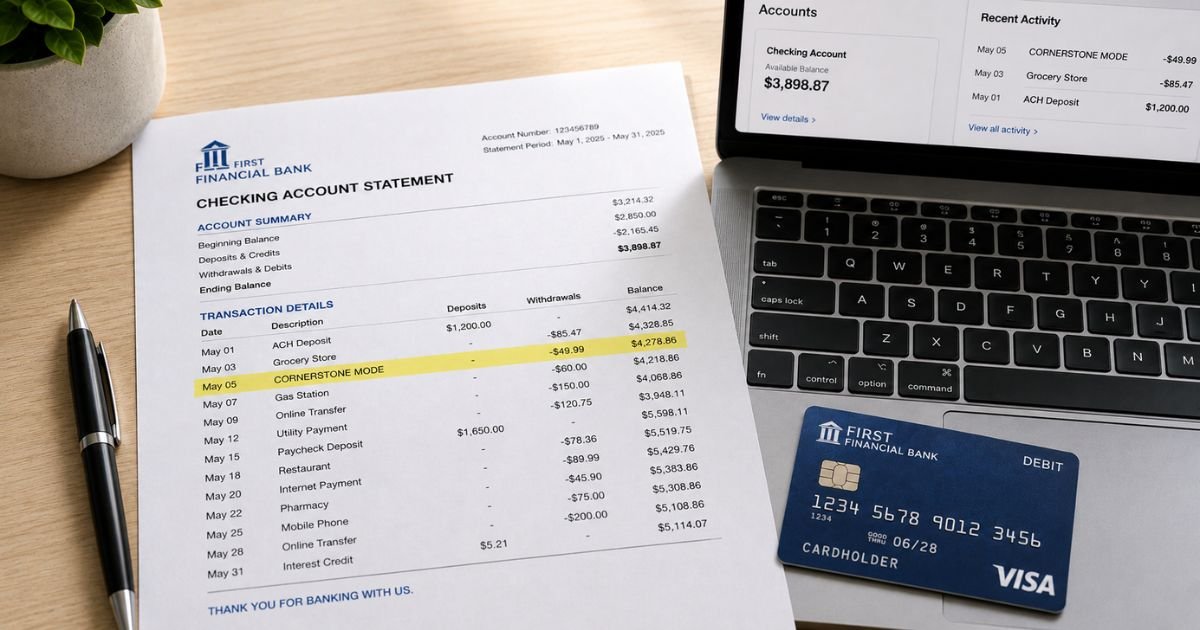
You open your bank or credit card statement and notice a charge labeled “Cornerstone Mode,” “CORNERSTONE MODE,” or a close variation. The name does not immediately ring a bell, and the amount may feel unexpected.
This guide walks you through the most likely explanations, how to verify the charge, and the practical steps to take next.
Table of Contents
What Is a Cornerstone Mode Charge?
“Cornerstone Mode” is not a major consumer-facing company that most people interact with daily. When it appears on a statement, it is often one of the following:
- A billing descriptor used by a business that processes payments through a company named Cornerstone (such as Cornerstone Merchant Services or Cornerstone Payment Systems).
- A charge from a local or niche service that includes “Cornerstone” in its name.
- In some cases, related to software, professional services, or other specialized billing.
Payment processors sometimes use shortened or stylized names on statements. The full merchant name or a phone number may appear alongside “Cornerstone Mode,” or the description may be limited by the bank’s character limits.
Because the descriptor is uncommon in public consumer databases, the most reliable way to identify it is to examine the complete statement line and cross-check with your own records.
Why Did This Charge Appear?
Possible reasons include:
- A purchase or payment at a business that uses Cornerstone as its payment processor.
- A recurring subscription or membership billed under that descriptor.
- A one-time service fee, registration, or professional charge.
- A family member or authorized user making a purchase with the card.
- An automatic renewal you may have overlooked.
Without a widely recognized national brand attached to “Cornerstone Mode,” the charge is most often linked to a specific merchant rather than a broad consumer service.
How to Verify the Charge
Use this checklist:
- Look at the full description on your statement, including any numbers, locations, or additional words.
- Note the exact date and amount.
- Search your email for receipts or confirmations around that date that match the amount.
- Check recent purchases, subscriptions, or services you or a household member may have used.
- Log into online banking and open the transaction details for any extra information the bank provides.
- If a phone number appears on the statement, call it during business hours and ask about the charge (have your statement ready).
Matching the amount and date to a receipt or known purchase usually resolves the question.
Is It Legitimate or Fraud?
Common legitimate scenarios
- Payment processed through a Cornerstone-branded merchant services company
- Charge from a local business, clinic, or service provider
- Recurring or one-time fee you authorized
Warning signs
- No matching receipt or memory of any related purchase
- Multiple unexplained charges with the same descriptor
- The amount seems unusually high for any service you use
- You cannot find any company details after reasonable checking
Because public documentation is sparse, treat unrecognized charges cautiously. Contact your bank if you cannot identify the source.
How to Cancel
Cancellation depends on the underlying merchant:
- Identify the business or service behind the charge using the full statement details and your records.
- Contact that merchant directly to cancel any subscription or recurring billing.
- If it is a one-time charge, request a refund according to the merchant’s policy.
- Ask your bank whether they can provide additional merchant information to help you reach the right company.
There is no single “Cornerstone Mode” customer service number that applies to every charge under this name.
Can You Get a Refund?
Refund options vary:
- Contact the merchant once identified and request a refund if the charge was made in error or can be reversed.
- If the charge is unauthorized, report it to your bank or card issuer promptly.
- Credit cards generally offer stronger dispute protections (often within 60 days of the statement). Debit card reports should be made as soon as possible.
Keep copies of the statement, any emails, and notes from phone calls.
What to Do If the Charge Is Unauthorized
- Review the complete transaction description and search for matching activity.
- Call your bank or card issuer the same day using the number on the back of your card.
- Report the charge as unrecognized and ask them to investigate or open a dispute.
- Request a temporary freeze or replacement card if you suspect broader misuse.
- Change passwords on any accounts that used the payment method.
- Monitor the account closely and document every conversation with dates and reference numbers.
Prevention Tips
- Review bank and credit card statements at least weekly.
- Turn on real-time transaction alerts through your banking app.
- Keep a simple list of active subscriptions and the cards they use.
- Prefer credit cards over debit cards for online or unfamiliar merchants.
- Remove saved card details from websites you no longer use.
- Use virtual card numbers when available for one-time payments.
- Enable two-factor authentication on banking and major accounts.
- Be cautious with free trials or new services that require a card.
Quick Identification Steps
| Step | Action |
|---|---|
| 1. Full descriptor | Read everything after “Cornerstone Mode” |
| 2. Date and amount | Match to receipts or account history |
| 3. Email search | Look for confirmations near the transaction |
| 4. Bank details | Open the transaction in online banking |
| 5. Contact | Call the merchant or your bank if unclear |
Dispute Timeline Overview
| Card Type | Typical Reporting Window |
|---|---|
| Credit card | Often within 60 days of statement |
| Debit card | Report as soon as possible |
| Bank investigation | Varies by institution |
FAQs: Cornerstone Mode Charge on Bank Statement
Q. Is Cornerstone Mode a well-known company?
A. No. It does not appear as a major national consumer brand in public charge databases. It is more likely a billing name used by a specific merchant or payment processor.
Q. Why can’t I find clear information about this charge online?
A. Some descriptors are used by smaller processors or local businesses and do not generate widespread consumer discussion. The most reliable information comes from your own statement and records.
Q. What should I do if the bank cannot identify the merchant?
A. Ask the bank to open a formal dispute or investigation. Provide the exact date, amount, and full description. You can also request a copy of any additional merchant data they hold.
Q. Could this be related to a mutual fund or investment?
A. Some investment products use the name “Cornerstone” (for example, certain Victory funds), but those usually appear differently on statements. Cross-check with any brokerage or investment accounts you hold.
Conclusion
A Cornerstone Mode charge on bank statement is uncommon and not tied to a widely recognized national consumer service. It most often reflects a payment processed under a Cornerstone-related billing name or a specific merchant’s descriptor.
Examine the full statement line, match the amount and date to your records, and contact your bank if the source remains unclear. Prompt action protects your account and helps resolve any unauthorized activity quickly.
Disclaimer: This article is for informational purposes only and is not financial or legal advice. Public information on this specific descriptor is limited. Always confirm details directly with your bank or card issuer.
Meet the Author
