
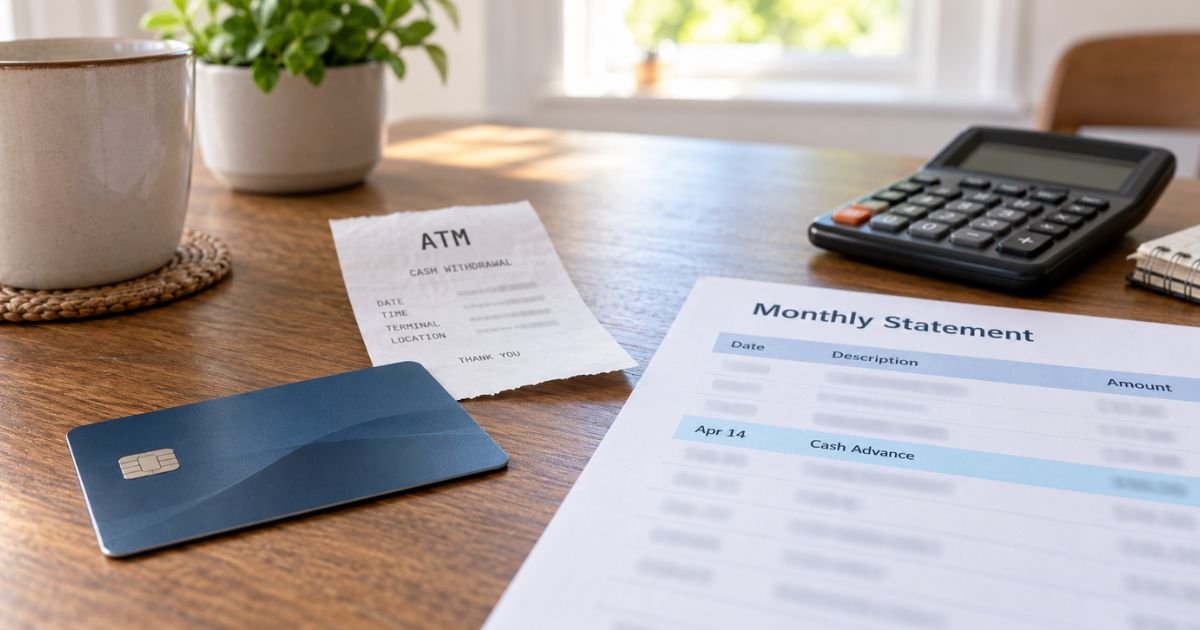
A cash advance charge on a credit card can feel confusing if you don’t recall signing up for anything. Many people first notice it as a separate line on the statement, often next to an ATM visit or a cash-like purchase.
This type of charge is generally a real loan from your card issuer, not a random store. Below, you’ll learn what the line means, what it usually costs, how to verify it, and how to pay it down.
Table of Contents
What Is a Cash Advance Charge on a Credit Card?
A cash advance charge on credit card is the borrowed cash, plus the related fee, that posts when you pull money from your card’s credit line.
You are not withdrawing from a checking account. You are borrowing cash from the issuer and adding it to your card balance.
The Consumer Financial Protection Bureau (CFPB) describes this as a short-term loan. It is typically more expensive than a regular purchase. Interest generally starts the same day, and there is usually no grace period.
Issuers also treat some cash-like buys as cash advances. That can include money orders, lottery tickets, gambling chips, wire transfers, and some person-to-person transfers. Your card agreement decides the category.
How a Cash Advance Shows Up on Your Statement
Your statement generally lists cash advances apart from purchases. You may see words like “CASH ADVANCE,” “ATM CASH,” “ADVANCE FEE,” or the name of the bank or ATM.
Look at three places on the bill:
- The transaction list for the cash amount and any cash advance fee
- The summary box for a separate cash advance balance
- The APR section for the cash advance rate, which is often higher than the purchase rate
You may also see a cash advance credit line. That limit is typically lower than your full credit limit. The CFPB notes that many cards keep a separate, smaller cap for cash advances and convenience checks.
What Transactions Usually Count as Cash Advances
An ATM withdrawal with your credit card and PIN is the most common trigger. You can also get cash at a bank branch that accepts your card network. Some issuers mail convenience checks that work the same way.
Issuers often treat cash-like items as cash advances. Terms vary by card, so confirm yours.
| Transaction type | How it is usually treated |
|---|---|
| ATM cash or bank-teller cash with your credit card | Cash advance |
| Issuer convenience check | Cash advance |
| Money orders, traveler’s checks, foreign currency, wires | Often a cash advance |
| Lottery tickets, casino chips, or wagers | Often a cash advance |
| Some P2P or “send money” transfers | Sometimes a cash advance |
| Everyday store or restaurant purchase | Purchase, not a cash advance |
Capital One’s help pages list several cash-like transfers and purchases as cash advances on its cards. Other issuers use similar lists. Always read your own terms.
Typical Fees, APR, and Why Interest Starts Right Away
A cash advance charge on a credit card usually has three cost layers.
Issuer cash advance fee. Many cards charge about 3% to 5% of the amount, or a flat minimum such as $5 or $10, whichever is greater. Consumer surveys have put the average fee near 4% of the amount withdrawn.
Your exact fee is in the Schumer Box on your agreement.
ATM or bank surcharge. The machine owner may add its own fee. That is separate from the issuer fee.
Cash advance APR. This rate is generally higher than your purchase APR. Many consumer guides place typical cash advance APRs in the mid-20s to around 30%, but your rate may differ.
Interest usually starts the day the advance posts. Paying your purchase balance in full does not stop interest on the cash advance portion. These advances generally earn no rewards.
| Item | Sample figure only |
|---|---|
| Cash taken | $400 |
| 5% issuer fee | $20 |
| Starting cash-advance balance | $420 |
| About 30 days of interest at 29.99% APR | Roughly $10 |
This table is an example, not a quote from your issuer. Your real numbers depend on your card and how long the balance sits.
How to Verify the Charge
Start with the statement date, amount, and location. Then log in to your card account and open the transaction details.
Check these items:
- Did you, or an authorized user, use the card at an ATM or bank that day?
- Does the amount match cash you received, plus a fee line?
- Is there a separate “cash advance fee” posting for the same date?
- Does your statement show a cash advance limit and a cash advance APR?
If the line matches an ATM visit, a convenience check, or a cash-like buy, the charge is typically legitimate.
If you do not recognize the date or location, treat it as a possible billing error. Contact the issuer using the number on the back of your card.
Pro Tip: Your latest statement lists the cash advance APR and cash advance limit. Review that box before you use the card at an ATM.
How Your Payments Get Applied
Federal rules matter here. Under Regulation Z, when you pay more than the minimum on a consumer credit card, the extra amount generally must go first to the balance with the highest APR. Cash advances often sit in that highest-APR bucket.
The minimum payment itself may be applied in a different order. A minimum-only payment can leave the cash advance balance in place longer. If you want the cash piece gone, pay more than the minimum until that segment is $0.
What to Do If You Did Not Take the Advance
If the cash advance is not yours, act quickly.
- Call the number on the back of your card and report the transaction.
- Ask the issuer to freeze or replace the card if the PIN or card may be compromised.
- Follow up in writing if the issuer asks for a billing error notice.
- Review recent ATM activity and any authorized users on the account.
- You can submit a complaint to the CFPB if the issuer does not resolve the issue.
Federal billing-error rules generally give you a window from the statement date to dispute many unauthorized charges. Do not assume a refund, because outcomes vary.
Never share your PIN or full card number with anyone who contacts you first.
Common Mistakes: People often confuse a credit card ATM withdrawal with a debit card withdrawal. A debit card pulls your own bank money. A credit card ATM visit is a loan. Some issuers also code certain app transfers as cash advances.
Safer Ways to Get Cash When You Need It
A cash advance can make sense in a true emergency when no cheaper option exists. For most shortfalls, other paths usually cost less.
- Withdraw cash from a checking or savings account with a debit card.
- Use an in-network ATM to avoid extra machine fees.
- Ask your bank about a small personal loan.
- If bills are the problem, call those companies and request a payment plan first.
FAQs: Cash Advance Charge on Credit Card
Q. Is a cash advance charge on a credit card a scam?
A. Usually no. It is typically a fee and loan posting from your own issuer after an ATM withdrawal, a convenience check, or a cash-like transaction.
It can still be unauthorized if you did not take the cash. Verify the date and location first.
Q. Why did interest start before my due date?
A. Cash advances generally have no grace period. The CFPB notes that interest usually starts as soon as you take the money.
Paying other purchases in full does not pause interest on the cash advance balance.
Q. Can I cancel a cash advance after it posts?
A. You generally cannot cancel a completed cash advance the way you cancel a subscription. You repay it through your card payments.
If the advance was unauthorized, dispute it with the issuer right away.
Q. Will this hurt my credit score?
A. The advance itself is not a separate item on your credit report. The higher card balance can raise utilization, which may lower your score for a time.
Late payments on the account can hurt your score as well.
Conclusion
A cash advance charge on a credit card is usually your issuer recording cash or a cash-like loan against your credit line. Check the date, ATM or merchant detail, fee line, and cash advance APR on your statement.
If the activity is yours, plan to pay more than the minimum so the higher-rate balance shrinks. If it is not yours, contact the issuer using the number on your card and ask about a billing-error review.
Disclaimer: This article is for general information only. It is not financial, legal, or tax advice. Cash advance fees, APRs, limits, and payment rules vary by issuer and by card. Confirm the details on your statement and card agreement, or ask your card company or bank about your account.
Meet the Author
