
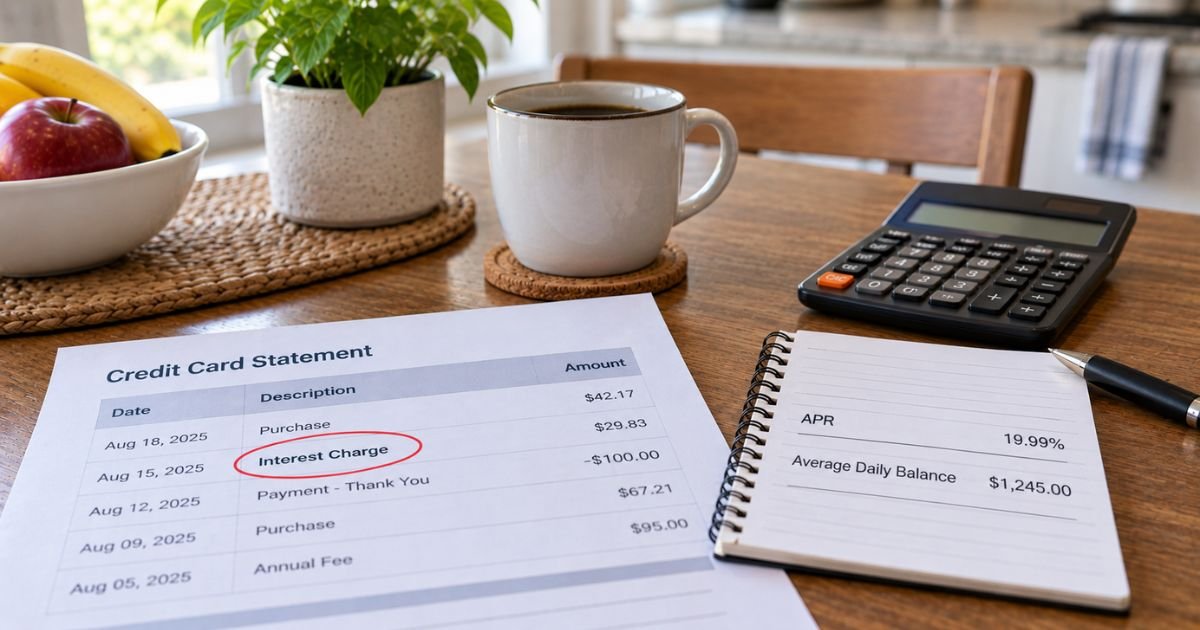
An interest charge on a credit card can feel confusing if you paid last month and still see a new fee. Many people look at the statement balance and assume that one number is what the bank used.
Most of the time the charge is real interest, not a mystery merchant. You can usually estimate it from your APR, your daily balances, and the length of the billing cycle.
This guide walks through the usual math, a simple example, and how to keep the charge at zero.
Table of Contents
How to Calculate an Interest Charge on a Credit Card
An interest charge on credit card is the periodic finance charge for carrying a balance. The Consumer Financial Protection Bureau (CFPB) says many issuers figure that amount daily, using your average daily balance. The daily rate they apply is called the daily periodic rate.
Your statement APR is a yearly number. Issuers convert it to a daily rate, then apply that rate to the balance that was subject to interest each day. If your card has a grace period and you pay the statement balance in full by the due date, purchase interest is typically $0.
The method on your card is in the card agreement. Common names are average daily balance (including new purchases) and daily balance (including current transactions). Your result can differ a little from a hand calculation when the issuer compounds interest daily.
The three numbers you need
Pull these from your latest statement or card agreement.
| Item | Where to find it | What it means |
|---|---|---|
| Purchase APR (or cash APR) | Interest-charge box on the statement | Yearly rate for that balance type |
| Daily periodic rate | Statement or APR divided by 365 or 360 | Daily rate the issuer uses |
| Days in the billing cycle | Statement heading | Usually about 28 to 31 days |
| Average daily balance | Interest-charge section | Sum of each day’s balance, divided by days in the cycle |
The CFPB notes that the daily periodic rate is generally the APR divided by 360 or 365, depending on the issuer. Do not assume every bank uses 365. Capital One’s public help page, for example, describes APR divided by 365.
If your statement already lists a daily periodic rate, use that figure. It is more accurate than a homemade split.
The basic formula
A common estimate is:
Interest charge = average daily balance × daily periodic rate × number of days in the billing cycle
First get the daily periodic rate:
Daily periodic rate = APR ÷ 365 (or ÷ 360, if that is what your issuer uses)
Write the APR as a decimal. An 18% APR is 0.18. Divided by 365, that is about 0.000493, or 0.0493% per day.
Then get the average daily balance:
- Write the balance at the end of each day in the cycle.
- Add a purchase on the day it posts.
- Subtract a payment on the day it posts.
- Add those daily balances.
- Divide by the number of days in the cycle.
That average is not always the “new balance” printed at the bottom of the bill. The new balance is the amount owed on the closing date. Interest looks at every day in the cycle.
A simple worked example
This is a rounded illustration, not a promise that your issuer will land on the same penny.
Assume:
- Purchase APR: 21.99%
- Issuer uses 365 days
- Billing cycle: 30 days
- You started the cycle with a $1,000 unpaid purchase balance
- No grace period this cycle because you did not pay last month in full
- No new purchases or payments
Daily periodic rate = 0.2199 ÷ 365 ≈ 0.0006025
Average daily balance = $1,000
Estimated interest = $1,000 × 0.0006025 × 30 ≈ $18.07
Now change only the timing of a payment. Same APR and 30-day cycle. You start at $1,000 and pay $400 on day 11.
- Days 1–10: $1,000 each day
- Days 11–30: $600 each day
Sum of daily balances = (10 × $1,000) + (20 × $600) = $22,000
Average daily balance = $22,000 ÷ 30 ≈ $733.33
Estimated interest ≈ $733.33 × 0.0006025 × 30 ≈ $13.26
Paying earlier generally lowers the average. The CFPB makes the same point. When interest is already accruing, an earlier payment usually costs less than waiting until the due date.
If the issuer compounds daily, each day’s interest is added to the next day’s balance. Your statement total can run a little higher than this estimate.
Different APRs on one bill
Your statement must show each rate category and the balance in that category. Purchases, cash advances, and balance transfers often have different APRs.
Calculate each bucket separately, then add the interest lines. Cash advances and convenience checks generally start accruing interest on the transaction date. A purchase grace period usually does not cover those items.
If you pay more than the minimum but less than the full balance, federal rules generally require the extra amount to go first to the balance with the highest APR. The issuer generally decides where the minimum portion goes. That allocation changes next month’s interest.
When the interest charge should be $0
Most cards offer a grace period on new purchases. The CFPB defines it as the time between the end of the billing cycle and the due date. If you pay the full statement balance by the due date, you typically owe no purchase interest.
Issuers are not required to offer a grace period. If they do, federal rules require the bill to reach you at least 21 days before the due date.
You can lose the grace period if you carry a balance. Then interest on new purchases generally starts on the purchase date, not after the next due date.
The CFPB notes that paying in full some months and not others can affect the grace period for the month you miss and the following month.
Pay one full statement after that to work toward getting the grace period back. Confirm the exact restore rule in your agreement.
A residual interest line can still appear after you pay in full. That usually covers days between the last statement close and the day your payment posted, if you had been carrying a balance. It should stop once you are current and stay paid in full.
Some agreements also list a minimum interest charge, often a small flat amount if any interest is due. If your calculated interest is $0.40 and the minimum is $1.00 or $2.00, the statement may show the minimum instead.
Pro Tip: Use the statement’s “Balance subject to interest rate” line, not the new balance, when you check the bank’s math. That subject-to-interest figure is the average daily balance the issuer says it used.
How to check your issuer’s math
- Find the interest-charge section and the days in the cycle.
- Confirm which method the agreement names.
- Recalculate one category, usually purchases.
- Allow a small gap for daily compounding and rounding.
- Call the number on the card if the gap is large.
Federal rules also limit an old two-cycle method after you lose a grace period. Your issuer should not reach back and re-price the prior cycle that way in those cases.
If the line is not labeled interest or finance charge, it may be a late fee, annual fee, or foreign-transaction fee. Those are separate from the periodic interest calculation.
Common Mistakes: People divide APR by 12 and multiply by the statement balance. That skips daily balances and the actual cycle length. Others pay only the minimum and expect purchase interest to stay at zero. The grace period generally requires the full statement balance, not the minimum.
FAQs: Interest Charge on a Credit Card
Q. What is the fastest way to calculate an interest charge on a credit card?
A. Divide the APR by 365 or 360 to get the daily periodic rate. Multiply that rate by the average daily balance and by the number of days in the cycle. Use the daily rate printed on the statement when you have it.
Q. Why is my interest not APR times the balance divided by 12?
A. Cards generally price interest by the day, not by a flat monthly slice of the closing balance. Purchases and payments in the middle of the cycle change the average. Daily compounding can add a little more.
Q. Do cash advances use the same interest math?
A. The same style of daily-rate math usually applies, but the cash APR is often higher. Interest generally starts on the day of the advance. A purchase grace period typically does not wipe out cash-advance interest.
Q. How do I avoid an interest charge next month?
A. If your card has a grace period, pay the full statement balance by the due date. That generally keeps purchase interest at zero. Pay cash advances as soon as you can, because those balances usually accrue from day one.
Conclusion
You can calculate an interest charge on a credit card from three pieces: the APR turned into a daily periodic rate, the average daily balance, and the days in the billing cycle. Many issuers follow that CFPB-described approach, with small differences for compounding and for cash or transfer APRs.
Pay the statement in full by the due date when you have a grace period, and the purchase interest charge is typically $0.
Disclaimer: This article is for general information only. It is not financial or legal advice. Interest methods, day-count rules, grace periods, and minimum interest charges vary by issuer and account. Use your statement and card agreement, or ask your issuer, before you rely on any estimate or dispute a charge.
Meet the Author
