
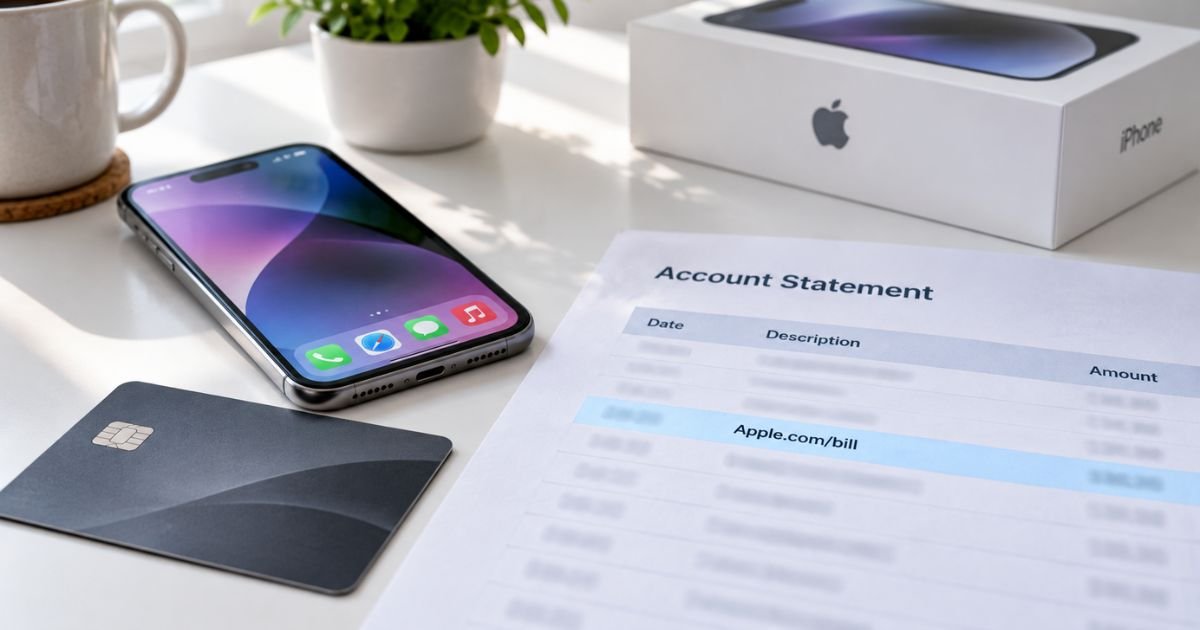
Apple charges on a credit card can feel confusing if you don’t recall signing up for anything. The line may say apple.com/bill, iTunes, Apple Store, or Apple Cash.
Most of these charges are legitimate bills from Apple Inc. They often cover apps, subscriptions, media, or a store purchase.
This guide shows you how to match the line, cancel a renewal, and respond if the charge is not yours.
Table of Contents
What Are Apple Charges on a Credit Card?
Apple charges on credit card are payments that Apple posts to the card saved on your Apple Account, or to a card you used in a store or on apple.com. Apple is a real U.S. company based in Cupertino, California.
The same company can print different words on your statement. Banks shorten the merchant name to fit. That is why one month may say APPLE.COM/BILL and another may say APPLE STORE or APPLE SERVICES.
Apple’s own help pages say apple.com/bill can appear when you buy apps, music, movies, or other content. It can also appear when a subscription renews, or when a family member buys through Family Sharing.
How Apple Charges Appear on Your Statement
Your issuer, not Apple’s marketing team, writes the short merchant line. Wording varies.
| Statement wording you might see | What it often means |
|---|---|
| APPLE.COM/BILL, itunes.com/bill, or APPLE COM ONE | Apps, media, in-app buys, or subscription renewals |
| APPLE STORE #R and numbers | A specific Apple Retail Store |
| APPLE CASH, SENT MONEY, or BALANCE ADD | Apple Cash send, receive, or reload activity |
| APPLE SERVICES | Digital purchases grouped on Apple Card |
| 1 INFINITE LOOP CA or CUPERTINO CA | Apple’s campus address used as the merchant location |
| APPLECARD GSBANK | Usually a payment you made on Apple Card, not an App Store buy |
Apple may group several small buys into one larger charge. You might not get a separate email for each item. The grouped total can show up a few days later.
A tiny pending amount can also appear when you add a card or add someone to Family Sharing. Apple says that kind of hold is temporary. Your bank usually drops it after a short time.
Common Reasons You See the Charge
Apple subscriptions. Apple Music, Apple TV, iCloud+, Apple Arcade, Apple Fitness+, Apple News+, Apple One, and AppleCare plans can renew each month or year. Prices vary by plan and by tax. Confirm your live price in Settings.
App Store and in-app purchases. A game, photo app, or streaming app can bill through Apple even if the brand is not Apple. Deleting the app does not cancel that bill.
Media and books. Movies, TV episodes, songs, and books can post as a one-time Apple charge.
Family Sharing. If Purchase Sharing is on, the family organizer’s card can pay for a child’s or partner’s buys.
A second Apple Account. An old iPad, work phone, or forgotten email login may still have your card on file.
Hardware or Apple Cash. A case, cable, or device often shows a store number or apple.com. Sending money in Wallet, adding cash, or moving a balance can create an Apple Cash line instead.
How to Verify an Apple Charge
Start with Apple’s own records, not a pop-up or a random phone number.
- Search your email for “receipt from Apple” or “invoice from Apple” around the charge date.
- Go to reportaproblem.apple.com and sign in with your Apple Account.
- Open each purchase date to see the full receipt, including tax.
- If you use Family Sharing, switch the Apple Account menu to each family member.
- On iPhone or iPad, check Purchase History under your name in Settings.
- Match the last four digits of the card on the receipt to your statement.
If the dollar amount still looks off, add the items from that day. Grouped purchases often explain a total that does not match one app.
Also check every Apple Account that may hold your card. Apple’s help pages say an unrecognized bill is sometimes from a second account.
Pro Tip: Some banks now show a “View Receipt” link next to App Store and iTunes charges. Open that link in your bank app before you call anyone.
How to Cancel an Apple Subscription
Cancel in the Apple Account that owns the plan. Apple’s official path on iPhone or iPad is:
- Open Settings and tap your name.
- Tap Subscriptions.
- Tap the plan you want to stop.
- Tap Cancel Subscription and confirm. You may need to scroll to see the button.
You can also manage plans at account.apple.com after you sign in. On a Mac, open the App Store, then Account Settings, then Subscriptions.
Cancel at least a day before the next renewal date when you can. Apple generally lets you keep the paid period until it ends. Check the next statement to confirm.
If the receipt shows a family member’s Apple Account, that person has to cancel. You cannot cancel their plan from your login.
If you cannot find the plan in Apple Subscriptions, the merchant may have billed you directly. Then you cancel with that company, not Apple.
Common Mistakes: People delete an app and think the subscription is gone. The bill keeps renewing until you cancel it in Subscriptions. Another mix-up is treating APPLECARD GSBANK as an App Store buy. That line is typically a payment toward Apple Card.
What to Do If You Still Do Not Recognize It
Work through this list before you assume fraud.
- Ask household members and anyone who uses your devices.
- Sign in to reportaproblem.apple.com with every Apple Account you have used.
- Change your Apple Account password if you suspect a stranger used it.
- Review devices listed on your account and remove ones you do not recognize.
- Turn on purchase approval for kids if you use Family Sharing.
- Request a refund at reportaproblem.apple.com if the item is eligible. Apple reviews requests and does not promise every refund.
- If the charge is not in any Apple history, call the number on the back of your card and ask your issuer about a billing error.
Watch for scams. Fake sites and texts may claim an Apple Pay charge and tell you to call a number on the screen. Use support.apple.com or the Support app instead.
Never give a one-time code, remote access, or gift cards to someone who contacted you first. A real apple.com/bill line is usually Apple billing. A fake pop-up that only copies Apple’s logo is not the same thing.
Apple Card Lines Versus App Store Lines
These two Apple labels are easy to mix up. Apple Card is a credit card issued with Goldman Sachs. A payment you send to that card often shows as APPLECARD GSBANK on a bank account.
That line is usually you paying the card bill. Apple Services or apple.com/bill on Apple Card is different. That is Apple charging the card for apps, media, or renewals.
In Wallet, you can tap the Apple Services line twice to see what was bought. For apps and subscriptions, use Apple’s refund page.
FAQs: Apple Charges on Credit Card
Q. Are Apple charges on a credit card a scam?
A. Usually no. Apple Inc. is a legitimate company, and apple.com/bill is its common digital billing label. A charge can still be unauthorized if someone used your Apple Account or card.
Compare the statement with reportaproblem.apple.com first.
Q. Why is the amount bigger than one app?
A. Apple often groups several purchases into one charge. The emailed receipt and the purchase-date view show the split.
Tax and a family member’s buy can also raise the total. Open the full receipt, not just the statement nickname.
Q. How do I stop future Apple charges on a credit card?
A. Cancel each subscription in Settings or at account.apple.com. Then remove the card under Payment & Shipping if you no longer want Apple to keep it on file.
Removing the card does not always cancel an active plan. Cancel first, then update payment methods.
Q. Can I get a refund from Apple?
A. App Store and iTunes purchases may be eligible. Sign in at reportaproblem.apple.com and choose Request a refund.
Apple decides case by case. Keep screenshots of the receipt and your statement while you wait.
Conclusion
Apple charges on a credit card are usually Apple billing for apps, media, store goods, Apple Cash, or a subscription renewal. Match the date and amount to your Apple receipts, including Family Sharing and any second account.
If the plan is yours and you want it gone, cancel it in Subscriptions. If the activity is not yours, use Apple’s report tools and the number on the back of your card.
Disclaimer: This article is for general information only. It is not financial, legal, or tax advice. Apple billing labels, refunds, and subscription rules can vary by account, device, and issuer. Confirm the details in your Apple Account and with your card company or bank.
Meet the Author
