
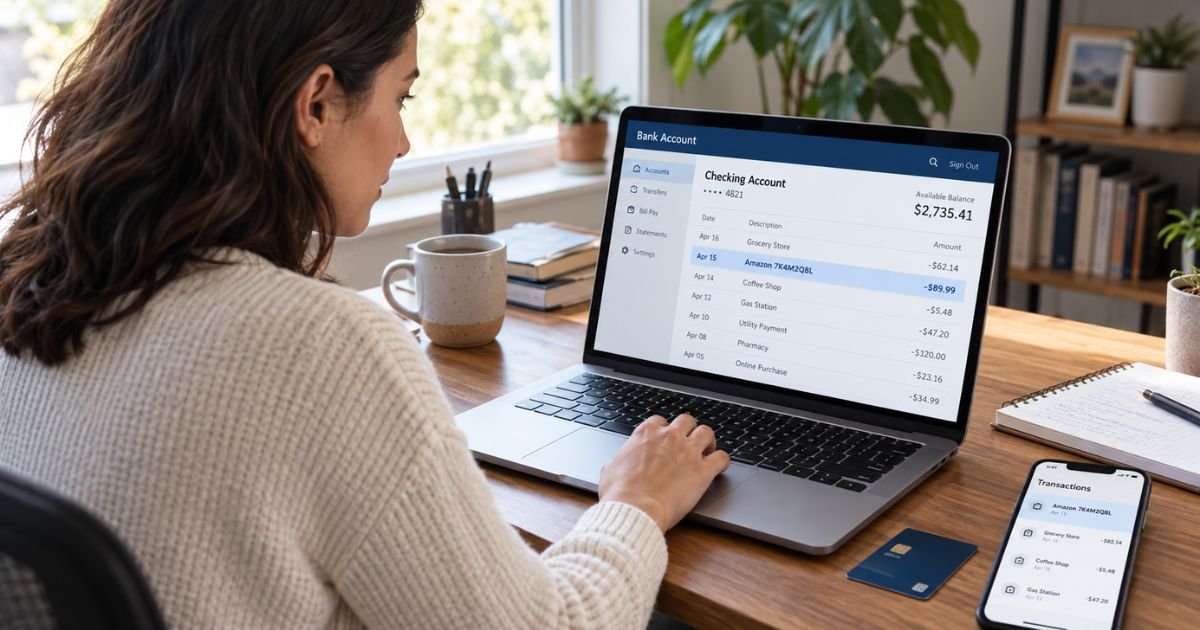
An Amazon Charge ID on Bank Statement can feel confusing if the amount doesn’t match an order you remember placing. The extra letters or numbers are generally transaction information that can help connect the bank charge with an Amazon purchase or payment.
An unfamiliar Amazon charge is often legitimate, but you should still investigate anything you cannot match. Here’s how charge IDs work, where to check your Amazon transactions, and what to do if the payment isn’t yours.
Table of Contents
What Is an Amazon Charge ID on Bank Statement?
An Amazon Charge ID on Bank Statement is generally a unique reference associated with a payment processed by Amazon. It can help distinguish one Amazon card transaction from another.
The charge identifier is not necessarily the same as your Amazon order number. One order may also produce multiple charges if Amazon ships items separately.
Your statement may show Amazon wording followed by letters, numbers, or both.
| Statement Description | What It May Mean |
|---|---|
| AMAZON MKTPLACE PMTS | Amazon marketplace purchase |
| AMZN Mktp US plus ID | Amazon.com merchandise transaction |
| AMAZON PRIME plus ID | Prime membership payment |
| AMAZON DIGITAL SVCS | Amazon digital product or subscription |
| AMAZON.COM PMT SVC | Amazon Pay transaction |
| AMAZONFRESH | Amazon Fresh order |
| Amazon plus alphanumeric code | Transaction or charge reference |
The exact wording depends on the transaction and your bank. Your banking app may also display more information than your monthly statement.
Is the Amazon Charge ID the Same as an Order Number?
Generally, no. Your Amazon order number identifies the order you placed, while a charge identifier relates to the payment.
This difference matters because Amazon does not always charge the entire order at once.
For example, you might order three products together. If they ship at different times, Amazon may create separate card charges.
You could therefore have one order number but several payment transactions.
Amazon Business also uses a Charge Identifier to help customers reconcile individual credit or debit card charges with orders and shipments.
Pro Tip: Don’t compare an unknown Amazon charge only with the total shown on your original order. Check individual shipments and Amazon’s transaction history because one order may be split into several charges.
How to Find the Amazon Order Behind a Charge
Start with your Amazon account rather than trying to decode the statement descriptor yourself.
Open your Amazon account and review Your Transactions. Compare the transaction amounts and dates with your bank statement.
You should also review:
- Your Orders
- Digital Orders
- Prime membership
- Memberships and subscriptions
- Amazon Pay activity
- Amazon Fresh orders
- Archived orders
The transaction date on your bank account may not exactly match the day you placed the order.
Amazon commonly charges for physical products when they ship. An item ordered several days or weeks earlier may therefore explain a newer charge.
Why Doesn’t the Charge Match Your Amazon Order Total?
Split shipments are one of the most common explanations.
Suppose you place a $90 order containing three items. Amazon might ship one item for $20, another for $30, and the last for $40.
Instead of one $90 transaction, your statement may show three separate charges.
Other reasons amounts may look different include:
- Partial shipments
- Backordered products
- Separate sellers
- Taxes
- Promotional credits
- Gift card balances
- Refunds
- Order changes
- Canceled items
Check the payment breakdown for the order before assuming the amount is wrong.
What Does Amazon Marketplace Mean on a Bank Statement?
A descriptor such as AMAZON MKTPLACE PMTS or AMZN Mktp US generally relates to an Amazon.com merchandise purchase.
The seller may be Amazon itself or a third-party seller using Amazon’s marketplace.
The statement usually does not display the name of the individual product you purchased.
That can make ordinary Amazon shopping look unfamiliar, especially if you place many orders.
Compare the statement amount with Amazon’s transaction history rather than relying only on your recent orders page.
What Is an Amazon Digital Charge?
A descriptor such as Amazon Digital Svcs generally indicates a digital purchase or subscription.
Possible examples include:
- Kindle books
- Prime Video purchases
- Prime Video Channels
- App purchases
- Software or game downloads
- Other Amazon digital services
Digital subscriptions can renew separately from Amazon Prime.
This means you may recognize your annual or monthly Prime payment but still see another Amazon charge for a digital subscription.
Check your Digital Orders and active subscriptions if the descriptor includes “Digital.”
Could the Charge Be Amazon Prime?
Yes. Amazon Prime memberships generally renew monthly or annually depending on your plan.
A Prime payment may appear with wording that includes Amazon Prime, AMZ Prime, or similar terminology.
Check your Prime membership settings for your renewal date and payment method.
You should also check other Amazon accounts you use. A card saved on an older account may still be paying for a Prime membership you forgot about.
What Is Amazon.com PMT SVC?
Amazon payment-service wording may be related to Amazon Pay rather than an ordinary Amazon.com order.
Amazon Pay lets you use payment information stored in your Amazon account with participating third-party merchants.
This can create a charge that looks like Amazon even though you bought something from another website.
If you see payment-service wording, review your Amazon Pay activity. Look for the same transaction amount and approximate date.
The merchant’s actual business name may be available within the transaction details.
Could It Be a Temporary Authorization?
Yes. Not every Amazon entry displayed by your bank is a completed charge.
Amazon may contact your bank to verify that your payment method is valid and that funds or credit are available. Your bank may show that authorization as pending.
A pending authorization may later disappear or be replaced by the final transaction.
Avoid counting both entries as separate purchases unless both actually post.
If a pending transaction remains for an unusually long time, your bank can explain its hold policy.
Why Is There an Amazon Charge but No Order?
Several situations can cause this.
First, check whether you have another Amazon account. Many consumers have created accounts using old email addresses or phone numbers.
Then consider whether:
- A household member used your card.
- An order was archived.
- A subscription renewed.
- A digital item was purchased.
- Amazon Pay was used.
- An older or backordered item finally shipped.
- The transaction is still pending.
Consumer discussions on Reddit frequently describe people finding mystery Amazon charges under another account, a family member’s purchase, or an older shipment.
Those reports are anecdotal. Your Amazon and bank transaction records should be your primary evidence.
How to Use the Charge ID When Contacting Amazon
Keep the complete statement description available when you contact Amazon about an unknown transaction.
Do not post the full descriptor publicly. Transaction identifiers can contain information that is more useful to Amazon support than to people on a public forum.
You should generally have:
- The charge amount
- Transaction date
- Full Amazon descriptor
- Charge or transaction reference
- Last four digits of the payment card
- Your Amazon account details
Amazon support may use available transaction information to help identify the payment.
Never provide your online banking password, full debit card PIN, or one-time security code.
What If the Amazon Charge Is Not Yours?
If you cannot find the transaction after checking your Amazon accounts, subscriptions, Amazon Pay activity, and household users, treat it as potentially unauthorized.
Contact Amazon through its official website or app.
If Amazon cannot identify or resolve the transaction, contact your bank or card issuer promptly.
Your bank may recommend:
- Locking the card
- Disputing the transaction
- Replacing the card
- Reviewing other recent activity
- Blocking additional unauthorized payments
The exact dispute process depends on whether you used a credit card, debit card, or bank account.
Common Mistakes: Don’t assume every Amazon descriptor is an ordinary merchandise order. Prime, digital subscriptions, Amazon Pay, Fresh, authorizations, and split shipments can all create separate transactions.
What BBB, Trustpilot, and Reddit Reports Show
Amazon billing complaints appear across consumer review sites and forums.
Common themes include difficulty matching statement charges to orders, subscription renewals, duplicate-looking authorizations, and charges consumers say they could not find in their account.
Some consumers report resolving the issue after checking transaction history rather than their main order list. Others report needing help from Amazon or their bank.
These individual reports do not prove that your transaction is incorrect. Always investigate your own account records before filing a fraud claim.
How to Make Amazon Charges Easier to Track
If you buy from Amazon frequently, reviewing individual transactions can prevent confusion at the end of the month.
You can also:
- Turn on bank transaction alerts.
- Keep Amazon order emails.
- Review digital subscriptions regularly.
- Check annual Prime renewal dates.
- Remove old payment cards.
- Close unused Amazon accounts when appropriate.
- Ask household members before disputing a charge.
- Review transactions before your bank statement closes.
Business customers may also benefit from Amazon’s reconciliation tools, which provide charge identifiers designed to match individual payments with orders.
FAQs: Amazon Charge ID on Bank Statement
Q. What is the ID after an Amazon charge on my bank statement?
A. It is generally a transaction or charge reference associated with the Amazon payment. It may help distinguish the charge from other Amazon transactions, but it is not necessarily your Amazon order number.
Q. How do I match an Amazon bank charge to an order?
A. Check Your Transactions in your Amazon account and compare amounts and dates. Also review individual shipments, Digital Orders, Prime subscriptions, Amazon Pay activity, and other Amazon accounts you use.
Q. Why did Amazon charge me separately for one order?
A. Amazon may charge items as they ship. One order containing products shipped at different times can therefore result in several separate bank transactions.
Q. What should I do if I cannot find an Amazon charge anywhere?
A. Check other Amazon accounts and ask authorized card users first. If the transaction remains unknown, contact Amazon and your bank promptly because the payment may be unauthorized.
Conclusion
An Amazon Charge ID on Bank Statement is generally a payment reference that helps identify a specific Amazon transaction.
The related charge may come from merchandise, Prime, a digital service, Amazon Pay, Amazon Fresh, a split shipment, or a temporary authorization.
Start with Amazon’s transaction history and compare the amount with individual payments rather than only looking at order totals.
If you cannot identify the transaction after checking every relevant account, contact Amazon and your bank promptly to investigate or dispute the charge.
Disclaimer: This article is for informational purposes only and isn’t financial or legal advice. Amazon billing practices, bank statement descriptions, subscription terms, and dispute procedures may vary, so verify account-specific questions directly with Amazon or your bank.
Meet the Author
