
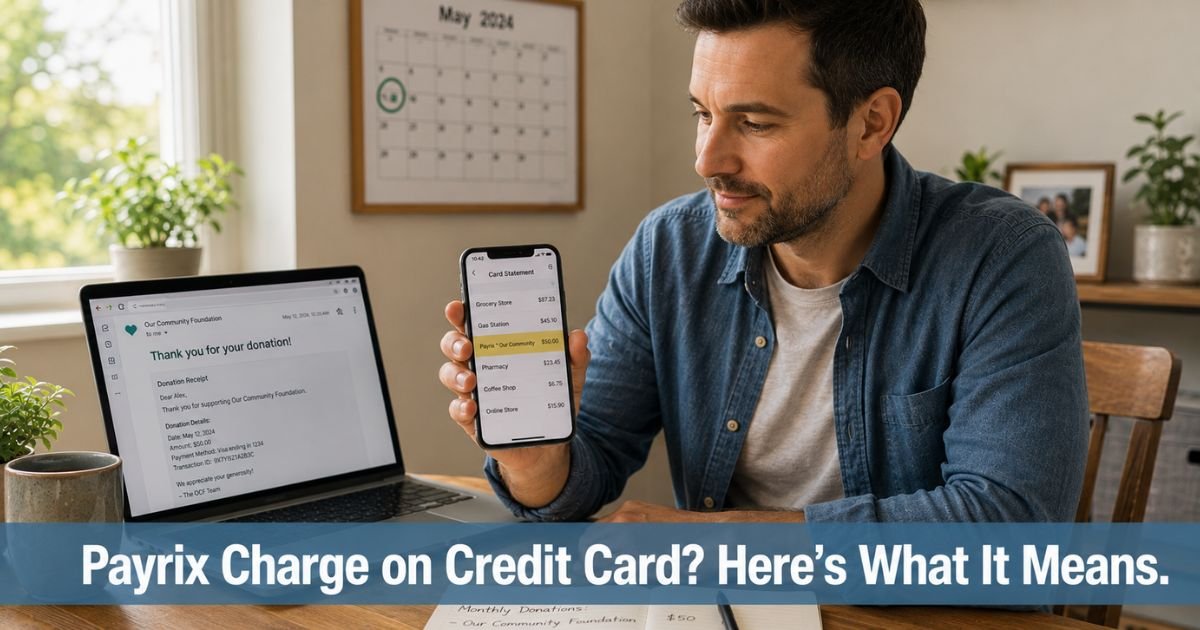
You open your credit card statement and notice a charge from Payrix that you do not immediately recognize. The name does not ring a bell, and for a moment you wonder what you purchased or donated to. This exact situation happens to plenty of people who pay invoices, memberships, or donations online.
A Payrix charge on credit card almost always comes from a legitimate payment you made through a business or organization that uses Payrix as their payment processor.
This guide explains exactly what the charge means in plain terms, the most common reasons it shows up, and the straightforward steps to match it to your own activity.
Table of Contents
What Is Payrix?
Payrix is a payment processing platform that helps businesses and organizations accept credit card and other payments. It operates as a payment facilitator, often under or in partnership with Worldpay for Platforms.
Many companies integrate Payrix into their own websites or software so customers can pay invoices, donations, event fees, or recurring bills directly.
Because Payrix works behind the scenes for the actual merchant, the charge on your statement usually shows as “Payrix,” “Payrix * [business or organization name],” or sometimes simply “Worldpay.” You never signed up directly with Payrix. You paid the business or group that chose Payrix to handle their card processing.
This setup is common with nonprofits accepting donations, small service businesses sending invoices, membership organizations collecting dues, or software platforms processing subscriptions. The convenience is real for the merchant, but the processor name can surprise customers later.
Why a Payrix Charge Appears on Credit Card
Several everyday situations trigger these charges. You will usually recognize one once you think back:
- You paid an invoice from a freelancer, contractor, or small business that uses Payrix for online payments.
- You made a donation to a nonprofit or charity that processes contributions through Payrix.
- You paid membership dues, event registration fees, or recurring bills through a platform that uses Payrix.
- You bought a product or service from a company whose checkout system runs on Payrix technology.
The charge can be one-time or recurring. If it repeats monthly or yearly, it usually ties to a subscription, membership, or ongoing service agreement you set up with the end merchant.
Example
Take Michael, who supports a local animal rescue. He made a one-time donation through their website and received a confirmation email. Two weeks later he spotted a $75 charge labeled “Payrix” on his credit card statement.
At first he felt uneasy because he did not recognize the name. He searched his email, found the donation receipt, and saw that the rescue used Payrix to process the payment.
The date and amount matched perfectly. He realized it was simply his donation processed through their payment system.
How to Verify the Payrix Charge Yourself
You can usually confirm the charge in just a few minutes with these steps:
- Search your email for recent messages containing “receipt,” “invoice,” “donation,” “payment confirmation,” or the name of any business or nonprofit you recently supported.
- Compare the exact date, amount, and any reference number on your credit card with the details in the email.
- Check your browser history or saved receipts for websites where you entered card details around that date.
- If the charge looks recurring, review any memberships, subscriptions, or automatic payment setups you have active.
Pro Tip: The next time you pay an invoice or make a donation online, forward the confirmation email to a dedicated “receipts” folder or label it right away. It takes seconds and makes matching future charges much faster.
If nothing matches after a thorough search, contact the business or organization you think you paid. They have the full transaction record and can usually confirm the details or issue a refund quickly.
What to Do If You Do Not Recognize the Charge
Most unrecognized Payrix charges turn out to be legitimate payments to a business or nonprofit you simply forgot about. Start by checking with family members who might share the card or handle household donations and bills.
If you still cannot match it, reach out to the merchant first. Provide the date and amount from your statement. Most organizations will look up the transaction and help resolve it.
For recurring charges you no longer want, cancel directly with the business or organization that set up the subscription or membership. Payrix itself does not manage customer relationships or cancellations. The end merchant handles that.
If the merchant does not respond or you believe the charge is completely unauthorized, dispute it with your credit card issuer. Provide the dates and your attempts to investigate. Most issuers will investigate while protecting your account.
Common Mistake: Some people see an unfamiliar Payrix charge and immediately assume fraud without checking their recent donations, invoices, or memberships first. Always search your email and recent activity before disputing. A quick check usually reveals the legitimate source and avoids unnecessary disputes.
How to Avoid Surprise Payrix Charges Going Forward
You cannot control every processor name that appears on statements, but you can reduce surprises:
- Turn on transaction alerts in your credit card app so you see charges the same day they post.
- When you pay an invoice or donation online, save or forward the confirmation immediately.
- Review recurring subscriptions and memberships a couple of times a year and cancel any you no longer use.
- Before entering card details on a new site, glance at the confirmation page for the processor name if it shows one.
These small habits keep you informed without much extra effort.
| Charge Description on Statement | Most Likely Meaning | Quick Verification Step |
|---|---|---|
| Payrix or Payrix * [Name] | Payment processed for a business or nonprofit | Search email for recent invoice, donation, or receipt |
| Worldpay via Payrix | Transaction through Worldpay-powered platform | Check browser history or saved confirmations |
| Payrix + recurring amount | Subscription, membership, or ongoing bill | Review active memberships and cancel with merchant |
| Payrix + small business or charity name | Invoice or donation payment | Contact the business or organization directly |
Source: Payrix payment processing descriptions and common consumer reports.
FAQs: Payrix Charge on Credit Card
Q. How do I find out which business caused the Payrix charge on my credit card statement?
A. Search your email for recent receipts, invoices, or donation confirmations around the charge date. Look for messages that mention payment or include a link to a receipt. If you still cannot match it, contact the business or nonprofit you think you paid and provide the date and amount. They can usually identify the transaction right away.
Q. Is a Payrix charge on my credit card legitimate or could it be fraud?
A. In the great majority of cases it is a legitimate payment processed through Payrix for a business, nonprofit, or platform you interacted with. Payrix serves as the behind-the-scenes processor for many organizations. Still, always verify by checking your email and recent activity first. If nothing matches, contact the merchant or dispute the charge with your card issuer.
Q. How can I stop recurring Payrix charges or get a refund?
A. Cancel directly with the business or organization that set up the recurring payment. Payrix does not handle customer subscriptions or cancellations. Ask the merchant for a refund of any unused portion if applicable. Keep written confirmation of the cancellation. If they do not respond, dispute the recurring charges with your credit card issuer and provide your documentation.
Conclusion
You now have a clear picture of what a Payrix charge on credit card usually means and how to handle it with confidence. Most of the time it simply reflects a payment you made to a business or organization that chose Payrix to process their cards.
Check your email and recent activity first, cancel recurring charges directly with the merchant, and save those quick confirmations going forward. If another unfamiliar charge appears, you will know exactly where to start.
Disclaimer: The content on ExplainCharges.com is for informational and educational purposes only and does not constitute financial, legal, or professional advice. We are not affiliated with any companies or services mentioned. The information provided may not apply to your specific situation. If you suspect unauthorized charges or fraud, contact your bank or credit card issuer immediately. Always verify details directly with the source and consult a qualified professional if needed.
Meet the Author
