
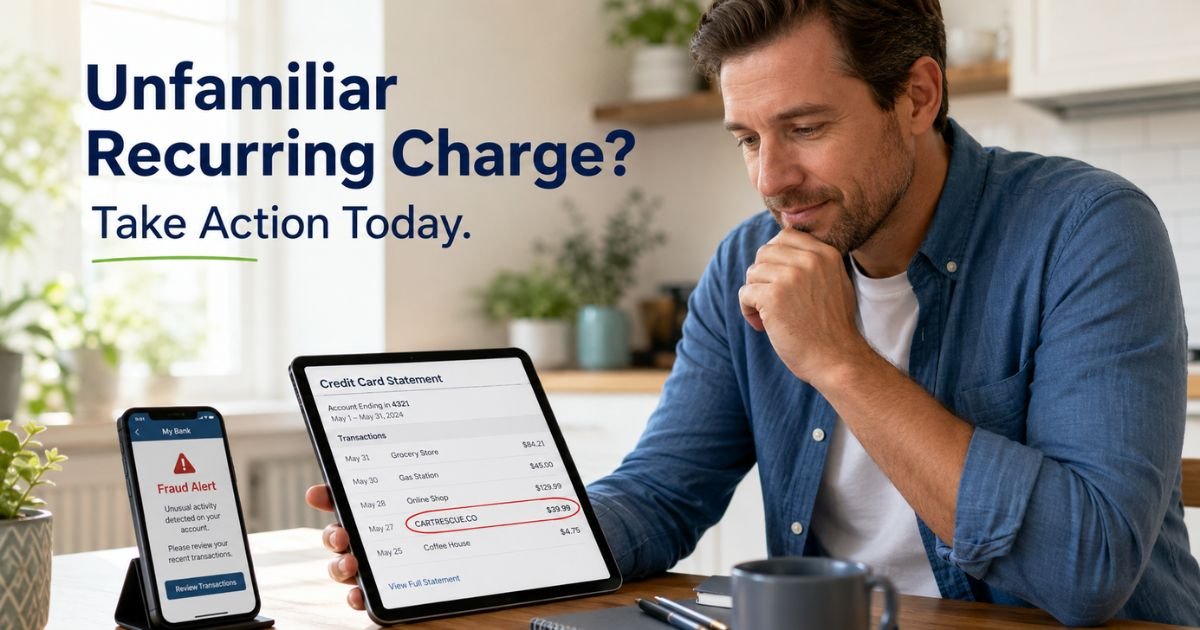
You check your credit card statement and spot a charge from CartRescue or cartrescue.co for about forty dollars. It does not match anything you remember buying, and the name feels completely unfamiliar.
Many people report seeing this exact charge repeatedly, even after contacting the company.
This guide explains what the CartRescue charge on credit card statements usually represents, why it appears, and practical steps to dispute it and prevent future billing.
Table of Contents
What Is the CartRescue Charge on Credit Card Statements?
CartRescue operates cartrescue.co and positions itself as a service that helps online merchants recover failed payments and abandoned transactions.
On consumer statements the charge typically appears as “CARTRESCUE.CO,” “CARTRESCUE CO XXX-XX01570 UT,” or a similar variation.
The most common amount reported is $39.99, and many people describe it as a recurring monthly charge.
While the company focuses on business tools for eCommerce stores, numerous cardholders report never signing up for any service and still receiving these charges.
Why Does the CartRescue Charge Keep Appearing?
Several patterns emerge from consumer reports. Some people notice the charge after shopping on various online stores, while others have no connection at all to the company.
In many cases the charge continues even after individuals call and request cancellation.
The company provides phone numbers such as 844-738-4915 and others like 844-630-1570 for support. However, people often report difficulty getting the recurring billing stopped permanently through the merchant alone.
This is why working directly with your credit card issuer is usually the most effective route.
How to Stop and Dispute the CartRescue Charge
Act quickly when you see an unfamiliar recurring charge. Follow these steps in order:
- Note the exact date, amount, and full descriptor on your statement.
- Call the customer service number on the back of your credit card immediately.
- Explain that you do not recognize the CartRescue charge and did not authorize any subscription or purchase.
- Request that the charge be disputed and that future payments from this merchant be blocked.
- If you have already contacted the company, mention the date and outcome of that conversation.
- Ask for written confirmation of the dispute and any block placed on the account.
Most issuers investigate these disputes promptly and often remove recent charges while the review takes place.
Take a 45-year-old teacher who noticed a $39.99 CartRescue charge on his statement. He called the company first and was told the charge would stop, yet it appeared again the following month. He then contacted his credit card issuer, disputed the charge as unauthorized, and requested a permanent block. The issuer removed the fee and stopped future attempts within days.
What to Expect When You Dispute the Charge
Your card issuer will typically issue a provisional credit while investigating. The process often takes 30 to 90 days. Providing clear details that you never signed up for the service strengthens your case.
You can also try reaching the company at one of their listed numbers, but many people find the issuer route faster and more reliable for stopping recurring billing.
Pro Tip: Freeze or lock your card through your bank’s app or website as soon as you notice an unauthorized recurring charge. This prevents additional attempts while you work on the dispute and request a new card if needed.
CartRescue Charge Quick Reference
| Action | Details | Why It Helps |
|---|---|---|
| Review your statement | Record date, amount, and full merchant name | Gives you exact information for the call |
| Call your card issuer | Use the number on the back of your card | Starts the official dispute process |
| Request a block | Ask them to block future CartRescue charges | Prevents repeat billing immediately |
| Get written confirmation | Request email or letter confirming the block | Creates a record if issues continue |
| Consider a new card | Request replacement if charges persist | Adds extra protection against further attempts |
Bottom line: Contacting your credit card issuer directly is the most reliable way to remove the CartRescue charge and stop it from recurring.
Common Mistake: Relying only on the merchant to stop the charges. When recurring billing continues after a cancellation request, going straight to your credit card issuer gives you stronger protection and faster results.
FAQs: CartRescue Charge on Credit Card
Q. How do I stop recurring CartRescue charges on my credit card?
A. Call the customer service number on the back of your card and report the charge as unauthorized. Ask them to dispute recent charges and place a permanent block on future payments from CartRescue or cartrescue.co. Many issuers handle this quickly when you explain you never signed up for the service.
Q. Will disputing the CartRescue charge get my money back?
A. In most cases yes, especially for recent charges. Credit card issuers usually remove unauthorized recurring fees during the investigation when you clearly state you did not authorize the subscription or purchase. Keep records of your request for best results.
Q. Why does the CartRescue charge keep coming back even after I asked them to stop?
A. Many people report that contacting the company alone does not always end the recurring billing. When this happens, working with your credit card issuer to dispute the charge and block the merchant provides stronger and faster protection against future attempts.
Conclusion
You now understand that the CartRescue charge on credit card statements is one many people dispute successfully when they act promptly.
The key steps are calling your issuer, clearly stating you did not authorize the charge, and requesting both a dispute and a future block.
Most issuers resolve these situations efficiently when you provide straightforward details. Enable transaction alerts on your account, review statements regularly, and reach out to your card company the same day you notice anything unfamiliar.
These habits protect your budget and give you control over every charge that appears.
Disclaimer: The content on ExplainCharges.com is for informational and educational purposes only and does not constitute financial, legal, or professional advice. We are not affiliated with any companies or services mentioned. The information provided may not apply to your specific situation. If you suspect unauthorized charges or fraud, contact your bank or credit card issuer immediately. Always verify details directly with the source and consult a qualified professional if needed.
Meet the Author
